Question
Explain trends in $M^{2+}/M$ standard electrode potentials.
Answer

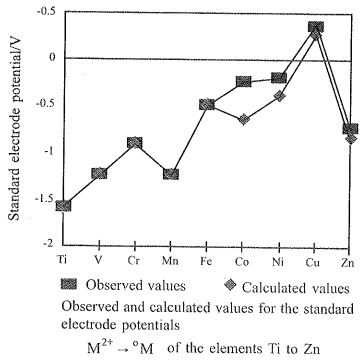
$\rightarrow$ An element in $M^{2+}$ state in aqueous medium is more stable if the electrode potential $(M^{2+}/M)$ value is more negative.
$\rightarrow$ The general trend towards less negative $ E^Θ$ values across the series is related to the general increase in the sum of the first and second ionization enthalpies.
$\rightarrow$ The unique behaviour of $Cu,$ having a positive $EV,$ accounts for its inability to liberate $H_2$ from acids. Only oxidising acids $($nitric and hot concentrated sulphuric$)$ react with $Cu,$ the acids being reduced.
Image
$\rightarrow$ It is interesting to note that the value of $EV$ for $Mn, Ni$ and $Zn$ are more negative than expected from the trend.

Need a full question paper?

Generate a complete, print-ready paper with questions like this in minutes — across 16+ boards, with answer keys.

Start Generating Free

Similar questions

The following data were obtained during the first order thermal decomposition of $SO_2Cl_2$ at a constant volume:
$SO_2Cl_2(g)$
$\rightarrow SO_2(g) + Cl_2(g)$
Experiment
Time/s$^{–1}$
Total pressure/atm
$1$
$0$
$0.4$
$2$
$100$
$0.7$
Calculate the rate constant.
$($Given: $\log 4 = 0.6021, \log 2 = 0.3010).$
Tarnished silver contains $Ag_2S.$ Can this tarnish be removed by placing tarnished silver ware in an aluminium pan containing an inert electrolytic solution such as $NaCl?$ The standard electrode potential for half reaction:
$\text{Ag}_2\text{S(s) + 2e}^-\xrightarrow{\ \ \ \ \ \ \ }2\text{Ag(s) + S}^{2-}\text{is}-0.71\text{V}$
and for $\text{Al}^{3+}+3\text{e}^{-}\xrightarrow{ \ \ \ \ \ \ \ \ \ \ }2\text{Al(s) is}-1.66\text{V}$
How will you carry out the following conversion?
Differentiate between molecular structures and behaviours of thermoplastic and thermosetting polymers. Give one example of each type.
State the general physical properties of amine compounds.
What may be the stable oxidation state of the transition element with the following d electron configurations in the ground state of their atoms: $3d^3,$
$3d^5, 3d^8$ and $3d^4?$
On heating compound $(A)$ gives a gas $(B)$ which is a constituent of air. This gas when treated with $3$ mol of hydrogen $(H_2)$ in the presence of a catalyst gives another gas $(C)$ which is basic in nature. Gas $C$ on further oxidation in moist condition gives a compound $(D)$ which is a part of acid rain. Identify compounds $(A)$ to $(D)$ and also give necessary equations of all the steps involved.
Note: In the following questions a statement of assertion followed by a statement of reason is given. Choose the correct answer out of the following choices.
Assertion: An ordinary filter paper impregnated with collodion solution stops the flow of colloidal particles.
Reason: Pore size of the filter paper becomes more than the size of colloidal particle.
Gold (atomic radius = 0.144 nm) crystallises in a face-centred unit cell. What is the length of a side of the cell?
For a reaction $\text{A + B}\xrightarrow{\ \ \ \ \ }\text{Products},$ the rate law is - $\text{Rate}=\text{k}[\text{A}][\text{B}]^\frac{3}{2}$ Can the reaction be an elementary reaction? Explain.