→ An element in M
2+ state in aqueous medium is more stable if the electrode potential (M
2+/M) value is more negative.
→ The general trend towards less negative E
Θ values across the series is related to the general increase in the sum of the first and second ionization enthalpies.
→ The unique behaviour of Cu, having a positive EV, accounts for its inability to liberate H
2 from acids. Only oxidising acids (nitric and hot concentrated sulphuric) react with Cu, the acids being reduced.
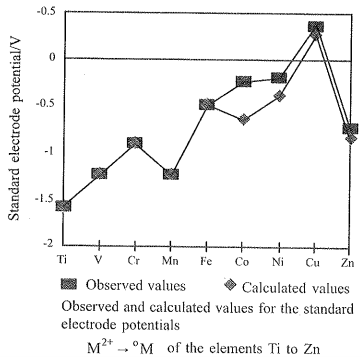
→ It is interesting to note that the value of EV for Mn, Ni and Zn are more negative than expected from the trend.
