Question
Explain typical structure of stomata.
✓
Answer
The typical structure of stomata:
Stomata are minute pores of elliptical shape surrounded by two specialized epidermal cells called guard cells.These guard cells are kidney shaped which control the opening and closing of stomata.It also consists of nucleus, stoma, epidermis and chloroplast.
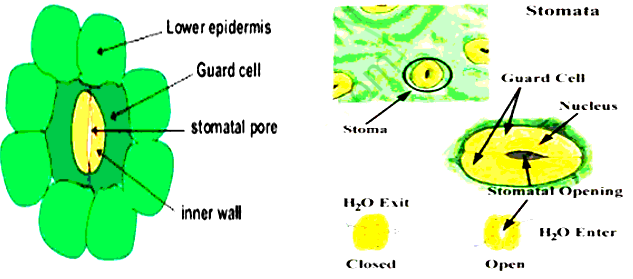
Stomata are minute pores of elliptical shape surrounded by two specialized epidermal cells called guard cells.These guard cells are kidney shaped which control the opening and closing of stomata.It also consists of nucleus, stoma, epidermis and chloroplast.
Need a full question paper?
Generate a complete, print-ready paper with questions like this in minutes — across 16+ boards, with answer keys.
Explore more
Similar questions
What is the difference between reflex action and voluntary action?
Explain the Term: The Bowman’s capsule
Draw the diagram external features of the heart.
Draw well labeled diagrams of part Artery and Superior vena cava to show the structural.
A woman had normal vision, but her father was colourblind. She marries a man, who is colourblind.
Find out the probability of the first child being colourblind, whether it is a boy or girl.
Find out the probability of the first child being colourblind, whether it is a boy or girl.
What is the difference between diffusion and osmosis? State the significance of osmosis in plant physiology.
The diagram below represents a layer of epidermal cells showing a fully grown root hair. Study the diagram and answer the questions that follow: 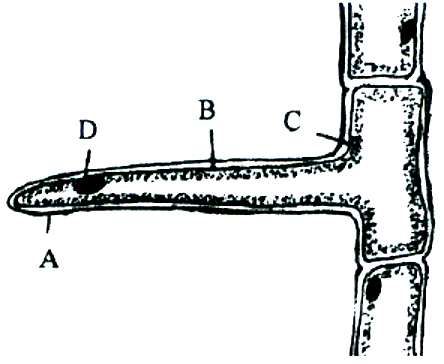
Draw a diagram of the above root hair cell as it would appear when a concentrated solution of fertilizers is added near it.
Draw a diagram of the above root hair cell as it would appear when a concentrated solution of fertilizers is added near it.
What are the health effects of Carbon Monoxide?
The following diagram refers to the ear of a mammal.
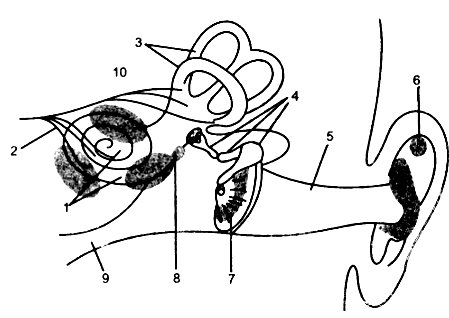
(i) Label the parts 1 to 10 to which the guidelines point.
(ii) Which structure:
(a) converts sound waves into mechanical vibrations?
(b) Converts vibrations into nerve impulses?
(c) Responds to change in position?
(d) Transmits impulses to the brain?
(e) Equalizes atmospheric pressure and pressure in the ear.
(i) Label the parts 1 to 10 to which the guidelines point.
(ii) Which structure:
(a) converts sound waves into mechanical vibrations?
(b) Converts vibrations into nerve impulses?
(c) Responds to change in position?
(d) Transmits impulses to the brain?
(e) Equalizes atmospheric pressure and pressure in the ear.
What is the difference between ‘flaccid’ and ‘turgid’? Give one example of flaccid condition in plants.