Question
Explain various addition reactions of alkynes.

Answer

SELF

Need a full question paper?

Generate a complete, print-ready paper with questions like this in minutes — across 16+ boards, with answer keys.

Start Generating Free

Similar questions

Define the first law of thermodynamics and also derive its mathematical form.
Explain the mechanism of halogenation of alkanes.
Explain the stability of benzene by resonance and molecular orbital diagram.
Write short notes on the following: (i) Hydroboration of alkenes (ii) Polymerisation of alkenes
  1. What are two conditions for the formation of hydrogen bond?
  2. In which of the following compounds 'S' does not obey octet rule?

$\text{SF}_2,\text{SF}_4,\text{SF}_6,\text{SO}_2$
  1. Explain the term hybridisation taking $\text{CH}\equiv\text{CH}$ as an example.
Explain the molecular orbital diagram of benzene.
Explain different types of isomerism in alkenes with example.
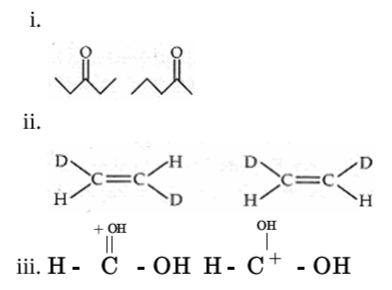
1. What is the relationship between the members of following pairs of structures? Are they structural or geometrical isomers or resonance contributors?
Image
2. A sample of 0.50 g of an organic compound was treated according to Kjeldahl's method. The ammonia evolved was absorbed in 50 mL of $0.5 M H _2 SO _4$. The residual acid required 60 mL of 0.5 M solution of NaOH for neutralisation. Find the percentage composition of nitrogen in the compound.
Explain with example the IUPAC nomenclature system for organic compounds having one functional group.
(i) Calculate the total number of electrons present in one mole of methane.
(ii) Find (a) the total number and (b) the total mass of neutrons in 7 mg of 14C. (Assume that mass of a neutron $=1.675 \times 10^{-27} kg$ )
(iii) Find (a) the total number and (b) the total mass of protons in 34 mg of $NH _3$ at STP.
Will the answer change if the temperature and pressure are changed?