Question
Explain what is quantization of charge and conservation of charge?

Answer

SELF

Need a full question paper?

Generate a complete, print-ready paper with questions like this in minutes — across 16+ boards, with answer keys.
Start Generating Free

Similar questions

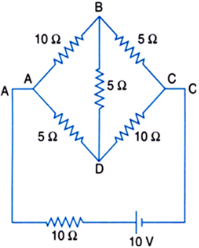
Determine the current in each branch of the network shown in Fig :
Explain the resolving power of an optical instrument. Write the formula for resolving power of telescope and microscope. Why is the resolving power of electron microscope more than that of optical microscope ?
Nuclei with magic no. of proton $Z = 2, 8, 20, 28, 50, 52$ and magic no. of neutrons $N = 2, 8, 20, 28, 50, 82$ and $126$ are found to be very stable.
  1. Verify this by calculating the proton separation energy $Sp$ for $^{120}Sn (Z = 50)$ and $^{121}Sb = (Z = 51)$. The proton separation energy for a nuclide is the minimum energy required to separate the least tightly bound proton from a nucleus of that nuclide. It is given by,
$\ce{Sp = (M_{Z-1' N} + M_H - M_{Z,N}) c^2}.$
Given $^{119}In = 118.9058u, ^{120}Sn = 119.902199u, ^{121}Sb = 120.903824u, ^1H = 1.0078252u.$
  1. What does the existance of magic number indicate
Explain the laws of refraction of light waves on the basis of Huygen's theory of secondary wavelets.
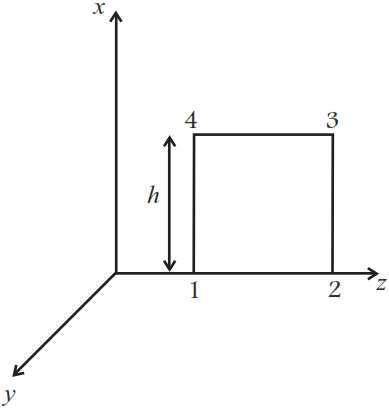
A plane EM wave travelling in vacuum along z direction is given by $\text{E}=\text{E}_0\sin(\text{kz}-\omega\text{t})\hat{\text{i}}\text{ and }\text{B}=\text{B}_0\sin(\text{kz}-\omega\text{t})\hat{\text{j}}$.
  1. Evaluate $\oint\text{E.dl}$ over the rectangular loop 1234 shown in Fig.
  2. Evaluate $\int\text{B.ds}$ over the surface bounded by loop 1234.
  3. Use equation $\oint\text{E.dl}=\frac{-\text{d}\phi_\text{B}}{\text{dt}}$ to prove $\frac{\text{E}_0}{\text{B}_0}=\text{c}$.
  4. By using similar process and the equation $\oint\text{B.dl}=\mu_0\text{I}+\epsilon_0\frac{\text{d}\phi_\text{E}}{\text{dt}}$, prove that $\text{c}=\frac{1}{\sqrt{\mu_0\epsilon_0}}$.
​​​​​​​
A ball of mass $100g$ and having a charge of $4.9 \times 10^{-5}C$ is released from rest in a region where a horizontal electric field of $2.0 \times 10^4NC^{-1}$ exists.
  1. Find the resultant force acting on the ball.
  2. What will be the path of the ball?
  3. Where will the ball be at the end of $2s?$
A current of 1.0A is established in a tightly wound solenoid of radius 2cm having 1000 turns/ metre. Find the magnetic energy stored in each metre of the solenoid.
A converging lens of focal length $15\ cm$ and a converging mirror of focal length $10\ cm$ are placed $50\ cm$ apart. If a pin of length $2.0\ cm$ is placed $30\ cm$ from the lens farther away from the mirror, where will the final image form and what will be the size of the final image?
During a thunderstorm the ‘live' wire of the transmission line fell down on the ground. A group of boys passing through noticed it and some of them wanted to place the wire by the side. As they were approaching the wire and trying to lift it, Bari noticed it and immediately pushed them away to prevent them from touching the wire. Two of them got hunt in the process. Bari took them to a doctor to get medical aid.
Based on the above paragraph, answer the following:
  1. Write two values which Bari displayed during the incident.
  2. Why is it that a bird can sit over a suspended ‘live' wire without any harm whereas touching it on the ground can give a fatal shock?
  3. The electric power from a power plant is set up to a very high voltage before transmitting it to distant consumers. Write the reason for it.
Find the expression for the energy stored in the capacitor. Also find the energy lost when the charged capacitor is disconnected from the source and connected in parallel with the uncharged capacitor. Where does this loss of energy appear?