Question
Explain why: A body with large reflectivity is a poor emitter.

Answer

A body with a large reflectivity is a poor absorber of light radiations. A poor absorber will in turn be a poor emitter of radiations. Hence, a body with a large reflectivity is a poor emitter.

Need a full question paper?

Generate a complete, print-ready paper with questions like this in minutes — across 16+ boards, with answer keys.
Start Generating Free

Similar questions

If the atmospheric pressure on Earth is 75.0 cm of mercury. If it is equal to the column, then what will be the measurement of the monometer on the top of a 250 meter high mountain? (Average density of air $=1.29 kg / m ^3$ )
Light of wavelength 560nm goes through a pinhole of diameter 0.20mm and falls on a wall at a distance of 2.00m. What will be the radius of the central bright spot formed on the wall?
A heavy particle of mass m falls freely near the earth's surface. What is the torque acting on this particle about a point 50cm east to the line of motion? Does this torque produce any angular acceleration in the particle?
Give the magnitude and direction of the net force acting on a stone of mass 0.1kg, (Neglect air resistance throughout.) Just after it is dropped from the window of a stationary train.
The maximum stress that can be applied to the material of a wire used to suspend on elevator is $1.3 \times 10^8Nm^{-2}$. If the mass of the elevator is $900kg$ and it moves up with an acceleration of $2.2ms^{-2}$, then what is the minimum diameter of the wire?
Can a body have energy without having momentum and have momentum without having energy? Explain.
Which of the following functions of time represent (a) simple harmonic, (b) periodic but not simple harmonic, and (c) non-periodic motion? Give period for each case of periodic motion ($\omega$ is any positive constant): $3\cos\Big(\frac{\pi}{4}-2\omega\text{t}\Big)$
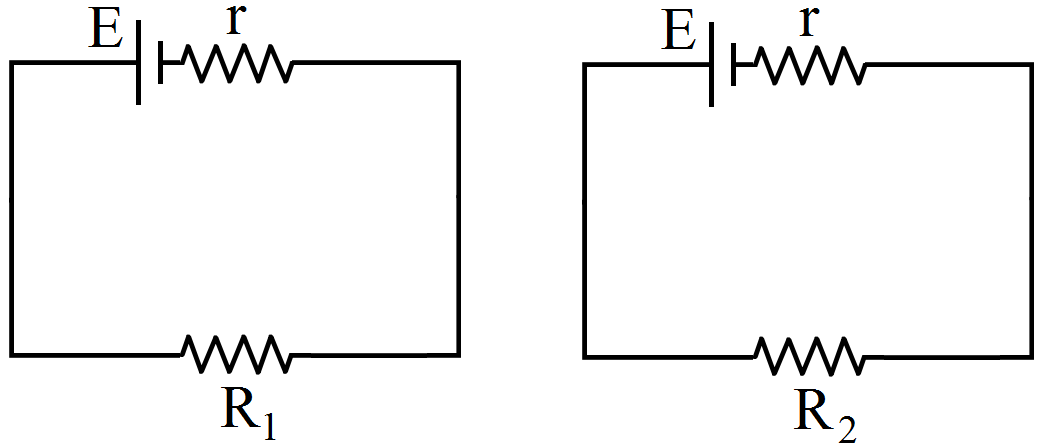
Two unequal resistances $R_1$ and $R_2$ are connected across two identical batteries of emf $\varepsilon$ and internal resistance r. Can the thermal energies developed in $R_1$ and $R_2$ be equal in a given time. If yes, what will be the condition?
A $200Hz$ wave with amplitude $1mm$ travels on a long string of linear mass density $6g/m$ kept under a tension of $60N.$
  1. Find the average power transmitted across a given point on the string.
  2. Find the total energy associated with the wave in a $2.0m$ long portion of the sring.
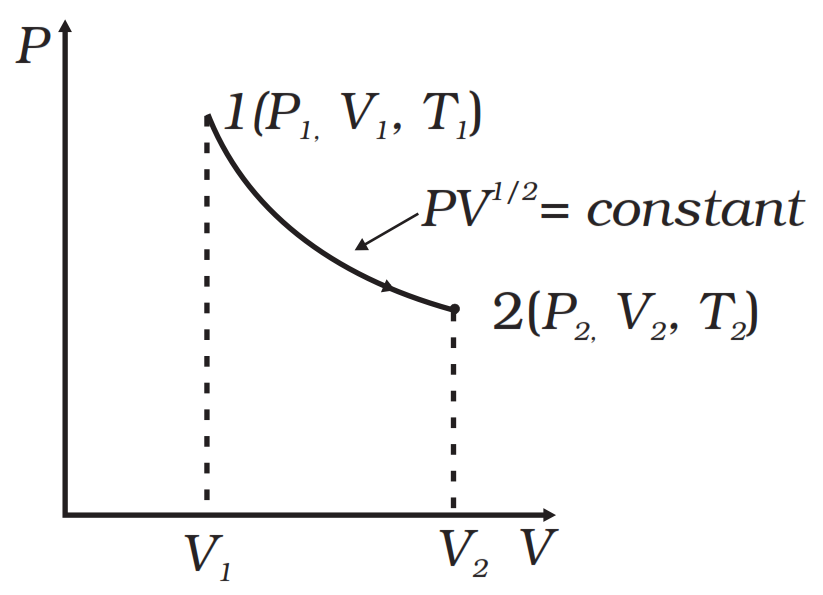
Consider a P-V diagram in which the path followed by one mole of perfect gas in a cylindrical container is shown in Fig.

Find the work done when the gas is taken from state 1 to state 2.