Question
Explain why HF is less viscous than $\mathrm{H}_2 \mathrm{O}$.

Answer

There is greater intermolecular hydrogen bonding in $\mathrm{H}_2 \mathrm{O}$ than that in HF as each $\mathrm{H}_2 \mathrm{O}$ molecule forms four H -bonds with other water molecules, whereas HF forms only two H -bonds with other HF molecules. Greater the intermolecular H-bonding, greater is the viscosity. Hence, HF is less viscous than $\mathrm{H}_2 \mathrm{O}$.

Need a full question paper?

Generate a complete, print-ready paper with questions like this in minutes — across 16+ boards, with answer keys.
Start Generating Free

Similar questions

If the uncertainty in the velocity of an electron is $6 \times 10^5 ms^{-1}$ then find the uncertainty in its position.
In the following ionisation processes, how will the bond orders in $\mathrm{N}_2$ and $\mathrm{O}_2$ be influenced?
  1. $\text{N}_2\xrightarrow{\ \ \ \ \ \ \ }\text{N}_2^++\text{e}^-$
  2. $\text{O}_2\xrightarrow{\ \ \ \ \ \ \ \ }\text{O}_2^++\text{e}^2$
What happens when.
$\mathrm{BF}_3$ is reacted with ammonia?
Critical temperatures of ammonia and carbon dioxide are 405.5K and 304.10K respectively. Which of these gases will liquefy first when you start cooling from500K to their critical temperature.
The equilibrium constant at $25^{\circ} \mathrm{C}$ for the process $\mathrm{CO}^{3+}(\mathrm{aq})+6 \mathrm{NH}_3(\mathrm{aq}) \rightleftharpoons\left[\mathrm{CO}\left(\mathrm{NH}_3\right)_6\right]^{3+}(\mathrm{aq})$ is $2.5 \times 10^6$. Calculate the value of $\Delta \mathrm{G}^{\circ}$ at $25^{\circ} \mathrm{C}\left(\mathrm{R}=8.314 \mathrm{~J} \mathrm{~K}^{-1} \mathrm{~mol}^{-1}\right)$. In which direction is the reaction spontaneous under standard conditions?
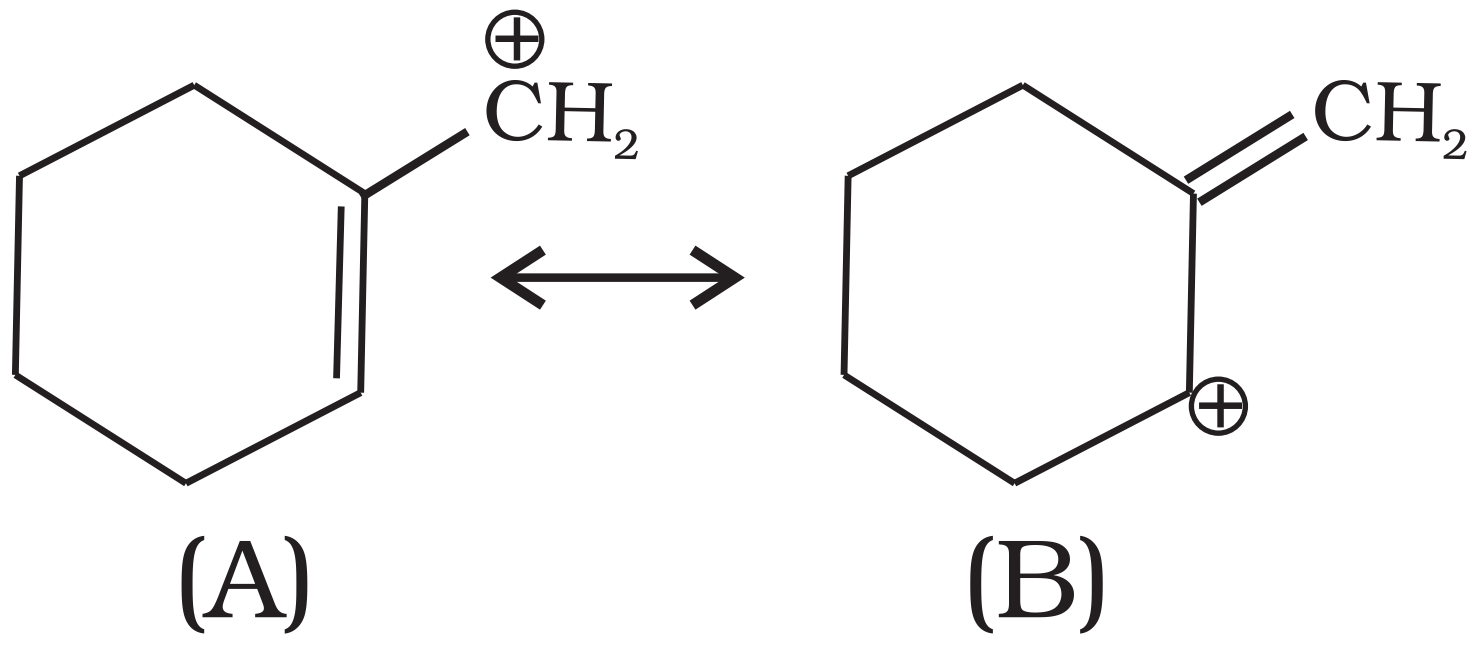
“Stability of carbocations depends upon the electron releasing inductive effect of groups adjacent to positively charged carbon atom involvement of neighbouring groups in hyperconjugation and resonance.”
Which of the following ions is more stable? Use resonance to explain your answer.
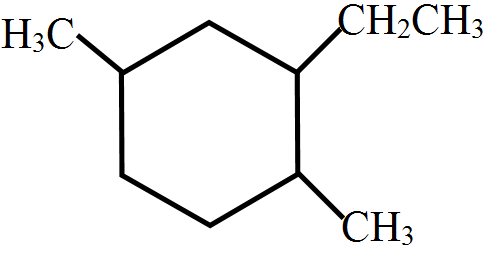
Give IUPAC name of the following:
  1.  
$\ \ \ \ \ \ \ \ \ \ \ \ \stackrel{8\ \ \ \ }{\text{CH}_2}-\stackrel{9\ \ \ \ }{\text{CH}_3}\ \ \ \ \ \ \ \ \ \ \ \ \ \text{CH}_3\ \ \ \text{CH}_2-\text{CH}_3\\\ \ \ \ \ \ \ \ \ \ \ \ \ \ |\ \ \ \ \ \ \ \ \ \ \ \ \ \ \ \ \ \ \ \ \ \ \ \ \ \ \ \ \ \ \ \ \ \ |\ \ \ \ \ \ \ \ \ | \\\text{CH}_3-\text{CH}-\text{CH}_2-\text{CH}_2-\text{CH}-\text{CH}-\text{CH}_2-\text{CH}_3\\\ \ \ \ \ \ \ \ \ \ \ \ \ \ ^{7\ \ \ \ \ \ \ \ \ \ \ \ \ 6\ \ \ \ \ \ \ \ \ \ \ \ \ \ \ 5\ \ \ \ \ \ \ \ \ \ \ \ \ \ \ 4\ \ \ \ \ \ \ \ \ \ \ \ \ \ \ 3\ \ \ \ \ \ \ \ \ \ \ \ \ \ \ 2\ \ \ \ \ \ \ \ \ \ \ \ \ \ 1}$
  1.  
Depict the galvanic cell in which the reaction $\mathrm{Zn}(\mathrm{s})+2 \mathrm{Ag}^{+}(\mathrm{aq}) \rightarrow \mathrm{Zn}^{2+}(\mathrm{aq})+2 \mathrm{Ag}(\mathrm{s})$ takes place, Further show: Which of the electrode is negatively charged.
Write formula for the following compound:
Chromium(III) oxide.

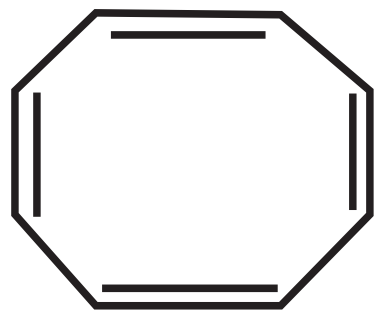
Explain why the following system are not aromatic?