Question
Explain why holes are made in hanging banners and hoardings.

Answer

The banner and hoarding are generally having a large surface area and are put out side in open where they may subject to varying air pressure depending on wind conditions. If wind pressure is high, then air will exert a great amount of pressure on the banners or hoarding causing it to flutter or blown away. To prevent this, holes are made in hanging banner and hording, through which air pressure gets leaked causing less damage or fluttering to banners or hoarding.

Need a full question paper?

Generate a complete, print-ready paper with questions like this in minutes — across 16+ boards, with answer keys.
Start Generating Free

Similar questions

Describe in detail about the occurrence of oceanic currents.
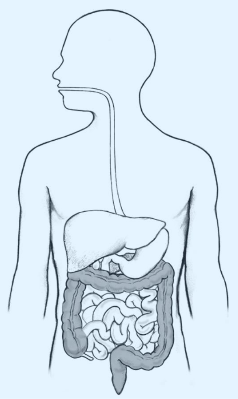
Observe the given picture.
Image
1. Label stomach, liver, pancreas, small intestine.
2. Name two organs that secrete digestive juices.
3. Mention the function of the organ that is longest.
What are the different blood groups in human$?$
A group of people were smoking cigarettes in a restaurant. The atmosphere was full of smoke. An old man sitting next to the group asked them to stop smoking while sitting in the premises or move out. They agreed to do so and promised not to repeat the mistake.
Answer the following questions.
(i) Write any three hazards of smoking.
(ii) Can smoking also affect the person who does not smoke?
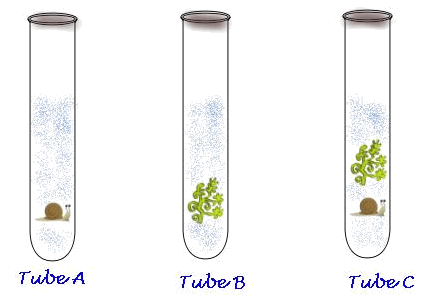
Take three test-tubes. Fill $\frac34\text{th}$ of each with water. Label them $A, B$ and $C.$ Keep a snail in test-tube $A,$ a water plant in test-tube $B$ and in $C,$ keep snail and plant both. Which test-tube would have the highest concentration of $\mathrm{CO}_2$?

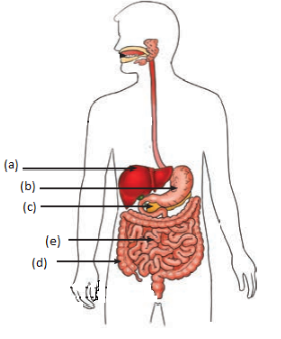
Label the following parts and name them.
Image
(a) Secretes bile that breaks down fats and neutralises acids.
(b) Breaks down proteins using digestive juice, acid, and mucus.
(c) Secretes pancreatic juice that digests carbohydrates, proteins, and fats.
(d) Absorbs water and salts; stores stool before egestion.
(e) Receives digestive juices and absorbs nutrients through finger-like projections.
Explain the two types of fibres.
Explain how the digestion of cellulose occurs in grass eating animals.
A part from new products, many other things accompany a chemical change, what are those things?
A vehicle moves along a straight line and covers a distance of 2 km. In the first 500 m, it moves with a speed of 10 m/s and in the next 500 m, it moves with a speed of 5 m/s. With what speed should it move the remaining distance so that the journey is complete in 200 s? What is the average speed of the vehicle for the entire journey?