Question
Explain, why is water sprayed on roads in evening in hot summer?

Answer

Water has the highest specific heat capacity of $4.2 Jg^{-1}^\circ C^{-1}.$ Thus, water absorbs large amount of heat from the roads, but its own temperature does not rise much. Thus, on the whole the roads get cooled.

Need a full question paper?

Generate a complete, print-ready paper with questions like this in minutes — across 16+ boards, with answer keys.
Start Generating Free

Similar questions

A meter scale is pivoted at its mid point and a 50 g mass suspended from the 20 cm mark. What mass balances the ruler when suspended from 65 cm mark?
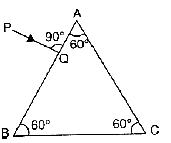
In given figure a ray of light PQ is incident normally on the face AB of an equilateral glass prism. Complete the ray diagram showing its emergence into air after passing through the prism.
(a) Write the angles of incidence at the faces AB and AC of the prism.
(b) name the phenomenon which the ray of light suffers at the face AB, AC and BC of the prism.
What is the use of the lever if its mechanical advantage is
  1. more than 1,
  2. equal to 1, and
  3. less than 1?
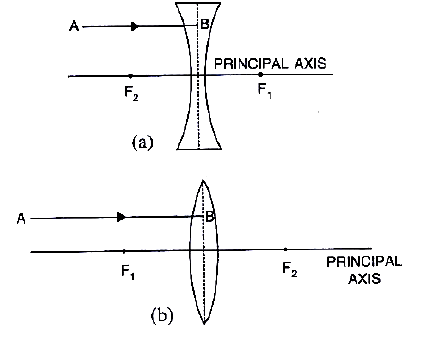
In following figure ,, F1 and F2 are the positions of the two foci of the thin lenses shown in diagram (a) and (b) draw accurately the path taken by the light ray AB after it emerges from the lens in each diagram (a) and (b).

Briefly describe an experiment to show that a prism itself produces no colour, during disperssion of white light.
State a law, which determines the direction of magnetic field around a current carrying wire.
Draw a neat labelled ray diagram to show the total internal reflection of a ray of light normally incident on one face of a 30°, 90°, 60° prism.
Water property of water makes it an effective coolant?
The length of a nut-cracker is 12 cm. A nut, when kept at a distance of 4 cm from its fulcrum, requires an effort of 100 gf to crack it. What force will be required to crack the nut without using the nut-cracker?

A bulb marked 12 V, 24 W operates on a 12 V battery for 20 minutes. Calculate:

(i) The current flowing through it, and

(ii) The energy consumed.