Question
Explain, why it is not possible to increase the temperature of a gas while keeping its volume and pressure constant?

Answer

According to kinetic theory of gases,

$\text{P}=\frac{1}{3}\rho\text{C}^2=\frac{1}{3}\frac{\text{M}}{\text{V}}\text{C}^2=\frac{1}{3}\frac{\text{M}}{\text{V}}\text{KT}$ ($\because$ C2 = KT. when K is constanst)

$\therefore\text{T}\propto\text{PV}$

Now as T is directly proportional to the product of P and V. If P and V are constant, then T is also constant.

Need a full question paper?

Generate a complete, print-ready paper with questions like this in minutes — across 16+ boards, with answer keys.
Start Generating Free

Similar questions

A aircraft executes horizontal loop of radius 1.00km with a steady speed of 900km/ h. Compare its centripetal acceleration with the acceleration due to gravity (g).
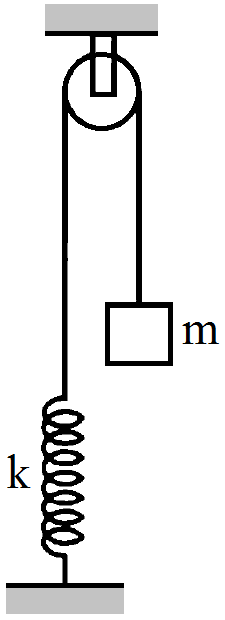
Consider the situation shown in figure. Initially the spring is unstretched when the system is released from rest. Assuming no friction in the pulley, find the maximum elongation of the spring.

Time period of a simple pendulum on the earth's surface $T_1$ is and when it is taken to a heights $\frac{1}{2} R$ from the earth's surface then period becomes $T_2 . R$ is the radius of earth. Find the value of $\frac{T_1}{T_2}.$
Consider a circuit containing an ideal battery connected to a resistor. Do "work done by the battery" and "the thermal energy developed" represent two names of the same physical quantity?
Find the height over the earth's surface at which the weight of a body becomes half of its value at the surface.
If the sound level in a room is increased from 50dB to 60dB, by what factor is the pressure amplitude increased?
A wheel is making revolutions about its axis with uniform angular acceleration. Starting from rest, it reaches 100rev/sec in 4 seconds. Find the angular acceleration. Find the angle rotated during these four seconds.
Given below are some functions of $x$ and $t$ to represent the displacement (transverse or longitudinal) of an elastic wave. State which of these represent (i) a travelling wave, (ii) a stationary wave or (iii) none at all :
(a) $y=2 \cos (3 x) \sin 10 t$
(b) $y=2 \sqrt{x-v t}$
(c) $y=3 \sin (5 x-0.5 t)+4 \cos (5 x-0.5 t)$
(d) $y=\cos x \sin t+\cos 2 x \sin 2 t$
The radius of a planet is R1 and a satellite revolves round it in a circle of radius R2. The time period of revolution is T. Find the acceleration due to the gravitation of the planet at its surface.
A particle is executing SHM according to the equation $\text{x}=5\sin\pi\text{t}$ where x is in cm. How long will the particle take to move from the position of equilibrium to the position of maximum displacement?