Question
Explain why, metals usually do not liberate hydrogen gas with dilute nitric acid.

Answer

Metals do not liberate hydrogen gas with nitric acid because nitric acid is a strong oxidizing agent. So, as soon as hydrogen gas is formed in the reaction between a metal and dilute nitric acid, the nitric acid oxidises this hydrogen to water.

Need a full question paper?

Generate a complete, print-ready paper with questions like this in minutes — across 16+ boards, with answer keys.

Start Generating Free

Similar questions

In the modem periodic table, the element Calcium (atomic number = 20) is surrounded by elements with atomic numbers 12, 19, 21 and 38. Which of these elements has physical and chemical properties resembling those of Calcium and why?
What happens when an acid reacts with a metal? Give chemical equation of the reaction involved.
Which of the following hydrocarbons can decolourise bromine water and which cannot? Why?
$C_6 H_{12}, C_6 H_{14}, C_6 H_{10}$
What is a covalent bond? What type of bond exists in(i) $CCl _4$, and (ii) $CaCl _2$ ?
Refractive indices of four media A, B, C and D are given below:
Medium
Refractive index
A
B
C
D
1.33
1.44
1.52
1.65
In which of these four media is the speed of light:
  1. Maximum, and
  2. Minimum?
List some things that concave lens and convex mirror have in common.
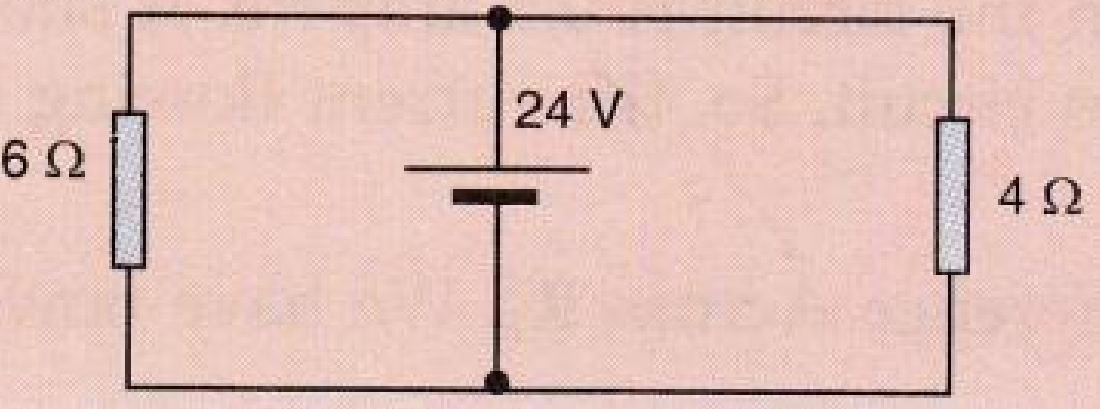
Find the current in each resistor in the circuit shown below:
The following table gives the refractive indices of a few media,
 
1
2
3
4
5
Medium:
Water
Crown glass
Rock salt
Ruby
Diamond
Refractive index:
1.33
1.52
1.54
1.71
2.42
Use this table to give an example of:
  1. A medium pair so that light speeds up when it goes from one of these medium to another.
  2. A medium pair so that light slows down when it goes from one of these medium to another.
Complete the following statements:
When the sun is setting, the light from it has to travel a ____ thickness of the earth's atmosphere and only ____ wavelength _____ light is able to reach us. Sunset is therefore ___.
A student added few pieces of aluminium metal to two test tubes A and B containing aqueous solutions of iron sulphate and copper sulphate. In the second part of her experiment, she added iron metal to another test tubes C and D containing aqueous solutions of aluminium sulphate and copper sulphate.In which test tube or test tubes will she observe colour change? On the basis of this experiment, state which one is the most reactive metal and why.