Question
Explain why (or how):
The shape of a pulse gets distorted during propagation in a dispersive medium.

Answer

A sound pulse is a combination of waves of different wavelength. As waves of different $\lambda$ travel in a dispersive medium with different velocities, therefore, the shape of the pulse gets distorted.

Need a full question paper?

Generate a complete, print-ready paper with questions like this in minutes — across 16+ boards, with answer keys.
Start Generating Free

Similar questions

A heavy particle of mass m falls freely near the earth's surface. What is the torque acting on this particle about a point 50cm east to the line of motion? Does this torque produce any angular acceleration in the particle?
Why are space crafts usually launched from west to east? Why is it more advantageous to launch rockets in the equatorial plane?
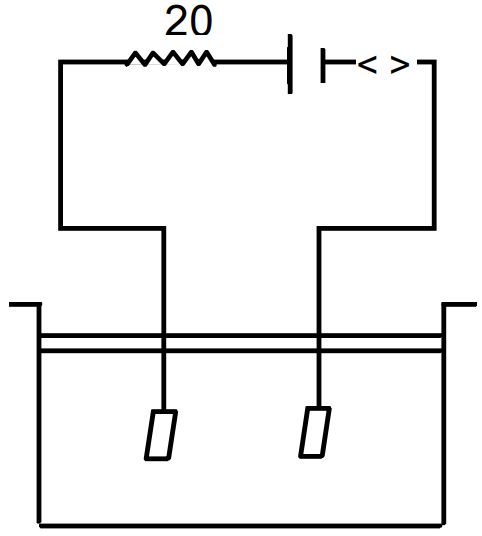
Figure shows an electrolyte of AgCl through which a current is passed. It is observed that 2.68g of silver is deposited in 10 minutes on the cathode. Find the heat developed in the $20\Omega$ resistor during this period. Atomic weight of silver is 107.9g/mole.
A gas is enclosed in a cylindrical vessel fitted with a frictionless piston. The gas is slowly heated for some time. During the process, $10\ J$ of heat is supplied and the piston is found to move out $10\ cm$ . Find the increase in the internal energy of the gas. The area of cross section of the cylinder $=4 \mathrm{~cm}^2$ and the atmospheric pressure $=100 \mathrm{kPa}$.
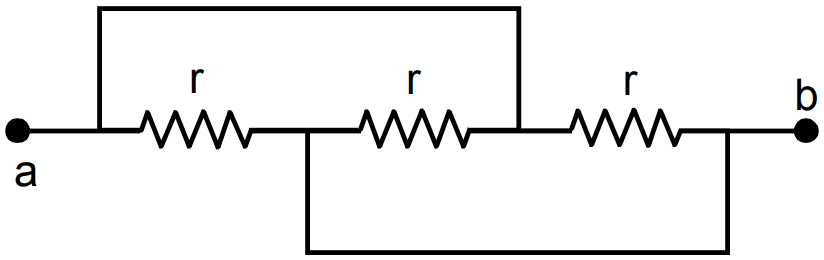
Find the equivalent resistance of the network shown in figure. between the points a and b.
The length and breadth of a rectangle are measured as $(\text{a}\pm\Delta\text{a})$ and $(\text{b}\pm\Delta\text{b})$ respectively. Find:
  1. Relative error.
  2. Absolute error in the measurement of area.
Explain why should the beams used in construction of bridge have large depth and small breadth?
A block of mass $2.00kg$ moving at a speed of $10.0m/s$ accelerates at $3.00m/s^2$ for $5.00s$. Compute its final kinetic energy.
A wire, fixed at both ends is seen to vibrate at a resonant frequency of $240Hz$ and also at $320Hz.$
  1. What could be the maximum value of the fundamental frequency?
  2. If transverse waves can travel on this string at a speed of $40m/s$, what is its length?
​​​​​​​
An electron gun emits $2.0 \times 10^{16}$ electrons per second. What electric current does this correspond to?