Question
Explain why steel is more elastic than rubber.

Answer

Consider two pieces of wires, one of steel and the other of rubber. Suppose both are of equal length (L) and of equal area of cross-section (a).

Let each be stretched by equal forces, each being equal to F. We find that the change in length of the rubber wire (lr) is more than that of the steel (ls) i.e. lr < ls.

If Ys and Yr the Young's moduli of steel and rubber respectively, then from the definition of Young's modulus,

$\text{Y}_\text{s}=\frac{\text{F.L}}{\text{a.l}_\text{s}}\text{ and }\text{Y}_\text{r}=\frac{\text{F.L}}{\text{a.l}_\text{r}}$

$\therefore\frac{\text{Y}_\text{s}}{\text{Y}_\text{r}}=\frac{\text{l}_\text{r}}{\text{l}_\text{s}}.$

As $\text{l}_\text{r}>\text{l}_\text{s}\therefore\frac{\text{Y}_\text{s}}{\text{Y}_r}>1\ \text{or }\text{Y}_\text{r}$

i.e., the Young's modulus of steel is more than that of rubber. Hence steel is more elastic than rubber.

OR

Any material which offers more opposition to the deforming force to change its configuration is more elastic.

Need a full question paper?

Generate a complete, print-ready paper with questions like this in minutes — across 16+ boards, with answer keys.
Start Generating Free

Similar questions

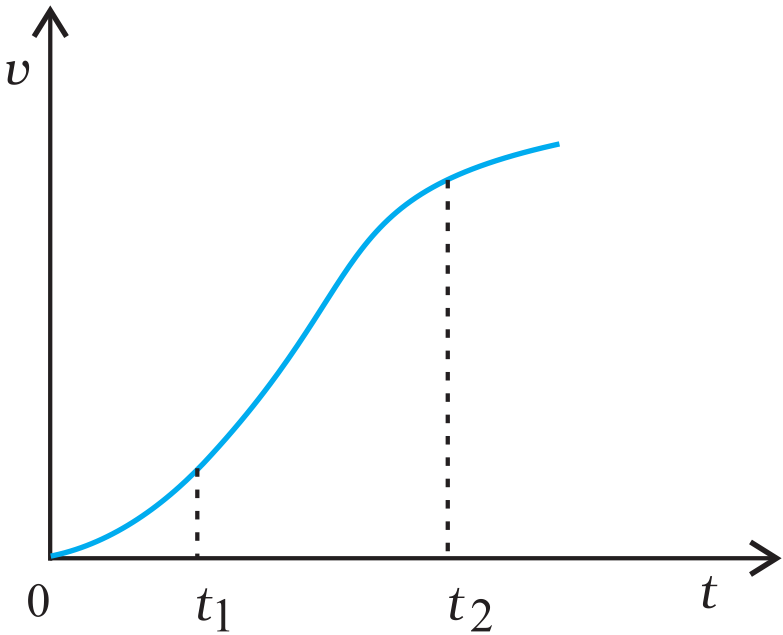
 The velocity-time graph of a particle in one-dimensional motion is shown in:

Which of the following formulae are correct for describing the motion of the particle over the time-interval t1 to t2:

  1. x(t2) = x(t1) + v(t1) (t2 – t1) + (1/2) a(t2 – t1)2

  2. v(t2) = v(t1) + a(t2 – t1)

  3. vaverage = (x(t2) –x(t1))/(t2 – t1)

  4. aaverage = (v(t2) –v(t1))/(t2 – t1)

  5. x(t2) = x(t1) + vaverage (t2 – t1) + (1/2) aaverage (t2 – t1)2

  6. x(t2) – x(t1) = area under the v-t curve bounded by the t-axis and the dotted line shown. 

The momentum p of a particle changes with time t according to the relation $\frac{\text{dp}}{\text{dt}}=(10\text{N})+(2\text{N/s)t}.$ If the momentum is zero at t = 0, what will the momentum be at t = 10s?
A horizontal force of 500N pulls two masses 10kg and 20kg (lying on a frictionless table) connected by a light string as shown. What is the tension in the string? Does the answer depend on which mass the pull is applied?

A physical quantity Q is given by

$\text{Q}= \frac{\text{A}^2\text{B}^\frac{3}{2}}{\text{C}^{+4}\text{D}^\frac{1}{2}}$

The percentage error in A, B, C, D are 1%, 2%, 4%, 2% respectively. Find the percentage error in Q.

A uranium reactor develops thermal energy at a rate of 300MW. Calculate the amount of 235U being consumed every second. Average released per fission is 200MeV.
State first law of thermodynamics. Why Cp > Cv? Prove Cp - Cv = R.
State law of conservation of linear momentum. Derive the law of conservation of momentum from Newton's third law of motion.
A body of mass 2kg is being dragged with a uniform velocity of 2ms-1 on a rough horizontal plane. The coefficient of friction between the body and the surface is 0.2. Calculate the amount of heat generated per second. Take g = 9.8ms-2 and J = 4.2J/ cal-1.
Two insulating small spheres are rubbed against each other and placed 1cm apart. If they attract each other with a force of 0.1N, how many electrons were transferred from one sphere to the other dunng rubbing?
A light ray, going through a prism with the angle of prism 60°, is found to deviate by 30°. What limit on the refractive index can be put from these data?