Question
Explain why the reactance offered by an inductor increases with increasing frequency of an alternating voltage.

Answer

The inductive reactance is given by $\text{X}_\text{L}=2\pi\text{fL}$, XL is proportional to the frequency and current is inversely proportional to the reactance. An inductor opposes the flow of current through it by developing a back emf according to Lenz’s law. If the current is decreasing, the polarity of the induced emf will be so as to increase the current and vice-versa.
Since, the induced emf is proportional to the rate of change of current.

Need a full question paper?

Generate a complete, print-ready paper with questions like this in minutes — across 16+ boards, with answer keys.
Start Generating Free

Similar questions

Write down the Coulomb's law and get the vector form of it.
When charcoal is prepared from a living tree, it shows a disintegration rate of 15.3 disintegrations of 14C per gram per minute. A sample from an ancient piece of charcoal shows 14C activity to be 12.3 disintegrations per gram per minute. How old is this sample? Half-life of 14C is 5730y.
A uniformly moving train passes by a long platform. Consider the events' engine crossing the beginning of the platform' and 'engine crossing the end of the platform'. Which frame (train frame or the platform frame) is the proper frame for the pair of events?
A long cylindrical wire of radius b carries a current i distributed uniformly over its cross-section. Find the magnitude of the magnetic field at a point inside the wire at a distance a from the axis.
Draw a schematic arrangement for winding of primary and secondary coils in a transformer with the two coils on separate limbs of the core. State its underlying principle and find the relation between the primary and secondary voltages in terms of the number of turns of the primary and secondary windings. How are the currents in the primary and secondary coils related to the voltages in the case of an ideal transformer?
In a hydrogen atom, the electron and proton are bound at a distance of about 0.53 $\mathring{\text{A}}$:
  1. Estimate the potential energy of the system in eV, taking the zero of the potential energy at infinite separation of the electron from proton.
  2. What is the minimum work required to free the electron, given that its kinetic energy in the orbit is half the magnitude of potential energy obtained in (a)?
  3. What are the answers to (a) and (b) above if the zero of potential energy is taken at 1.06 Å separation?
With the help of a simple diagram, explain the working of a silicon solar cell, giving all three basic processes involved. Draw its I-V characteristic.
What is nuclear binding energy?
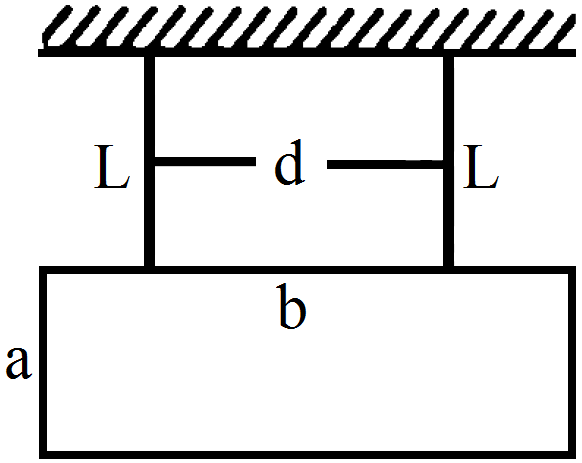
A rectangular plate of sides a and b is suspended from a ceiling by two parallel strings of length L each figure The separation between the strings is d. The plate is displaced slightly in its plane keeping the strings tight. Show that it will execute simple harmonic motion. Find the time period.

Why is the mass of a nucleus always less than the sum of the masses of its constituents, neutrons and protons?

If the total number of neutrons and protons in a nuclear reaction is conserved, how then is the energy absorbed or evolved in the reaction? Explain.