Question
Explain why. There is fall in temperature with increase in altitude.

Answer

The temperature of atmosphere is due to the kinetic energy of air molecule. Due to lower atmospheric pressure at higher altitude molecules of air rises up so their potential energy increase in turn the kinetic energy decrease results the decrease in temperature. Due to lower atmospheric pressure at higher altitude the gas expands and gives cooling effect and so decrease the temperature.

Need a full question paper?

Generate a complete, print-ready paper with questions like this in minutes — across 16+ boards, with answer keys.
Start Generating Free

Similar questions

Show that when a particle is moving in S.H.M. its velocity at a distance $\frac{\sqrt{3}}{2}$ of its amplitude from the central position is half its velocity in central position.
What is meant by parallax? How can we find the distance of a nearby star by parallax method?OR
Given measurement $a_1, a_2, a_3$________ $a_n$. With the help of these, explain absolute error, relative error and percent -age error.
Consider the situation of the previous problem. Assume that the temperature of the water at the bottom of the lake remains constant at 4°C as the ice forms on the surface (the heat required to maintain the temperature of the bottom layer may come from the bed of the lake). The depth of the lake is 1.0m. Show that the thickness of the ice formed attains a steady state maximum value. Find this value. The thermal conductivity of water $=0.50\text{Wm}^{-1}{^{\circ}}\text{C}^{-1}.$ Take other relevant data from the previous problem.
Just as precise measurements are necessary in science, it is equally important to be able to make rough estimates of quantities using rudimentary ideas and common observations. Think of ways by which you can estimate the following (where an estimate is difficult to obtain, try to get an upper bound on the quantity): The number of air molecules in your classroom.
State three basic laws of motion. Show that the first law of motion gives the definition of force and the second law of motion gives the measure of force.
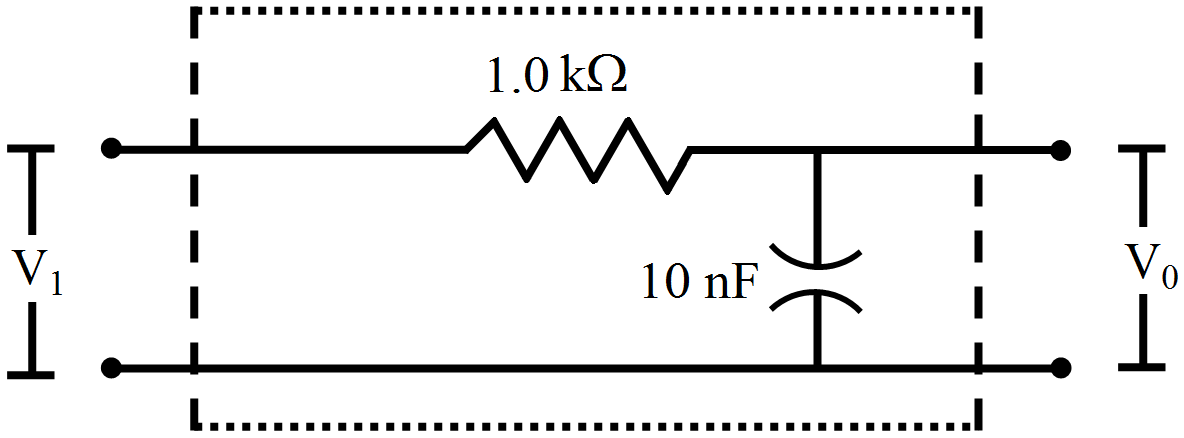
Figure shows a typical circuit for a low$-$pass filter. An $A C$ input $V_i=10 \mathrm{mV}$ is applied at the left end and the output $V_0$ is received at the right end. Find the output voltage for $v=10 \mathrm{kHz}, 1.0 \mathrm{MHz}$ and $10.0 MHz$ . Note that as the frequency is increased the output decreases and, hence, the name low$-$pass filter.
A body is moving with a uniform acceleration. Its velocity after 5 seconds is $25m/s$ and after $8$ seconds is $34m/s$. Calculate the distance it will cover in $10^{th}$ second.
The work function of a metal is $2.5 \times 10^{-19}J$.
  1. Find the threshold frequency for photoelectric emission.
  2. If the metal is exposed to a light beam of frequency $6.0 \times 10^{-14} Hz$, what will be the stopping potential?
The average separation between the proton and the electron in a hydrogen atom in ground state is $5.3 \times 10^{-11} m$.
  1. Calculate the Coulomb force between them at this separation.
  2. When the atom goes into its first excited state the average separation between the proton and the electron increases to four times its value in the ground state.What is the Coulomb force in this state?
Suppose white light falls on a double slit but one slit is covered by a violet filter (allowing $\lambda=400\text{nm}$). Describe the nature of the fringe pattern observed.