Question
Explain why.
There is no atmosphere on moon.

Answer

As acceleration due to gravity on moon is 1/6th of g on earth. So the escape velocity

on moon $\text{V}_{\text{es}}=\sqrt{2\text{gR}}=2.38\text{km}/\text{s}$

M = Mass of hydrogen, As H2 is lightest gas m = 1.67 × 10-24kg

$\text{v}_\text{rms}=\sqrt{\frac{3\text{K}_\text{B}\text{T}}{\text{m}}}=\sqrt{\frac{3\times1.38\times10^{-23}\times300}{1.67\times10^{-24}}}$

= 2.72 km/s

Due to small gravitational force and vrms is greater than escape velocity so molecule of air can escape out.

As the distance of moon from sun is approximately equal to that of earth so the intensity of energy of sun reaches to moon is larger due to lower density of atmosphere, distance become smaller than earth when moon is towards sun during its rotation around earth.

Due to this (sun light), rms speed of molecule increase and some of them can speed up more than escape velocity and so probability of escaping out increased.

Hence over a long time moon has lost most of its atmosphere.

Need a full question paper?

Generate a complete, print-ready paper with questions like this in minutes — across 16+ boards, with answer keys.
Start Generating Free

Similar questions

A brass boiler has a base area of 0.15m2 and thickness 1.0cm. It boils water at the rate of 6.0kg/ min when placed on a gas stove. Estimate the temperature of the part of the flame in contact with the boiler. Thermal conductivity of brass = 109J s–1 m–1 K–1 ; Heat of vaporisation of water = 2256 × 103J kg–1.
Repeat the previous problem if the particle C is displaced through a distance x along the line AB.
A biconvex thick lens is constructed with glass $(\mu=1.50)$ Each of the surfaces has a radius of 10cm and the thickness at the middle is 5cm. Locate the image of an object placed far away from the lens.
What is the density of water at a depth where pressure is 80.0 atm, given that its density at the surface is 1.03 × 10³kg m-3?
If the earth supposed to be a uniform sphere, contracts slightly so that its radius becomes less by $\Big(\frac{\text{R}}{\text{n}}\Big)$ than before, show that the length of the day shortens by $\Big(\frac{48}{\text{n}}\Big)$ hours.
Explain the resolution of a vector in a threedimensional coordinate system and prove that
$
|\overrightarrow{A}|=\sqrt{A_x^2+A_y^2+A_z^2}
$
What is meant by beats? Discuss graphical method of formation of beats.
Two ball bearings of mass m each moving in opposite directions with equal speed v collide head-on with each other. Predict the outcome of the collision, assuming it to be perfectly elastic.
A particle of mass m is kept on a fixed, smooth sphere of radius R at a position, where the radius through the particle makes an angle of 30° with the vertical. The particle is released from this position.
  1. What is the force exerted by the sphere on the particle just after the release?
  2. Find the distance travelled by the particle before it leaves contact with the sphere.
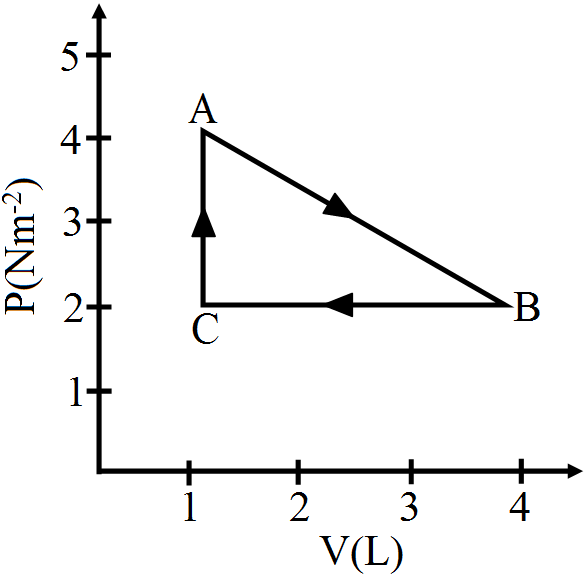
The P-V diagram for a cyclic process is a triangle ABC drawn in order. The co-ordinates of A, B, C are (4, 1), (2, 4) and (2, 1). The co-ordinates are in the order (P-V). Pressure is in Nm-2 and volume is in litre. Calculate work done during the process from A to B, B to C and C to A. Also, calculate work done in the complete cycle.