Question
Explain why.
There is no atmosphere on moon.

Answer

As acceleration due to gravity on moon is 1/6th of g on earth. So the escape velocity

on moon $\text{V}_{\text{es}}=\sqrt{2\text{gR}}=2.38\text{km}/\text{s}$

M = Mass of hydrogen, As H2 is lightest gas m = 1.67 × 10-24kg

$\text{v}_\text{rms}=\sqrt{\frac{3\text{K}_\text{B}\text{T}}{\text{m}}}=\sqrt{\frac{3\times1.38\times10^{-23}\times300}{1.67\times10^{-24}}}$

= 2.72 km/s

Due to small gravitational force and vrms is greater than escape velocity so molecule of air can escape out.

As the distance of moon from sun is approximately equal to that of earth so the intensity of energy of sun reaches to moon is larger due to lower density of atmosphere, distance become smaller than earth when moon is towards sun during its rotation around earth.

Due to this (sun light), rms speed of molecule increase and some of them can speed up more than escape velocity and so probability of escaping out increased.

Hence over a long time moon has lost most of its atmosphere.

Need a full question paper?

Generate a complete, print-ready paper with questions like this in minutes — across 16+ boards, with answer keys.
Start Generating Free

Similar questions

Find the reading of the spring balance shown in figure. The elevator is going up with an acceleration of $\frac{\text{g}}{10},$ the pulley and the string are light and the pulley is smooth.
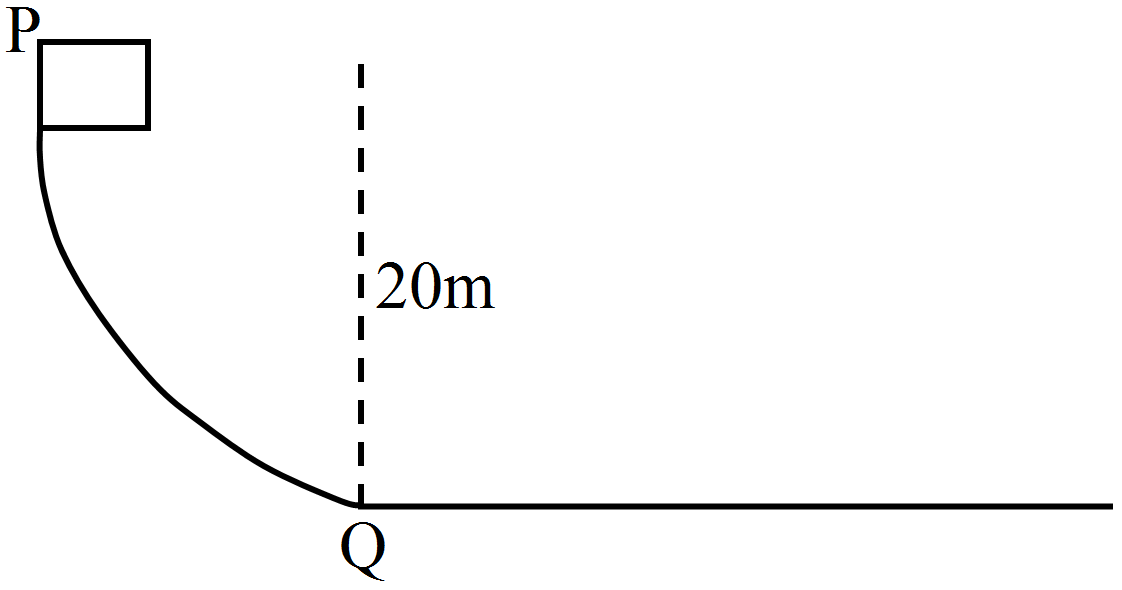
A block of mass 200g is released from P which slides down without friction till it reaches a point Q of a circular path of radius 2.0m. Find.

  1. The velocity of the block at point Q and.
  2. The coefficient of friction if the block comes to rest 2.0m from Q, assuming the horizontal part of the path is rough. Take g = 10ms-2.


A capacitor of capacitance $8.0\mu\text{F}$ is connected to a battery of emf 6.0V through a resistance of $24\Omega.$ Find the current in the circuit (a) just after the connections are made and (b) one time constant after the connections are made.
A body describes simple harmonic motion with an amplitude of 5cm and a period of 0.2s. Find the acceleration and velocity of the body when the displacement is (a) 5cm (b) 3cm (c) 0cm.
Air is pumped into an automobile tyre's tube up to a pressure of 200kPa in the morning when the air temperature is 20°C. During the day the temperature rises to 40°C and the tube expands by 2%. Calculate the pressure of the air in the tube at this temperature.
If a body moving with uniform acceleration in straight line describes successive equal distance in time interval t1, t2 and t3, then show that
$\frac{1}{\text{t}_1}-\frac{1}{\text{t}_2}+\frac{1}{\text{t}_3}=\frac{3}{\text{t}_1+\text{t}_2+\text{t}_3}$
Find the centre of mass of a uniform:
  1. Half-disc.
  2. Quarter-disc.
What is the kinetic theory of gases? Explain the hypothesis of this theory and point out its limitations.
What is a thermometer? What things should be kept in mind while designing a thermometer? Explain to them.
A constant force acting on a body of mass 3.0kg changes its speed from 2.0ms-1 to 3.5ms-1 in 25s. The direction of the motion of the body remains unchanged. What is the magnitude and direction of the force?