Question
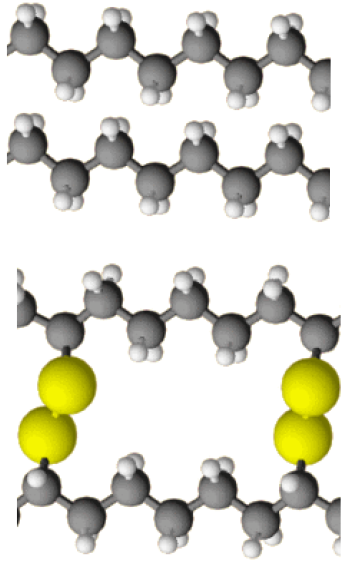
Explain why, thermoplastics become soft on heating but thermosetting plastics do not become soft on heating. Draw labelled diagrams to illustrate your answer.
Answer

Thermoplastic materials are made of polymers which are linked by intermolecular forces, forming linear or branched structures. On the other hand, thermosetting plastics are those materials that are made by polymers joined together by chemical bonds, having a highly-crosslinked polymer structure. In case of thermoplastics, the shape hardens when it is cooled, but can be reshaped when heated up again. Polythene is a thermoplastic polymer. Its tangled polymer chains can uncoil and slide past each other, making it a flexible material. On the other hand, Thermosetting polymers, once moulded, cannot be softened when heated. They cannot be reshaped. Vulcanised rubber is a thermosetting polymer which is used to make tyres. Its polymer chains are joined together by cross-links, so they cannot slide past each other easily.

Need a full question paper?

Generate a complete, print-ready paper with questions like this in minutes — across 16+ boards, with answer keys.

Start Generating Free

Similar questions

What is the cause of friction? Explain with the help of a labelled diagram.
How can you differentiate prokaryotes from eukaryotes?
State five uses of each, metals and non$-$metals.
The material $A$ is a fossil fuel which is extracted from the earth. It is said to be formed from the buried, large land plants by a very slow process $B$. When $A$ is heated in the absence of air in a process called $C$, then it gives three products $D, E$ and $F$. The product $D$ is used as a reducing agent in the extraction of metals, the product $E$ is used as an industrial fuel whereas the product $F$ has been traditionally used for metalling the roads.
$a.$ What could material $A$ be?
$b.$ What is $(i)$ physical state, and $(ii)$ colour, of $A$?
$c.$ Name the processes $(i) B,$ and $(ii) C$.
$d.$ What are $(i) D,$ $(ii) E,$ and $(iii) F$?
Explain the main steps of nitrogen cycle with the help of a diagram.
What are weeds? How can we control them?
What are metalloids? Name two metalloids.
What is meant by the terms ‘internal fertilization and ‘external fertilization’? Explain with example.
Electric force attracts tiny bits of paper. Explain by an activity and write your observations.
Look at the pictures of the Moon in the figure, and answer the following questions.
Image
Q.1. Write the correct panel number corresponding to the phases of the Moon shown in the pictures above.
Picture label (e.g. A, B, C, etc.)Phase of Moon
 Three days after New Moon
 Full Moon
 Three days after the Full Moon
 A week after the Full Moon
 Day of New Moon
Q.2. List the picture labels of the phases of the Moon that are never seen from Earth.