Question
Explain with diagram - Hershey and Chase experiment.###On the basis of experimental proof explain the diagram that DNA is genetic material.###How did Hershey and Chase differentiate between DNA and protein in their experiment while proving that DNA is the genetic material?

Answer

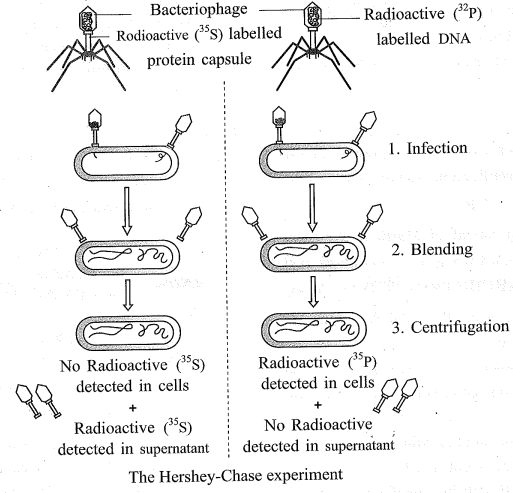
→ The unequivocal proof that DNA is the genetic material came from the experiments of Alfred Hershey and Martha Chase (1952). They worked with viruses that infect bacteria called bacteriophages.
→ The bacteriophage attaches to the bacteria and its genetic material then enters the bacterial cell.
→ The bacterial cell treats the viral genetic material as if it was its own and subsequently manufactures more virus particles.
→ Hershey and Chase worked to discover whether it was protein or DNA from the viruses that entered the bacteria.
→ They grew some viruses on a medium that contained radioactive phosphorus and some others on medium that contained radioactive sulfur.
→ Viruses grown in the presence of radioactive phosphorus contained radioactive DNA but not radioactive protein because DNA contains phosphorus but protein does not.
→ Similarly, viruses grown on radioactive sulfur contained radioactive protein but not radioactive DNA because DNA does not contain sulfur.
→ Radioactive phages were allowed to attach to E.coli bacteria.
→ Then, as the infection proceeded, the viral coats were removed from the bacteria by agitating them in a blender.
→ The virus particles were separated from the bacteria by spinning them in a centrifuge.
→ Bacteria which was infected with viruses that had radioactive DNA were radioactive, indicating that DNA was the material that passed from the virus to the bacteria.
→ Bacteria that were infected with viruses that had radioactive proteins were not radioactive.
→ This indicates that proteins did not enter the bacteria from the viruses.
→ DNA is therefore the genetic material that is passed from virus to bacteria.
Image

Need a full question paper?

Generate a complete, print-ready paper with questions like this in minutes — across 16+ boards, with answer keys.

Start Generating Free

Similar questions

Read the following text carefully and answer the questions that follow:
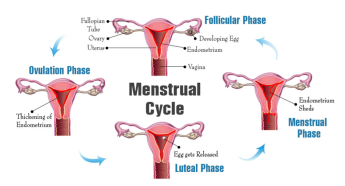
The image below shows the menstrual cycle of a human female. On the basis of this cycle:
Image
i. Explain the menstrual phase in a human female. State the level of ovarian and pituitary hormones during this phase. (1)
ii. Why is follicular phase in the menstrual cycle also referred as proliferative phase? Explain. (1)
iii. Explain the events that occur in a Graafian follicle at the time of ovulation and thereafter. (2)
OR
Draw a Graafian follicle and label antrum and secondary oocyte. (2)
Read the following and answer any four questions from (i) to (v) given below:
The Kakapo is the world's largest and heaviest parrot, found only in New Zealand. It is unusual in that it is nocturnal, flightless and ground-dwelling. It is an excellent climber of trees, has strong legs that allow it to "jog" several kilometres in a single trip, and has mossy green plumage mottled with brown and yellow. The Kakapo is also critically endangered as of now, there were only few known living individuals left.
  1. Which could be the possible reason for Kakapo to be well-adapted to its environment prior to the arrival of humans in New Zealand?
  1. Kakapo was active only in the night when its potential predators would not be out for hunting.
  2. The Kakapo would likely be well-camouflaged among the forest foliage due to its greenish plumage.
  3. It was able to effectively hunt for food in the night.
  4. All of these.
  1. When humans started to settle in New Zealand, they took with them non-native animals, including mammals such as cats, dogs and stoats. By which of the following ways, human settlement likely contributed to a near decimation of Kakapo populations in New Zealand?
  1. Habitat destruction.
  2. Alien species invasion.
  3. Pollution.
  4. Both (a) and (b).
  1. All known survived Kakapo have been relocated by the New Zealand government to three predator-free islands, where they are monitored year round by staffs and volunteers to ensure that the birds are safe, healthy and well-fed. The extremely low population of Kakapo is a hurdle to the species becoming viable in the long term, despite such dedicated conservation efforts. This is because.
  1. The small population results in very small gene pool.
  2. There would be very Ii mited genetic diversity among the resulting offspring.
  3. Of reduced capacity of the species to adapt and survive changes in the environment.
  4. All of these.
  1. The reasons behind conserving biodiversity have been grouped into which of the following categories?
  1. Narrowly utilitarian.
  2. Broadly utilitarian.
  3. Ethical.
  4. All of these.
  1. One of the ex situ conservation methods for endangered species is:
  1. Wildlife sanctuaries.
  2. Biosphere reserves.
  3. Cryopreservation.
  4. National parks.
Read the following and answer any four questions from (i) to (v) given below:
Population is defined as the total number of individuals of a species present in a particular area at a given time. 'The scientific study of human population is called demography. The rapid increase in population over a relatively short period is called population explosion. Four basic processes are involved in increase or decrease in the population size. Population shows two types of growth; exponential and logistic.
  1. Which of the following factors are responsible for population explosion?
  1. Decrease in number of people of reproducible age.
  2. Decline in infant mortality rate.
  3. Increase in maternal mortality rate.
  4. Rapid decline in death rate.
  1. A and B
  2. B and C
  3. B and D
  4. A and D
  1. What is the shape of curve showing logistic growth?
  1. Sigmoid.
  2. J-shape.
  3. Linear.
  4. Hyperbola.
  1. What is immigration?
  1. Number of individuals of the population who left the habitat.
  2. Number of individuals that have come into the habitat.
  3. Number of individuals of a species per unit area at given time.
  4. Number of births per 1000 individuals.
  1. Equation of Verhulst-Pearl logistic growth is:
  1. $\frac{\text{dN}}{\text{dt}}=\text{rN}$
  2. $\frac{\text{dN}}{\text{dt}}=\frac{\text{K-N}}{\text{k}}$
  3. $\frac{\text{dN}}{\text{dt}}=\text{rN}\Big(\frac{\text{K-N}}{\text{k}}\Big)$
  4. $\frac{\text{dN}}{\text{dt}}=\text{rN}\Big(1-\frac{\text{K-N}}{\text{k}}\Big)\text{r}$
  1. Which of the following contributes to decrease in population?
  1. Fertility.
  2. Natality.
  3. Social mobility.
  4. Emigration.
Describe pregnancy and embryonic development.
The bacterium Bacillus thuringiensis is widely used in contemporary biology as:
  1. Agent for production of dairy products.
  2. Source of industrial enzyme.
  3. Indicator of water pollution.
  4. Insecticide.
Read the following text carefully and answer the questions that follow:
Cleavage is the series of rapid mitotic divisions in zygote and forms blastula. The 2, 4, 8, 16 daughter cells are called blastomeres. Embryo with 64 blastomeres is known as blastocyst and has blastocoel cavity. Blastocyst gets implanted in uterine wall and leads to pregnancy.
i. Why the cells of the inner cell mass of blastocyst are called stem cells? (1)
ii. At which stage of embryonic development trophoectoderm develops? (1)
iii. What is the site of implantation? (2)
OR
What is the correct sequence of various structures formed during embryonic development? (2)
Read the following and answer any four questions from (i) to (v) given below:

When it comes to biopesticides, one of the most widely used fungi is Beauveria bassiana. It infects a range of insects like, pecan weevil, Colorado potato beetle, kudzu bug, etc. It causes a disease known as the white muscardine. Even after an insect is killed, the white mold continues to produce millions of new infective spores that are released into the environment. It is commercially formulated as products including Naturalis L, Mycotrol, BotaniGard, etc. Some other widely used molds are Trichoderma, Metarhizium, etc. Some of them release enzymes that dissolve potential pathogens, others form barriers around plant roots and make it impossible for harmful bacteria and pathogens to pass through.

  1. The key benefits of the biopesticides are that they are:
  1. Highly effective.
  2. Target specific.
  3. Reduced environmental risks.
  4. all of these.
  1. Naturalis-L is a conunercial formulation containing:
  1. Bacterial biopesticide.
  2. Fungal biopesticide.
  3. Fungal biofertiliser.
  4. Chemical pesticide.
  1. Which of the following is used as an effective bacterial biopesticide?
  1. Trichoderma.
  2. Beauveria.
  3. Bacillus thuringiensis.
  4. All of these.
  1. Baeuveria causes a disease called:
  1. White muscardine.
  2. Aspergillosis
  3. Green muscardine.
  4. Powdary mildews.
  1. Assertion: Trichoderma, found in root ecosystem, exerts biological control over several plant pathogens.

Reason: Trichoderma release enzyme which inhibits growth of several disease causing pathogens.

  1. Both assertion and reason are true and reason is the correct explanation of assertion.
  2. Both assertion and reason are true but reason is not the correct explanation of assertion.
  3. Assertion is true but reason is false.
  4. Both assertion and reason are false.
Read the following and answer any four questions from (i) to (v) given below:
The foundations of recombinant DNA (rDNA) were laid by the discovery of restriction enzymes. These enzymes are present in many bacterias where they function as a part of their defense mechanism called the Restriction Modification system (RM system). Molecular basis of this system was explained first by Werner Arber in 1962. The Restriction Modification system consists of two components:
  • A restriction enzyme (called restriction endonuclease) identifies the introduced foreign DNA and cuts it into pieces.
  • The second component is a modification enzyme (methylase) that adds a methyl group to DNA at specific site to protect it from the restriction enzyme cleavage.
  1. Restriction endonucleases are enzymes present in ________ where they function as a part of _______ mechanism.
  1. (i) bacteria (ii) digestive
  2. (i) protists (ii) transcription
  3. (i) plant cells (ii) replication
  4. (i) prokaryotes (ii) defence
  1. Which of the following statements regarding modification enzyme is correct?
  1. It adds methyl group to one or two bases usually within the host DNA sequence to protect it from the restriction enzyme.
  2. It adds ethyl group to one or two bases usually within the sequence recognised by the restriction enzymes.
  3. It adds methyl group to only one of bases within the foreign DNA sequence that is recognised by the restriction enzymes.
  4. None of these.
  1. Which of the following is a type II restriction enzyme?
  1. Alu I
  2. EcoR I
  3. BamH I
  4. All of these.
  1. Which of the following is the first discovered restriction endonuclease?
  1. Sal I
  2. EcoR I
  3. Hind II
  4. EcoR II
  1. Components of Restriction Modification System include?
  1. Restriction enzyme.
  2. Modification enzyme.
  3. Lysing enzyme.
  4. Both (a) and (b).
Read the following and answer any four questions from (i) to (v) given below:

Ginkgo tree has been saved from extinction by selective breeding followed by channeling into trade of nature lovers. This is an ex-situ conservation, where endangered species are protected from all adverse factors. Offspring produced in captive breeding are released in natural habitat for acclimatisation.

  1. What is the significance of offsite collections?
  1. Restock depleted populations.
  2. Protection of endangered species.
  3. Reintroduce species in wild.
  4. All of these.
  1. Which of the following is not an ex-situ conservation?
  1. Wetlands
  2. Orchards
  3. Aquaria
  4. Botanical gardens.
  1. Select the incorrect statements for ex-situ conservation.
  1. It is conservation of species outside their natural habitats.
  2. Endangered species are kept under human supervision and provided all the essentials.
  3. The species population recovers in natural environment.
  4. Both (b) and (c).
  1. Conditions maintained in seed banks for orthodox seeds are:
  1. Low moisture content.
  2. Anaerobic conditions.
  3. Low temperature.
  4. All of these.
  1. Assertion: Animal species which have become extinct in wild continue to be maintained in zoological parks.

Reason: Captive breeding is the conservation of those cases where these is no realistic chance of in-situ survival.

  1. Both assertion and reason are true and reason is the correct explanation of assertion.
  2. Both assertion and reason are true but reason is not the correct explanation of assertion.
  3. Assertion is true but reason is false.
  4. Both assertion and reason are false.
Read the following text carefully and answer the questions that follow:
Malaria and dengue fever are major mosquito-borne public health problems in tropical countries. The authors report a malaria and dengue co-infection in an 11-year-old boy who presented with sustained fever for 10 days. The physical examination revealed a flushed face, injected conjunctivae and left submandibular lymphadenopathy. His peripheral blood smear showed few ring-form trophozoites of Plasmodium falciparum. His blood tests were positive for dengue NS-1 antigen and IgM antibody, and negative for IgG antibody. After the initiation of antimalarial treatment with artesunate and mefloquine, his clinical condition gradually improved. However, he still had low-grade fever that persisted for 6 days. Finally, he recovered well without fluid leakage, shock or severe bleeding.
i. Name the fish that help in eradication of mosquito larvae.
ii. What is the reason of symptoms of malaria?
iii. Name the body parts and host in which following events takes place in life cycle of plasmodium.
a. asexual reproduction
b. sexual reproduction.
OR
Name some vector borne diseases and their vector.