Question
Explain with help of suitable example polar covalent bond.

Answer

Polar covalent bond : It is an ideal situation for a bond to be $100 \%$ ionic or covalent. But in reality no bond or compound is completely covalent or ionic.
When a covalent bond is formed between two similar atoms (like $H _2, O _2, Cl _2, N_2$ and $F _2$ ) then the valence electron pair is equally attracted by both atoms. Due to this, the electron pair is located exactly in middle of two identical nuclei. The bond thus obtained is called non-polar covalent bond. On the contrary, in a hetero-atomic molecule like HF, the shared electron pair between two atoms gets displaced towards the more electronegative atom fluorine. This bond is called polar covalent bond.

Need a full question paper?

Generate a complete, print-ready paper with questions like this in minutes — across 16+ boards, with answer keys.

Start Generating Free

Similar questions

Find the oxidation number of Clin HCl, HClO, CIO4- and Ca(OCI)CI.
Compound with carbon-carbon double bond, such as ethylene (C2H4) and hydrogen in a reaction is called hydrogenation.

$\text{C}_2\text{H}_4(\text{g})+\text{H}_2(\text{g})\overrightarrow{\ \ \ \ \ \ }\ \text{C}_2\text{H}_6(\text{g})$

Calculate enthalpy change for the reaction using the following combustion data:

$\text{C}_2\text{H}_4(\text{g})+3\text{O}_2(\text{g})\overrightarrow{\ \ \ \ \ }\ 2\text{CO}_2(\text{g})+2\text{H}_2\text{O(g)};$ $\Delta\text{H}=-1401\text{kJ/ mol}$

$\text{C}_2\text{H}_6(\text{g})+\frac{7}{2}\text{O}_2(\text{g})\overrightarrow{\ \ \ \ \ \ }\ 2\text{CO}_2(\text{g})+3\text{H}_2\text{O(l)};$ $\Delta\text{H}=-1550\text{kJ/ mol}$

$\text{H}_2(\text{g})+\frac{1}{2}\text{O}_2(\text{g})\overrightarrow{\ \ \ \ \ \ }\ \text{H}_2\text{O(l)};$ $\Delta\text{H}=-286.0\text{kJ/ mol}$
Arrange the three isomers of pentane in increasing order of their boiling points.
How many significant figures should be present in the answer of the following calculations?
0.0125 + 0.7864 + 0.0215
Resonance structures of propenal are given below. Which of these resonating structures is more stable? Give reason for your answer.
$\ \ \ \ \ \ \ \ \ \ \ \ \ \ \ \ \ \ \ \ \ \ \ \ \ \ \ \ \ \ \ \ \ \ \ \ \ \ \ \ \ \ \ \ _{\oplus}\ \ \ \ \ \ \ \ \ \ \ \ \ \ \ \ \ \ \ \ \ \ \ _{\ominus}\\\text{CH}_2-\text{CH}-\text{CH}=\text{O}\leftrightarrow\text{CH}_2-\text{CH}=\text{CH}-\text{O}\\\ \ \ \ \ \ \ \ \ \ \ \ \ \ \ \ \ \text{I}\ \ \ \ \ \ \ \ \ \ \ \ \ \ \ \ \ \ \ \ \ \ \ \ \ \ \ \ \ \ \ \ \ \ \ \ \ \ \ \ \ \ \text{II}$
Calculate the number of molecules present in 22.0g of CO2 [C = 12u, H = 14u]
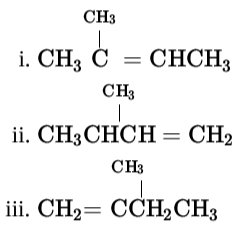
Arrange the following alkenes in the decreasing order of stability.
Image
What is bond energy? Why is it called enthalpy of atomisation?
Calculate the wavenumber for the longest wavelength transition in the Balmer series of atomic hydrogen.
Give reasons for the following:
$\text{H}^+_2$ and $\text{H}^-_2$ ions have same bond order but $\text{H}^+_2$ ions are more stable than $\text{H}^-_2.$