Question
Explain with proper diagram, the application of a $p$ - $n$ junction diode as a halfwave rectifier.

Answer


Image
Image
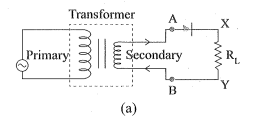
The circuit diagram for the half-wave rectifier is shown in the figure. One $p-n$ junction diode is required in the half wave rectifier circuit.
As shown in fig. (a), the primary coil of a step down transformer is connected to an A.C. source. The secondary coil of transformer is connected in series with the $p-n$ junction diode and load resistance $R_L$.
The secondary of a transformer supplies the desired ac voltage across terminals A and B. When A is positive the diode is forward biased and it conducts. So, some output voltage is obtained between two terminals of load resistance $R_L$.
When A is negative, the diode is reverse-biased and it does not conduct. The reverse saturation current of a diode is negligible and can be considered equal to zero for practical purposes.
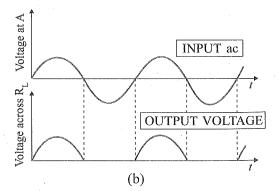
As shown in fig. (b), in the positive half cycle of ac there is a current through the load resistor $R _{ L }$ and we get an output voltage. Whereas there is no current in the negative half-cycle. In the next positive half cycle, again we get the output voltage.
Thus, the output voltage, though still varying, is restricted to only one direction and is said to be rectified. Since the rectified output of this circuit is only for half of the input ac wave so it is called the half-wave rectifier.

Need a full question paper?

Generate a complete, print-ready paper with questions like this in minutes — across 16+ boards, with answer keys.
Start Generating Free

Similar questions

Two cells of EMFs $1 V, 2 V$ and internal resistance $2 \Omega$ and $1 \Omega$ respectively are connected in
i. series,
ii. parallel. What should be the external resistance in the circuit so that the current through the resistance be the same in the two cases? In which case, more heat is generated in the cells?
The acceleration of a cart started at t = 0, varies with time as shown in figure. Find the distance travelled in 30 seconds and draw the position-time graph.

Establish an expression for mobility by giving definition of mobility. Establish relation between mobility of free electrons and electric current.
Explain the quantisation of angular momentum for an electron orbiting a nucleus.
###
Write second postulate of Bohr's model and De-Broglie's explanation of it.
The horizontal component of earth’s magnetic field at a given place is 0.4 × 10⁻⁴ Wb/m2 and angle of dip is 30°. Calculate the value of (i) Vertical component (ii) Total intensity of earth’s magnetic field.
An ideal battery sends a current of 5A in a resistor. When another resistor of value $10\Omega$ is connected in parallel, the current through the battery is increased to 6A. Find the resistance of the first resistor.
Deuteron is a bound state of a neutron and a proton with a binding energy $B =2.2 MeV$. A $\gamma$-ray of energy E is aimed at a deuteron nucleus to try to break it into a (neutron + proton) such that the n and p move in the direction of the incident $\gamma$-ray. If $E = B$, show that this cannot happen. Hence calculate how much bigger than B must E be for such a process to happen.
An electric dipole with dipole moment 4 × 10⁻⁹ Cm is aligned at 30° with the direction of a uniform electric field of magnitude 5 × 10⁴ NC-1. Calculate the magnitude of the torque acting on the dipole.
Answer the following questions:
  1. In a double slit experiment using light of wavelength 600 nm, the angular width of the fringe formed on a distant screen is 0.1o. Find the spacing between the two slits.
  2. Light of wavelength 5000 Å. Propagating in air gets partly reflected from the surface of water. How will the wavelengths and frequencies of the reflected and refracted light be affected?
When charcoal is prepared from a living tree, it shows a disintegration rate of 15.3 disintegrations of 14C per gram per minute. A sample from an ancient piece of charcoal shows 14C activity to be 12.3 disintegrations per gram per minute. How old is this sample? Half-life of 14C is 5730y.