Maharashtra BoardEnglish MediumSTD 12 SciencePhysicsQuestion Bank [ 2022 ]4 Marks
Question
Explain work done during a thermodynamic process.
✓
Answer
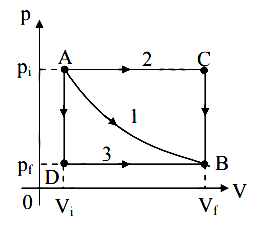
Consider the system is initially at state A with its pressure is pi and volume is $V_i.$ Let the state be indicated as coordinates $(V_i, p_i)$. It can attain the final state $(V_f, p_f)$ along different possible paths as shown in the p-V diagram below.
Different ways to change a system
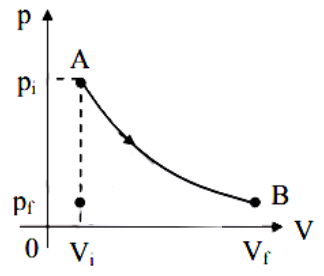
Consider a system that changes its state from initial state A to final state B via path 1 as shown in the figure.
Pressure and volume both change a. When the system changes itself from A to B, both its pressure and volume change. The pressure decreases while volume increases. b. The work done by the system is given by the area under the curve. It is positive when the volume increases (as shown in the figure) or negative when the volume decreases.
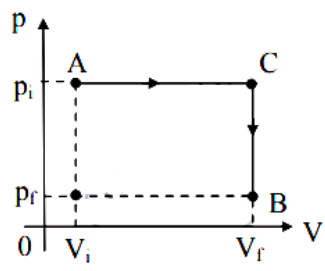
Consider the system changes its state from A to B via path 2 as shown in figure (a).
Figure (a) a. In this case, the volume increases to $V_i $ from point A up to point C at the constant pressure $p_i.$ b. After point C, the pressure of the system decreases to $p_f $ at constant volume as shown in figure (a). c. The system thus, reaches its final state B with co-ordinates $(V_f, p_f)$. Work done in this process is represented by the shaded area under the curve in figure (a).
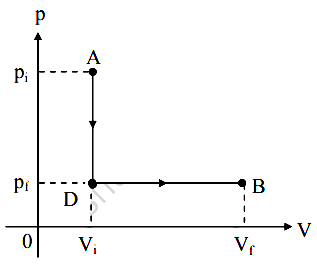
Consider the system changes its state from A to B via path 3 as shown in figure (b). Figure (b) a. In this case, the pressure decreases from $p_i$ to $p_f$ at constant volume $V_i $ along the path AD. b. After point D, the volume of the system increases to $V_f$ at constant pressure $p_f$ as shown in figure (b). c. Work done in this process is represented by the shaded area under the curve in figure (b).
From figures (a) and (b) we can conclude that the work done is more when the system follows path ACB than the work done by the system along the path ADB.
Thus, the work done by a system in a thermodynamic process depends not only on the initial and the final states but also on the intermediate states, i.e., on the paths along which the change takes place.
Need a full question paper?
Generate a complete, print-ready paper with questions like this in minutes — across 16+ boards, with answer keys.