Question
Explanation hydrogen spectrum on the basis of Bohr's principle.

Answer

Explanation of Hydrogen spectrum on the basis of Bohr's principle:
In general the energy of electron in nth orbit of the hydrogen atom is given by: $E _n=-\left(13.6 / n^2\right) eV$.
$E_1=-\left(13.6 / 1^2\right) eV =-13.6 eV$
$E _2=-\left(13.6 / 2^2\right) eV =-1.51 eV$
$E_3=-\left(13.6 / 3^2\right) e V=-0.85 e V$
$E _4=-\left(13.6 / 4^2\right) eV =-0.54 eV$
$E _5=-\left(13.6 / 5^2\right) eV =-0.37 eV$
...................................................................
$E_{\infty}=-\left(13.6 / \infty^2\right) e V=0$
From these values it is obvious that the electron in hydrogen atom can have only certain discrete values of energy while revolving in different orbits. It is also obvious that the first orbit corresponds to the lowest energy and is called ground state. As $n$ increases, the energy becomes less negative i.e, goes on increasing. When $n$ becomes very large $(n \rightarrow \infty)$ the energy becomes zero. This zero level represents the state of maximum energy. The minimum energy required to remove an electron from n = 1 to n = ∞ is called ionisation energy of H2 atom and it is equal to difference of E1 and $E_{\infty}$ infty i.e., it is 13.6 eV. Zero energy state is called ionisation state of the atom. It is also obvious that with increasing value of $n$ the difference between the energy of different states goes on decreasing.
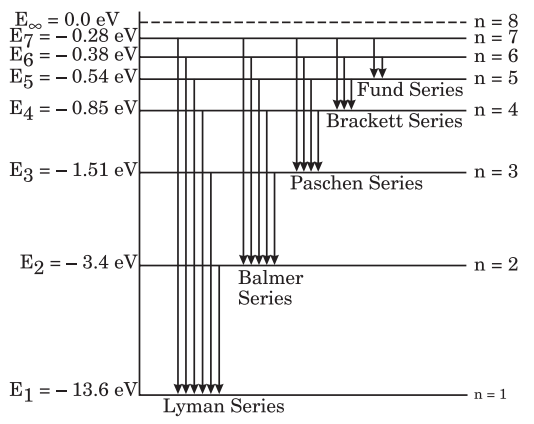
Image
Taking all the above points into account if a diagram is drawn in which the energies of the different orbits (energy states) of H2 atom are represented by parallel horizontal lines with some suitable energy scale, this diagram is called energy level diagram of H2 atom. In this diagram the transitions corresponding to different spectral series of hydrogen atom are also shown.
formula :
$\frac{1}{\lambda}= R \left(\frac{1}{n_1^2}-\frac{1}{n_2^2}\right)$ ...(1)
On the basis of this formula production of all the five spectral series can be explained as follows :
(1) Lymann Series : When the electron of hydrogen atom transits from some higher energy level to the first energy level (lowest energy level), (i.e., n1 = 1 and n2 = n = 2 ,3,4,....) then the emitted spectral lines are obtained in the ultraviolet region of the spectrum and make the Lymann series. Hence the wavelength of these lines can be found by the following form of the above equation (1),
$\frac{ 1 }{\lambda}= R \left(\frac{ 1 }{ 1 ^2}-\frac{ 1 }{ n ^2}\right), \quad$ where $n=2,3,4, \ldots$
Where R is Rydberg's constant and its value is 1.097$\times 10^7 m^{-1}$. Somewhere it is also denoted by RH.
The series lies in the ultra-violet. Lymann, in 1916, photographed the lines of this series of hydrogen spectrum. Hence this series is named 'Lymann series'. The longest wavelength of this series (for n = 2 ) is 1216 Å and the shortest wavelength (for n = ∞ ) is 912 Å. The wavelength (912 Å) corresponding to n = ∞ is called the 'series limit'.
(2) Balmer Series : Its wavelengths are given by
$\frac{1}{\lambda}= R \left(\frac{1}{2^2}-\frac{1}{n^2}\right),(n=3,4,5, \ldots)$ ...(2)
The lines of this series were seen and studied for the first time by Balmer in 1885. Hence this series is named as Balmer series. The longest wavelength of this series (for n = 3 ) is 6563 Å and the shortest wavelength (for n = ∞) is 3646 Å.
For n = 3 4, 5, 6, ...the spectral lines of Balmer series were termed as $H _\alpha, H _\beta, H _\gamma, H _\delta, \ldots$ and so on.
(3) Paschen Series : Its wavelengths are given by
$\frac{1}{\lambda}= R \left(\frac{1}{3^2}-\frac{1}{n^2}\right),(n=4,5,6, \ldots$ ...(3)
The series lies in the near infrared region.
This series was discovered by Paschen.
The greatest wavelength of this series is 18751 Å and the shortest is 8107 Å.
(4) Brackett Series : Its wavelengths are given by
$\frac{1}{\lambda}= R \left(\frac{1}{4^2}-\frac{1}{n^2}\right),(n=5,6,7, \ldots$ ...(4)
The series lies in the far infrared region.
This series was discovered by Brackett in 1922. The greatest wavelength of this series is 40500 Å and the shortest is 14516 Å.
(5) Pfund Series : Its wavelengths are given by
$\frac{1}{\lambda}= R \left(\frac{1}{3^2}-\frac{1}{n^2}\right),(n=6,7,8, \ldots)$ ...(5)
The series lies in far infrared region.
This series was discovered by Pfund is 1924. The largest wavelength of this series is 74000 Å and shortest is 23673 Å.

Need a full question paper?

Generate a complete, print-ready paper with questions like this in minutes — across 16+ boards, with answer keys.
Start Generating Free

Similar questions

If neutrons exert only attractive force, why don't we have a nucleus containing neutrons alone?
i. Derive lens maker’s formula for a biconvex lens.
ii. A point object is placed at a distance of 12 cm on the principal axis of a convex lens of focal length 10 cm. A convex mirror is placed coaxially on the other side of the lens at a distance of 10 cm. If the final image coincides with the object, sketch the ray diagram, and find the focal length of the convex mirror.
A screen is placed 90 cm from an object. The image of the object on the screen is formed by a convex lens at two different locations separated by 20 cm. Determine the focal length of the lens.
Gautam went for a vacation to the village where his grandmother lived. His grandmother took him to watch ‘nautanki’ one evening. They noticed a blackbox connected to the mike lying nearby. Gautam’s grandmother did not know what that box was. When she asked this question to Gautam, he explained to her that it was an amplifier.
  1. Which values were displayed by the grandmother? How can inculcation of these values in students be promoted?
  2. What is the function of an amplifier?
  3. Which basic electronic device is used in the amplifier?
What will be the energy corresponding to the first excited state of a hydrogen atom if the potential energy of the atom is taken to be 10eV when the electron is widely separated from the proton? Can we still write $\text{E}_\text{n}=\frac{\text{E}_1}{\text{n}^2}?\text{ r}_\text{n}=\text{a}_0\text{n}^2?$ 
A converging lens of focal length 15cm and a converging mirror of focal length 10cm are placed 50cm apart. If a pin of length 2.0cm is placed 30cm from the lens farther away from the mirror, where will the final image form and what will be the size of the final image?
A capacitor has some dielectric between its plates, and the capacitor is connected to a DC source. The battery is now disconnected and then the dielectric is removed. State whether the capacitance, the energy stored in it, electric field, charge stored and the voltage will increase, decrease or remain constant.
A particle is observed from two frames S1 and. S2. The frame Smoves with respect to Swith an acceleration a. Let F1 and F2 be the pseudo forces on the particle when seen from S1 and S2 respectively. Which of the following are not possible?
  1. F1 = 0, F2 ≠ 0
  2. F1 ≠ 0, F2 = 0
  3. F1 ≠ 0, F2 ≠ 0
  4. F= 0, F= 0
Find the magnitude of the electric field at a point 4cm away from a line charge of density 2 × 10⁻⁶Cm-1.
Derive Snell's law for refraction of light by Huygen's wave theory.