Question
Express the following decimal as a rational number.$0.017$

Answer

Let $x=0.0 \overline{17}$
$=0.01717 . .$
Here, only numbers $17$ is being repeated,
so first we need to remove $0$ which proceeds $17.$
We multiply by $10$ so that the recurring digits remain after decimal.
$\therefore 10 x=0.1717 \ldots (1)$
The number of digits recurring equation $(1)$ is $2$,
​​​​​​​so we multiply both sides of the equation $(1)$ by $100 .$
$\therefore 1000 x=100 \times 0.1717 \ldots$
$=17.1717 \ldots \ldots(2)$
On subtracting $(1)$ from $(2)$, we get
$990 x=17$
$\therefore x=\frac{17}{990}$
$\therefore 0.017=(17) /(990)$

Need a full question paper?

Generate a complete, print-ready paper with questions like this in minutes — across 16+ boards, with answer keys.
Start Generating Free

Similar questions

A balloon is connected to a meteorological station by a cable of length 200 metres, inclined at 60 to the horizontal. Determine the height of the balloon from the ground, assuming that there is no slack in the string. (Take $\sqrt{3}=1.73$ )
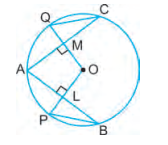
In the given figure, AB and AC are equal chords of a circle with centre $O$ and $O P \perp A B, O Q \perp A C$.
Prove that $PB = QC$.
Image
A sum of money was invested for $3$ years, interest being compounded annually. The rates for successive years were $10\%, 15\%$ and $18\%$ respectively. If the compound interest for the second year amounted to $Rs. 4,950$, find the sum invested.
A steamer goes in downstream from one port to another in $4$ hours. It covers the same distance in upstream in $5$ hours. If the speed of the stream be $2 \ km/h$, find the distance between the two ports.
One year ago a man was four times as old as his son. After 6 years, his age exceeds twice his son's age by 9 years. Find their present ages.
A man borrows $Rs.62500$ at $8\% p.a.$, simple interest for $2$ years. He immediately lends the money out at $CI$ at the same rate and for same time. What is his gain at the end of $2$ years?
The internal length, breadth, and height of a box are $30 \ cm, 24 \ cm$, and $15 \ cm$. Find the largest number of cubes which can be placed inside this box if the edge of each cube is$;(i) 3 \ cm ;(ii) 4 \ cm ;(iii) 5 \ cm$
Solve the following system of linear equations graphically $:\ 4x - 5y - 20 = 0;3x + 3y - 15 = 0$.Determine the vertices of the triangle formed by the lines, represented by the above equations and the $y-$axis.
Image
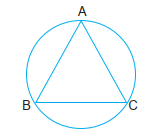
Case Study : There is a circular park in a colony. The diameter of the park is 40 m . Three poles A, B and C have been eracted at equal distances on the boundary of the park. These poles have been connected with each other using straight wires, as shown in the figure.
Based on the above information, answer the following questions : [Use $\pi=3.14$ ]
1. The circumference of the circular park is:
(a) 125.6 m
(b) 130 m
(c) 251.2 m
(d) 257.2 m
2. A child cycles along the boundary of the park in clockwise direction. The distance covered by the child in going from B to C is:
(a) 41.8 m
(b) 83.7 m
(c) 20.9 m
(d) 125.6 m
3. $\triangle ABC$ is :
(a) a scalene triangle
(b) a right triangle
(c) an equilateral triangle
(d) an isosceles triangle
4. If we draw perpendicular from $B$ on $A C$, then it will pass through:
(a) centre of the circle
(b) circomentre of the circle
(c) centroid of the circle
(d) all the above
5. The length of the piece of wire used to connect any two poles is :
(a) 20 m
(b) $20 \sqrt{3} m$
(c) $20 \sqrt{2} m$
(d) $60 \sqrt{3} m$
Image
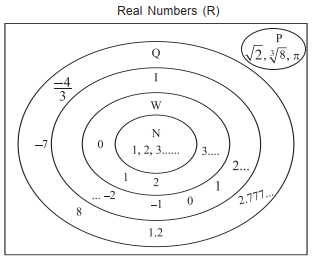
Case Study I: The union of the set of rational numbers (Q) and irrational numbers (P) form the set of real numbers (R). Rational numbers are the set of numbers which can be written in the form $\frac{a}{b}$ , where a and b are integers and $b \neq 0$. The decimal expansion of a rational number is either terminating or non-terminating repeating. The number which cannot be expressed in the form $\frac{a}{b}$ are called irrational numbers. The decimal expansion of irrational numbers is non-terminating non-repeating.
Based on the above information, answer the following questions:
1. Every rational number is:
(a) a natural number (b) a whole number
(c) an integer (d) a real number
2. Every real number is:
(a) an integer
(b) a rational number
(c) an irrational number
(d) either a rational number or an irrational number.
3. The sum of two irrationals is:
(a) irrational (b) rational
(c) either rational or irrational (d) neither rational nor irrational
4. The product of a rational and an irrational number is:
(a) an irrational number
(b) a rational number
(c) either a rational number or an irrational number
(d) neither a rational number nor an irrational number
5. The number of irrational numbers is:
(a) finite (b) infinite
(c) neither finite nor infinite (d) none of these