Question
Express the following decimal as a rational number.$2.67$

Answer

Let $x=2 . \overline{67}$
Then, $x =2.676767 \ldots (1)$
Here, the number of digits recurring is $2$ ,
so we multiply both sides of the equation $(1)$ by $100 .$
$\therefore 100 x =100 \times 2.676767 \ldots $
$=267.8989 \ldots \ldots(2)$
On subtracting $(1)$ from $(2),$ we get
$99 x=265 $
$\therefore x=\frac{265}{99} $
$\therefore 2 . \overline{67}=\frac{265}{99}$

Need a full question paper?

Generate a complete, print-ready paper with questions like this in minutes — across 16+ boards, with answer keys.
Start Generating Free

Similar questions

Using a scale of $1 \ cm$ to $1$ unit for both the axes, draw the graphs of the following equations: $6y = 5x + 10, y = 5x - 15$.From the graph find :$(i)$ the coordinates of the point where the two lines intersect;$(ii)$the area of the triangle between the lines and the $x-$axis.
Solve the following equations for the unknown: $\frac{1}{2}\left(y-\frac{1}{3}\right)+\frac{1}{4}\left(2 y+\frac{1}{5}\right)=\frac{3}{4}\left(y-\frac{1}{12}\right)$
Find the point on $y-$axis whose distances from the points $A (6, 7)$ and $B (4, -3)$ are in the ratio $1: 2.$
If $s=\frac{n}{2}[2 a+(n-1) d]$, the $n$ express $d$ in terms of $s, a$ and $n$, find $d$ if $n=3, a=n+1$ and $s=18$.
Construct a $\triangle XYZ$ with $YZ = 7.5 \ cm, \angle Y = 60^\circ $ and $\angle Z = 45^\circ $. Draw the bisectors of $\angle Y$ and $\angle Z$. If these bisectors meet at $O$, measure $\angle YOZ.$
In parallelogram $\text{ABCD}, P$ is the mid $-$ point of $D C . Q$ is a point on $A C$ such that $C Q=\frac{1}{4} A C. P Q$ produced meets $B C$ at $R$. Prove that$:\ (i) R$ is the mid $-$ point of $B C$, and $(ii) PR =\frac{1}{2} DB$.
The ratio of two numbers is $\frac{2}{3}$. If $2$ is subtracted from the first and 8 from the second, the ratio becomes the reciprocal of the oriainal ratio. Find the numbers.
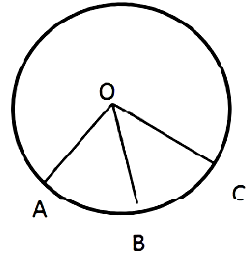
In the given figure, arc $AB$ and arc $BC$ are equal in length. If $\angle AOB = 48^\circ $, find:$(i) \angle BOC;(ii) \angle OBC;(iii) \angle AOC;(iv) \angle OAC$
​​​​​​​
$\text{ABC}$ and $\text{DBC}$ are two isosceles triangles on the same side of $BC$. Prove that:$(i) DA$ or $(AD)$ produced bisects $BC$ at right angle.$(ii)\text{BDA} =\text{CDA}.$
Find the mean and median of the data $: 35, 48, 92, 76, 64, 52, 51, 63$ and $71.$If $51$ is replaced by $66,$ what will be the new median?