Question
Factorise the following:$5 - 4(a - b) - 12(a - b)^2$

Answer

$5 - 4(a - b) - 12(a - b)^2$
$= 5 - 10(a - b) + 6(a - b) - 12(a - b)^2$
$= 5[1 - 2(a - b)] + 6(a - b)[1 - 2(a - b)]$
$= [5 + 6(a - b)][1 - 2(a - b)]$
$= (5 + 6a - 6b)(1 - 2a + 2b).$

Need a full question paper?

Generate a complete, print-ready paper with questions like this in minutes — across 16+ boards, with answer keys.
Start Generating Free

Similar questions

The side $AC$ of a $\triangle ABC$ is produced to point $E$ so that $CE =AC. D$ is the mid$-$point of $BC$ and $ED$ produced meets $AB$ at $F.$ Lines through $D$ and $C$ are drawn parallel to $AB$ which meet $AC$ at point $P$ and $EF$ at point $R$ respectively. Prove that:$(i) 3DF = EF,(ii) 4CR = AB.$
If $a-\frac{1}{a}=8$ and $a \neq 0$ find:$(i)\ a+\frac{1}{a};(ii)\ a^2-\frac{1}{a^2}$
Simplify by rationalising the denominator in the following.$\frac{1}{5+\sqrt{2}}$
Evaluate the following:$\frac{5 \cot 5^{\circ} \cot 15^{\circ} \cot 25^{\circ} \cot 35^{\circ} \cot 45^{\circ}}{7 \tan 45^{\circ} \tan 55^{\circ} \tan 65^{\circ} \tan 75^{\circ} \tan 85^{\circ}}+\frac{2 \operatorname{cosec} 12^{\circ} \operatorname{cosec} 24^{\circ} \cos 78^{\circ} \cos 66^{\circ}}{7 \sin 14^{\circ} \sin 23^{\circ} \sec 76^{\circ} \sec 67^{\circ}}$
$O$ is any point in the $\triangle ABC$ such that the perpendicular drawn from $O$ on $AB$ and $AC$ are equal. Prove that $OA$ is the bisector of $\angle BAC.$
The sum of two numbers is $8$ and the sum of their reciprocals is $\frac{8}{15}$. Find the numbers.
Use the graphical method to find the value of $k$, if:$(5, k - 2)$ lies on the straight line $x - 2y + 1 = 0$
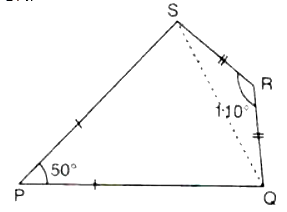
In a quadrilateral $\text{PQRS}, PQ = PS$ and $RQ = Rs$. If $\angle 50^\circ $ and $\angle R = 110^\circ $, find $\angle PSR.$
​​​​​​​
Find the area of a right angled triangle whose hypotenuse is $15\ cm$ and the base is $9\ cm.$
In a parallelogram $\text{ABCD, M}$ is the mid$-$point $AC. X$ and $Y$ are the points on $AB$ and $DC$ respectively such that $AX = CY$. Prove that:$(i)$ Triangle $\text{AXM}$ is congruent to $\triangle CYM$, and;$(ii) \text{XMY}$ is a straight line.