Question
Factorize: $a^2 + 2ab + b^2 - c^2$

Answer

$a^2+2 a b+b^2-c^2$ Using the identity $(p+q)^2=p^2+q^2+2 p q=(a+b)^2-c^2$
Using the identity $p^2-q^2=(p+q)(p-$
$q)=(a+b+c)(a+b-c)$
$\therefore a^2+2 a b+b^2-c^2=(a+b+c)(a+b-c)$

Need a full question paper?

Generate a complete, print-ready paper with questions like this in minutes — across 16+ boards, with answer keys.

Start Generating Free

Similar questions

Draw, in the same diagram, a histogram and a frequency polygon to represent the following data which shows the monthly cost of living index of a city in a period of $2$ years:
Cost of living inex: $440-460$ $460-480$ $480-500$ $500-520$ $520-540$ $540-560$ $560-580$ $580-600$
No.of months: $2$ $4$ $3$ $5$ $3$ $2$ $1$ $4$
Find the value of $\frac{6}{\sqrt5-\sqrt3},$ it being given that $\sqrt3=1.732$ and $\sqrt5=2.236.$
Without actual division, prove that $2x^4 - 5x^3 + 2x^2 - x + 2$ is divisible $by x^2 - 3x + 2.$
[Hint: Factorise $x^2 - 3x + 2$]
Simplify by rationalising the denominator: $\frac{7\sqrt{3}-5\sqrt{2}}{\sqrt{48}+\sqrt{18}}$
E and F are respectively the mid-points of the non-parallel sides AD and BC of a trapezium ABCD. Prove that EF || AB and$\text{EF}=\frac{1}{2}(\text{AB}=\text{CD})$
[Hint: Join BE and produce it to meet CD produced at G.]
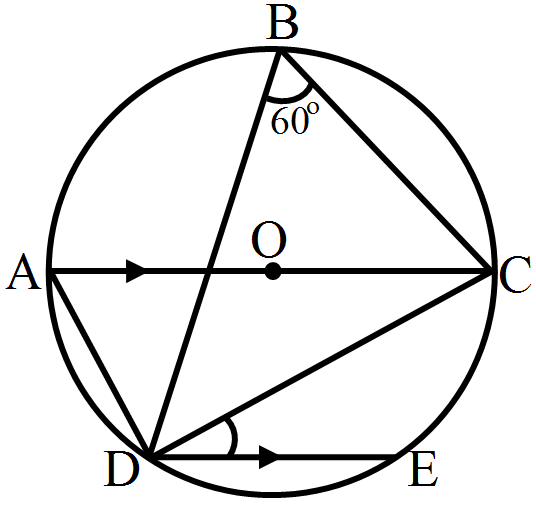
In the adjoining figure, $DE$ is a chord parallel to diameter $AC$ of the circle with centre $O$. If $\angle\text{CBD}=60^\circ,$calculate $\angle\text{CDE}.$
Simplify:
$\frac{2+\sqrt{3}}{2-\sqrt{3}}+\frac{2-\sqrt{3}}{2+\sqrt{3}}+\frac{\sqrt{3}-1}{\sqrt{3}+1}$
$\text{ABC}$ is a triangle in which $D$ is the mid$-$point of $BC. E$ and $F$ are mid$-$points of $DC$ and $AE$ respectively. $IF$ area of $\triangle\text{ABC}$ is $16\ cm^2$, find the area of $\triangle\text{DEF}.$