Question
Fan is based on

Answer

Fan is based on Electric motor

Need a full question paper?

Generate a complete, print-ready paper with questions like this in minutes — across 16+ boards, with answer keys.
Start Generating Free

Similar questions

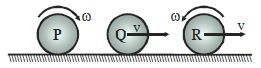
Three solid spheres are made to move on a rough horizontal surface. Sphere $P$ is given a spin and released. Sphere $Q$ is given a forward linear velocity. Sphere $R$ is given linear and rotational motions as shown in the figure. Directions of the friction force on spheres $P, Q, R$ are respectively
A drop of liquid of density $\rho$ is floating half immersed in a liquid of density $\sigma$ and surface tension $7.5 \times 10^{-4}\,N\,cm ^{-1}$. The radius of drop in $cm$ will be : (Take : $g =10\,m / s ^{2}$ )
If a magnet is hanged with its magnetic axis then it stops in
A thin circular ring first slips down a smooth incline then rolls down a rough incline of identical geometry from same height. Ratio of time taken in the two motion is ........
Cyclotron is used to accelerate
A car is moving with speed of $150\,km / h$ and after applying the brake it will move $27\,m$ before it stops. If the same car is moving with a speed of one third the reported speed then it will stop after travelling $....m$ distance.
A particle initially at rest starts moving from reference point. $\mathrm{x}=0$ along $\mathrm{x}$-axis, with velocity $v$ that varies as $v=4 \sqrt{\mathrm{x} m} / \mathrm{s}$. The acceleration of the particle is __________$ \mathrm{ms}^{-2}$.
A ball is dropped from height $5\,\,m$. The time after which ball stops rebounding if coefficient of restitution between ball and ground $e = 1/2$, is ............. $\mathrm{sec}$
A particle executes simple harmonic motion between $x =- A$ and $x =+ A$. If time taken by particle to go from $x=0$ to $\frac{A}{2}$ is $2 s$; then time taken by particle in going from $x =\frac{ A }{2}$ to $A$ is $.........\,s$
A body of mass $m$ is moving in a circular orbit of radius $R$ about a planet of mass $M$. At some instant, it splits into two equal masses. The first mass moves in a circular orbit of radius $\frac{R}{2}$ , and the other mass, in a circular orbit of radius $\frac{3R}{2}$. The difference between the final and initial total energies is