MCQ
Faraday constant
  • A
    Is a numerical constant
  • B
    Depends on equivalent
  • Depends upon the current passed
  • D
    Depends on the number of electrons

Answer

Correct option: C.
Depends upon the current passed
c
(c)Faraday constant depends upon the current passed.

Need a full question paper?

Generate a complete, print-ready paper with questions like this in minutes — across 16+ boards, with answer keys.

Start Generating Free

Similar questions

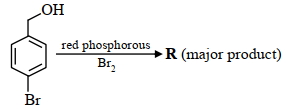
Consider the following reaction. On estimation of bromine in $1.00 g$ of $R$ using Carius method, the amount of $AgBr$ formed (in $g$ ) is. . . .

$\overline{\text { [Given : }}$ Atomic mass of $H =1, C =12, O =16, P =31, Br =80, Ag =108]$
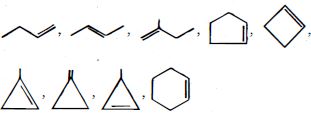
How many of the following compounds on reductive ozonolysis produce formaldehyde as one of the product ?
Select correct statement among following 
What would be the electrode potential for the given half cell reaction at $pH = 5$ ? ........... $\mathrm{V}$

$2 \mathrm{H}_{2} \mathrm{O} \rightarrow \mathrm{O}_{2}+4 \mathrm{H}^{\oplus}+4 \mathrm{e}^{-} ; \mathrm{E}_{\mathrm{red}}^{0}=1.23 \mathrm{V}$

$(\mathrm{R}=8.314 \;\mathrm{J} \mathrm{mol}^{-1} \mathrm{K}^{-1} ; \text { Temperature }=298 \;\mathrm{K} ;$ oxygen under std. atm. pressure of $1 \;bar$)

When acetamide is treated with $NaOBr,$ the product formed is
When phthalic acid is heated, phthalic anhydride is formed, $IUPAC$ name of phthalic anhydride is?
$200\, mL$ of an aqueous solution of a protein contains its $1.26\, g.$ The osmotic pressure of this solution at $300\, K$ is found to be $2.57 \times 10^{-3}$ bar. The molar mass of protein will be  .........$g\, mol^{-1}$

$(R = 0.083 \,L\, bar \,mol^{-1}\, K{-1})$

Consider the following reaction :

Ethanol $\xrightarrow{{PB{r_3}}}X\,\xrightarrow{{alc.\,KOH}}\,Y$$\,\xrightarrow[{(ii)\,{H_2}O\,,\,heat}]{{(i)\,{H_2}S{O_4},\,room\,\,temperature}}Z$

the product $Z$ is
How much volume of oxygen at $STP$ will be liberated by $2$ $ampere$ flowing for $3\, minutes$ and $13\, seconds$ through acidified water ............ $\mathrm{cc}$
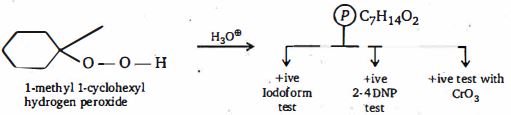
Compound $(P)$ is