MCQ
Faraday law of electrolysis indirectly shows
  • quantisation of charge
  • B
    quantisation of angular momentum
  • C
    quantisation of current
  • D
    quantisation of viscosity

Answer

Correct option: A.
quantisation of charge
a
Faraday's law says that amount of substance liberated or deposited at an electrode is proportional to quantity of charge passed through it. Thus, mass $ \propto $ charge. Since mass is quantised hence indirectly charge is quantised

Need a full question paper?

Generate a complete, print-ready paper with questions like this in minutes — across 16+ boards, with answer keys.
Start Generating Free

Similar questions

To measure which of the following, is a tangent galvanometer used
A $36 \,\Omega$ galvanometer is shunted by resistance of $4\,\Omega$. The percentage of the total current, which passes through the galvanometer is
The focal lengths of objective lens and eye lens of a Galilean telescope are respectively $30\, cm$ and $3.0\, cm$. telescope produces virtual, erect image of an object situated far away from it at least distance of distinct vision from the eye lens. In this condition, the magnifying power of the Galilean telescope should be
The focal length of the objective lens of a compound microscope is
Electric flux over a surface in an electric field may be:
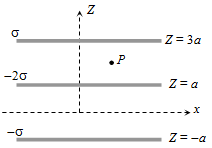
Three infinitely long charge sheets are placed as shown in figure. The electric field at point P is
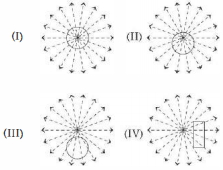
The black shapes in the figure below are closed surfaces. The electric field lines are in red. For which case, the net flux through the surfaces is non-zero?
If a ray of light is incident normally on a plane mirror then the value of the angle of reflection is:
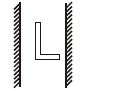
An object shaped as $'L'$ is placed between two parallel plane mirrors as shown. In the first seven closest images, how many laterally inverted images are formed
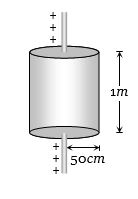
Electric charge is uniformly distributed along a long straight wire of radius $1\, mm$. The charge per $cm$ length of the wire is $Q$ $coulomb$. Another cylindrical surface of radius $50$ $cm$ and length $1\,m$ symmetrically encloses the wire as shown in the figure. The total electric flux passing through the cylindrical surface is