Question
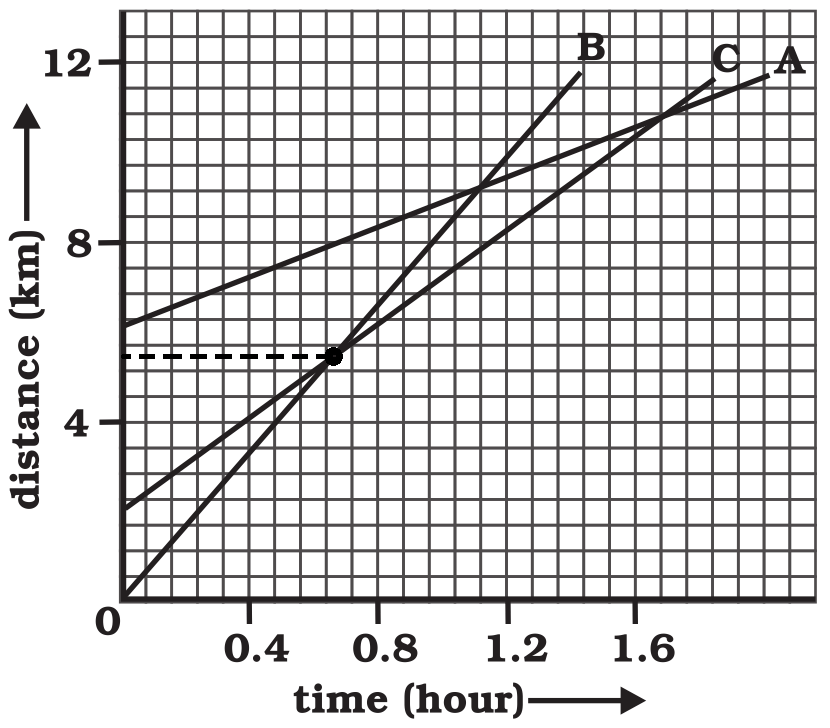
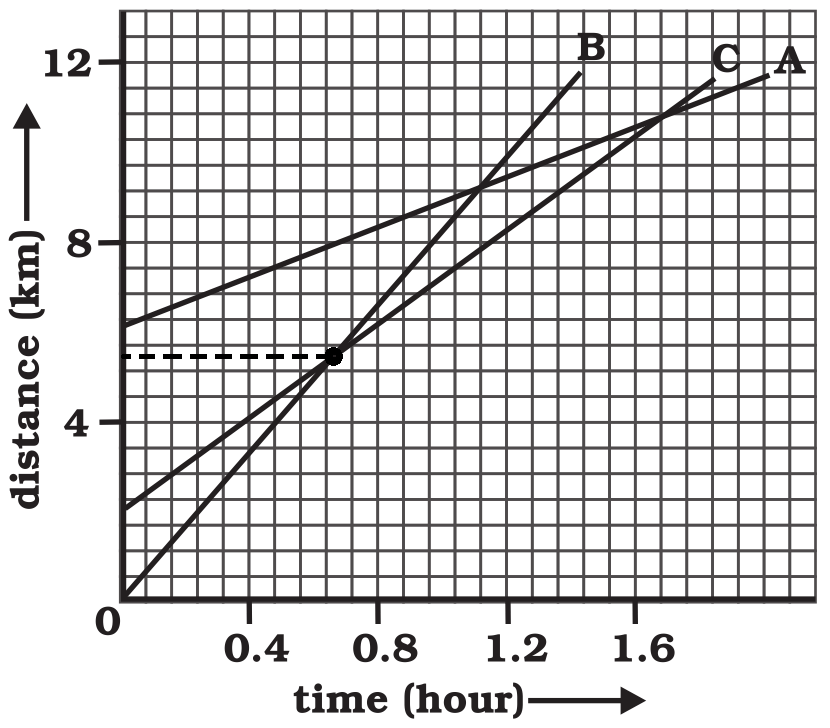
Fig shows the distance-time graph of three objects A, B and C. Study the graph and answer the following questions:
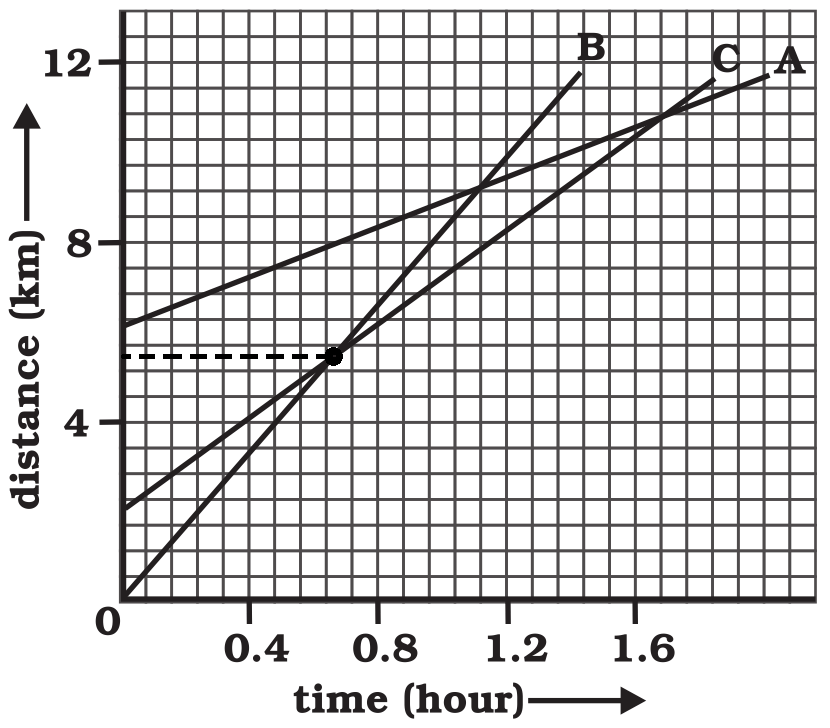
  1. Which of the three is travelling the fastest?
  2. Are all three ever at the same point on the road?
  3. How far has C travelled when B passes A?
  4. How far has B travelled by the time it passes C?
Need a full question paper?

Generate a complete, print-ready paper with questions like this in minutes — across 16+ boards, with answer keys.

Start Generating Free

Similar questions

Name in which:

Virus, bacterium and protozoa can be causal agent.

When a cricket ball is thrown vertically upwards, it reaches a maximum height of 5 meters.
  1. What was the initial speed of the ball?
  2. How much time is taken by the ball to reach the highest point? (g = 10ms-2)

Mention two ways by which a photosynthesing cell belonging to this group differs from a cell of your body.

The functional combination of nerve and muscle tissue is fundamental to most animals. Comment.
A constant force acts on an object of 5kg for a period of 2s. It increases the velocity of an object from 3m $s ^{-1}$ to 7m $s ^{-1}$. Find the magnitude of the applied force. Now, if the force was applied for a period of 5s, then what would be the final velocity of the object?
Distinguish between the following:
Chromoplast and chloroplast.
Describe how the gravitational force between two objects depends on the distance between them.
If the distance between masses of two objects is increased by five times, by what factor would the mass of one of them have to be changed to maintain the same gravitational force? Would there be an increase or a decrease in the same?

Give three important reasons why soil is essential for living organisms.’

Non metals are usually poor conductors of heat and electricity. They are non-lustrous, non-sonorous, non-malleable and are coloured.
  1. Name a lustrous non-metal.
  2. Name a non-metal which exists as a liquid at room temperature.
  3. The allotropic form of a non-metal is a good conductor of electricity. Name the allotrope.
  4. Name a non-metal which is known to form the largest number of compounds.
  5. Name a non-metal other than carbon which shows allotropy.
  6. Name a non-metal which is required for combustion.