Figure below shows a portion of an electric circuit with the currents in amperes and their directions. The magnitude and direction of the current in the portion $P Q$ is
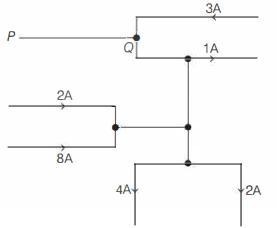
KVPY 2011, Medium
Download our app for free and get started
(d)
Using Kirchhoff's junction rule, directions and magnitudes of currents are as,
Clearly, current in the portion $P Q$ is from $Q$ to $P$ is $6 A$.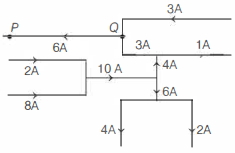

Download our appand get started for free
Experience the future of education. Simply download our apps or reach out to us for more information. Let's shape the future of learning together!No signup needed.*
Similar Questions
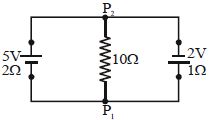
- 1A $5\, V$ battery with internal resistance $2\, \Omega$ and a $2\,V$ battery internal resistance $1\, \Omega$ are connected to a $10\, \Omega$ resistor as shown in the figure. The current in the $10\, \Omega$ resistor is :-View Solution
- 2A carbon resistor of $(47 \pm 4.7) \;k\Omega$ is to be marked with rings of different colours for its identification. The colour code sequence will bView Solution
- 3A potentiometer has uniform potential gradient. The specific resistance of the material of the potentiometer wire is $10^{-7} \, ohm-meter$ and the current passing through it is $0.1\, ampere$; cross-section of the wire is $10^{-6}\, m^2$. The potential gradient along the potentiometer wire isView Solution
- 4The length of a given cylindrical wire is increased to double of its original length. The percentage increase in the resistance of the wire will be..... $\%$.View Solution
- 5A car has a fresh battery of $e.m.f$. $12\, V$ and internal resistance of $0.05\, \Omega$. If the starter motor draws a current of $90\, A$, the terminal voltage when the starter is on will be ............... $V$View Solution
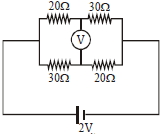
- 6The reading of an ideal voltmer in the circuit shown is.....$V$View Solution
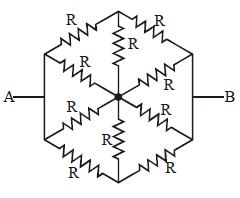
- 7Find out equivalent resistance between $A$ and $B$View Solution
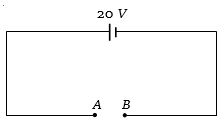
- 8In the shown circuit, what is the potential difference across $A$ and $B$ ......... $V$View Solution
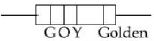
- 9View SolutionA carbon resistance has a following colour code. What is the value of the resistance?
- 10A potentiometer having the potential gradient of $2\, mV/cm$ is used to measure the difference of potential across a resistance of $10 \,\Omega$. If a length of $50\, cm$ of the potentiometer wire is required to get the null point, the current passing through the $10 \,\Omega$ resistor is (in $mA$)View Solution