MCQ
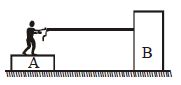
Figure shows a boy on a horizontal platform $A$ on a smooth horizontal surface, holding a rope attached to a box $B$ . Boy pulls the rope with a constant force of $50\ N$ . (boy does not slip over the platform). The combined mass of platform $A$ and boy is $250\ kg$ and that of box $B$ is $500\ kg$ . The velocity of $A$ relative to the box $B$ , $5\ s$ after the boy on $A$ begins to pull the rope, will be ............ $m/s$
  • A
    $1$
  • $1.5$
  • C
    $2$
  • D
    $0.5$

Answer

Correct option: B.
$1.5$
b
$a_{1}=\frac{1}{5} \mathrm{m} / \mathrm{s}^{2} \mathrm{a}_{2}=\frac{1}{10} \mathrm{m} / \mathrm{s}^{2}$

$\mathrm{v}_{1}=5 \times \frac{1}{5}=1 \mathrm{m} / \mathrm{s} \quad \mathrm{v}_{2}=5 \times \frac{1}{10}=\frac{1}{2} \mathrm{m} / \mathrm{s}$

$\mathrm{v}_{12}=1.5 \mathrm{m} / \mathrm{s}$

Need a full question paper?

Generate a complete, print-ready paper with questions like this in minutes — across 16+ boards, with answer keys.

Start Generating Free

Similar questions

One end of a slack wire (Young's modulus $Y$, length $L$ and cross-sectional area $A$ ) is clamped to a rigid wall and the other end to a block (mass $m$ ), which rests on a smooth horizontal plane. The block is set in motion with a speed $v$. What is the maximum distance, then the block will travel after the wire becomes taut?
Two stones are projected with the same speed but making different angles with the horizontal. Their ranges are equal. If the angle of projection of one is $\pi /3$ and its maximum height is $h_1$ then the maximum height of the other will be
An aircraft executes a horizontal loop with a speed of $150\, m/s$ with its wings banked at an angle of $12^o$. The radius of the loop is ..........  $km$ $(g = 10\, m/s^2 \; and\; \tan 12^o = 0.2125)$
A soap bubble in vacuum has a radius of $3 \,cm$ and another soap bubble in vacuum has a radius of $4 \,cm$. If the two bubbles coalesce under isothermal condition, then the radius of the new bubble is ....... $cm$
An aluminium sphere of $20 \;cm$ diameter is heated from $0^{\circ} C$ to $100^{\circ} C$. Its volume changes by (given that coefficient of linear expansion for aluminium $\alpha_{A l}=23 \times 10^{-6}\;/{^o}C$
Two particles of equal mass have velocities $2\,\hat i\, ms^{-1}$ and $2\,\hat j\, ms^{-1}$. First particle has an acceleration $(\,\hat i\, + \,\hat j\,)$ $ms^{-2}$ while the acceleration of the second particle is zero. The centre of mass of the two particles moves in
Two simple pendulums of length $0.5\, m$ and $2.0\, m$ respectively are given small linear displacement in one direction at the same time. They will again be in the phase when the pendulum of shorter length has completed .... oscillations.
Two bodies of masses $0.1 \,kg$ and $0.4 \,kg$ move towards each other with the velocities $1\, m/s$ and $0.1 \,m/s$ respectively, After collision they stick together. In $10 \,sec$ the combined mass travels .......... $m$
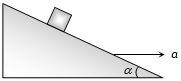
A block is kept on a frictionless inclined surface with angle of inclination '$\alpha$'. The incline is given an acceleration $ 'a'$ to keep the block stationary. Then a is equal to
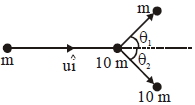
A particle of mass $m$ is moving along the $x$ -axis with initial velocity $u \hat i$. It collides elastically with a particle of mass $10\, m$ at rest and then moves with half its initial kinetic energy (see figure). If $\sin \theta_{1}=\sqrt{n} \sin \theta_{2}$ then value of $n$ is.....