Question
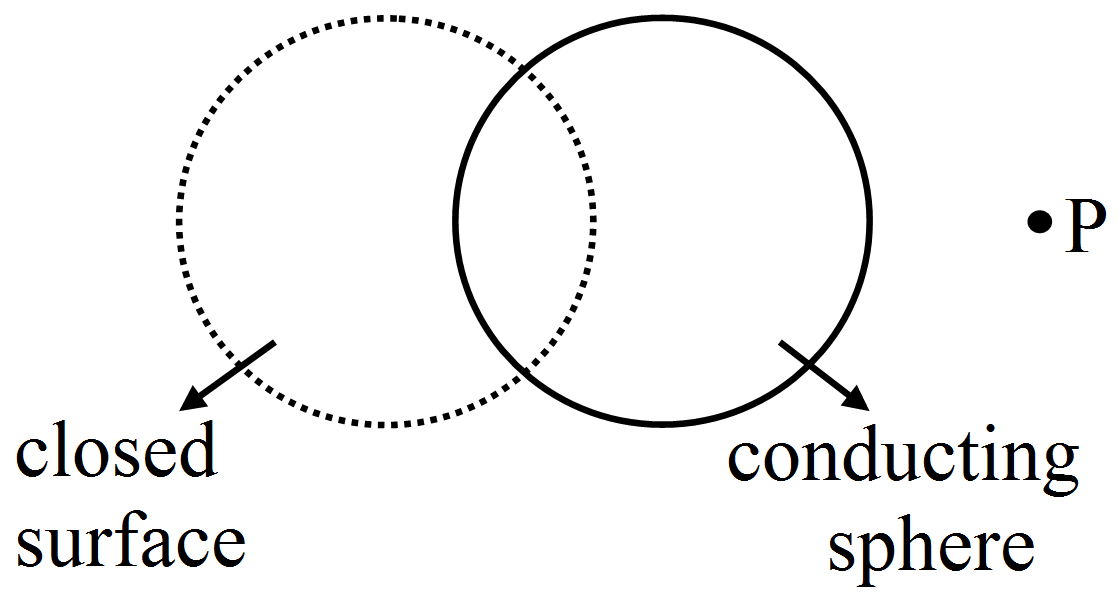
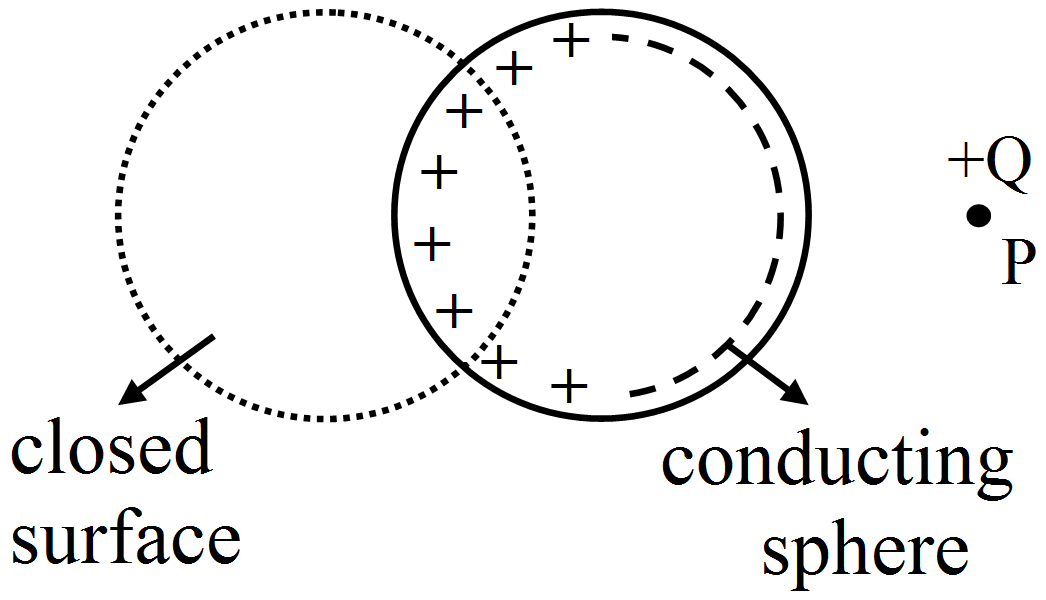
Figure shows a closed surface which intersects a conducting sphere. If a positive charged is placed at the point P, the flux of the electic field through the closed surface:
Answer

  1. Will become positive.
Explanation:
Charge distribution:

Due to charge distribution, intersection by the closed surface of conducting sphere containing the positive charge. So we can say that the flux of the electric field through the closed surface will become positive.
$\therefore\phi=\frac{\text{q}_{\text{in}}}{\epsilon_0}\Rightarrow+\text{ve}$

Need a full question paper?

Generate a complete, print-ready paper with questions like this in minutes — across 16+ boards, with answer keys.
Start Generating Free

Similar questions

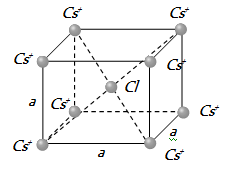
What is the net force on a $Cl^–$ placed at the centre of the bcc structure of $CsCl$
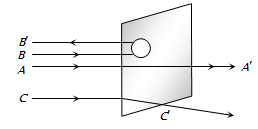
A beam of fast moving alpha particles were directed towards a thin film of gold. The parts $A^{\prime}, B^{\prime}$ and $C^{\prime}$ of the transmitted and reflected beams corresponding to the incident parts $A, B$ and $C$ of the beam, are shown in the adjoining diagram. The number of alpha particles in
Equipotential surface is:
If two streams of protons move parallel to each other in the same direction, then they(a) Do not exert any force on each other(b) Repel each other(c) Attract each other(d) Get rotated to be perpendicular to each other


A current of 2.0 ampere passes through a cell of e.m.f. 1.5 volts having internal resistance of 0.15 ohm.  The potential difference measured, in volts, across both the ends of the cell will be(a) 1.35(b) 1.50(c) 1.00(d) 1.20
       
If the distance between the plates of parallel plate capacitor is halved and the dielectric constant of dielectric is doubled, then its capacity will(a) Increase by 16 times(b) Increase by 4 times(c) Increase by 2 times(d) Remain the same
   
   
Bohr’s atom model is the modification of Rutherford’s atom model by the application of:
When a soap bubble is negatively charged, its radius is:
A particle is acted upon by a force of constant magnitude which is always perpendicular to the velocity of the particle. The motion of the particle takes place in a plane. It follows that:
  1. Its velocity is constant.
  2. Its acceleration is constant.
  3. Its kinetic energy is constant.
  4. It moves in a circular path.
Consider four circuits shown in the figure below. In which circuit power dissipated is greatest  $($Neglect the internal resistance of the power supply$)$