Question
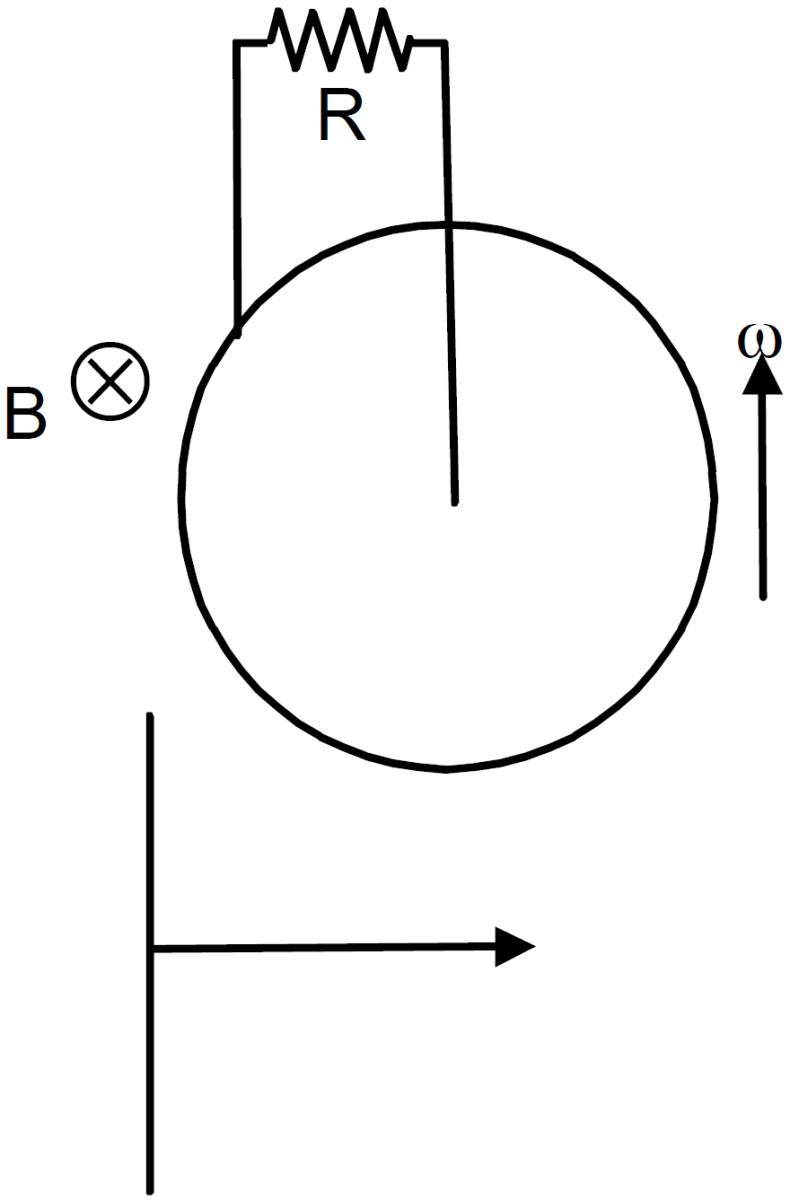
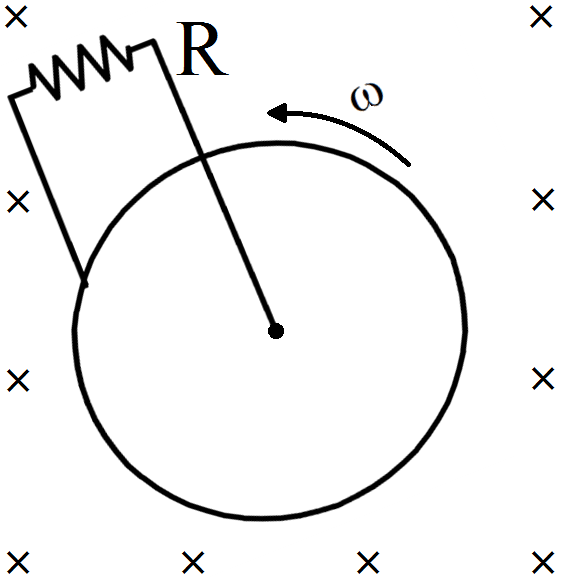
Figure shows a conducting disc rotating about its axis in a perpendicular magnetic field B. A resistor of resistance R is connected between the centre and the rim. Calculate the current in the resistor. Does it enter the disc or leave it at the centre? The radius of the disc is 5.0cm, angular speed $\omega=10 \ \text{rad/s}, \ \text{B}=0.40\text{T}$ and $\text{R}=10\Omega.$
Answer


$\text{B}=0.40\text{T},\omega=10 \ \text{rad}/',\text{r}=10\Omega$

$\text{r}=5\text{cm}=0.05\text{m}$

Considering a rod of length 0.05m affixed at the centre and rotating with the same $\omega$.

$\text{V}=\frac{\text{L}}{2}\times\omega=\frac{0.05}{2}\times10$

$\text{e}=\text{BLV}=0.40\times\frac{0.05}{2}\times10\times0.05=5\times10^{-3}\text{V}$

$\text{L}=\frac{\text{e}}{\text{R}}=\frac{5\times10^{-3}}{10}=0.5 \ \text{mA}$

It leaves from the centre.

Need a full question paper?

Generate a complete, print-ready paper with questions like this in minutes — across 16+ boards, with answer keys.

Start Generating Free

Similar questions

Which wavelengths will be emitted by a sample of atomic hydrogen gas (in ground state) if electrons of energy 12.2eV collide with the atoms of the gas?
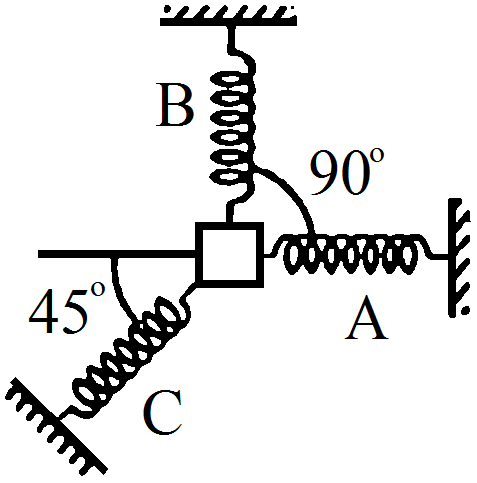
A particle of mass in is attatched to three springs A, B and C of equal force constants k as shown in figure If the particle is pushed slightly against the spring C and released, find the time period of oscillation.

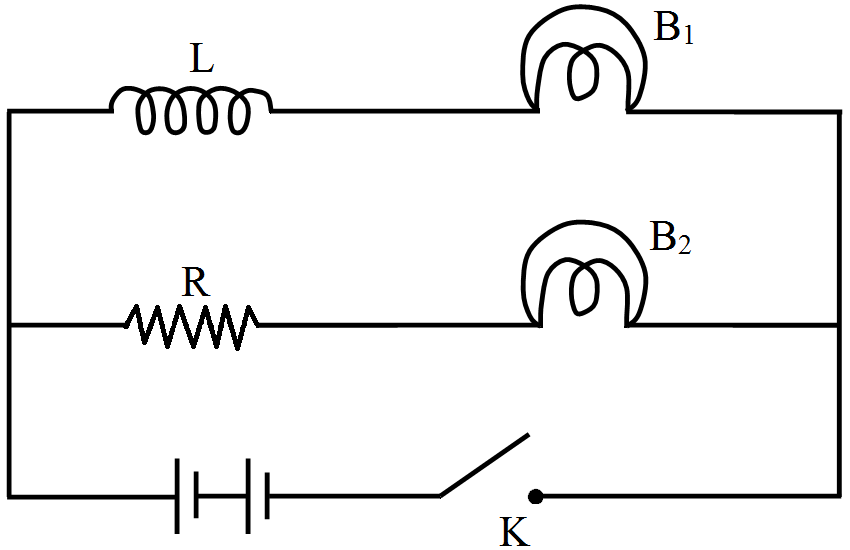
In the given circuit, the value of resistance effect of the coil L is exactly equal to the resistance R. Bulbs B1 and B2 are exactly identical.

Answer the following questions based on above information:

  1. Which one of the two bulbs lights up earlier, when key K is closed and why?
  2. What will be the comparative brightness of the two bulbs after sometime if the key K is kept closed and why?
A compound microscope uses an objective lens of focal length 4 cm and eyepiece lens of focal length 10 cm. An object is placed at 6 cm from the objective lens. Calculate the magnifying power of the compound microscope. Also calculate the length of the microscope.
  1. State the law of radioactive decay. Write the SI unit of ‘activity’.
  2. There are $4\sqrt{2}\times10^6$ radioactive nuclei in a given radioactive sample. If the half life of the sample is 20 s, how many nuclei will decay in 10 s?
The magnetic intensity Hat the centre of a long solenoid carrying a current of 2.0A, is found to be 1500A/m. Find the number of turns per centimetre of the solenoid.
An inductor L of inductance XL is connected in series with a bulb B and an ac source. How would brightness of the bulb change when (i) number of turns in the inductor is reduced, (ii) an iron rod is inserted in the inductor and (iii) a capacitor of reactance XC = XL is inserted in series in the circuit. Justify your answer in each case.
Two identical particles, each having a charge of 2.0 × 10-4C and mass of 10g, are kept at a separation of 10cm and then released. What would be the speeds of the particles when the separation becomes large?
A 10 m long wire of uniform cross-section and 20 $\Omega$ resistance is used in a potentiometer. The wire is connected in series with a battery of 5V along with an external resistance of 480 $\Omega$. If an unknown emf E is balanced at 6.0 m length of the wire, calculate:
  1. The potential gradient of the potentiometer wire.
  2. The value of unknown emf  E.
Two capacitors of capacitance $10\mu\text{F}$ and $20 \mu\text{F}$ are connected in series with a 6 V battery. After the capacitors are fully charged, a slab of dielectric constant (K) is inserted between the plates of the two capacitors. How will the following be affected after the slab is introduced:
  1. The electric field energy stored in the capacitors.
  2. The charges on the two capacitors.
  3. The potential difference between the plates of the capacitors.
Justify your answer.