Question
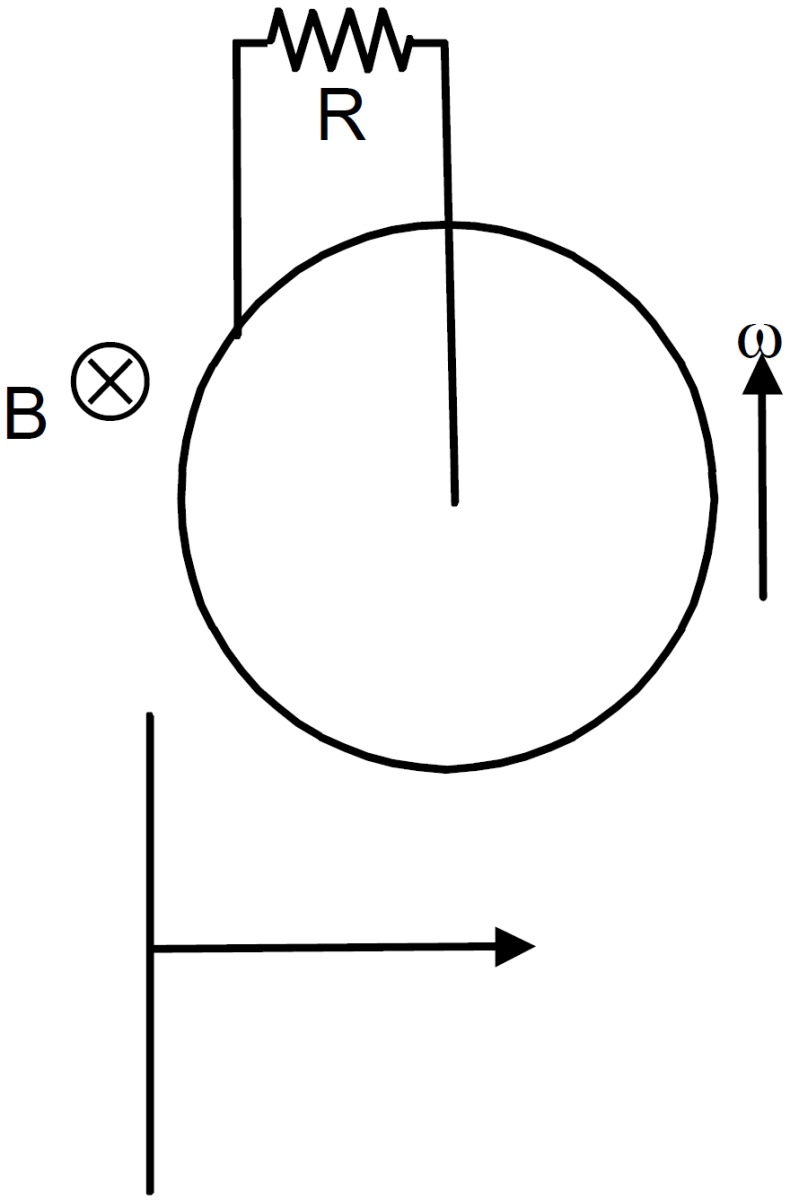
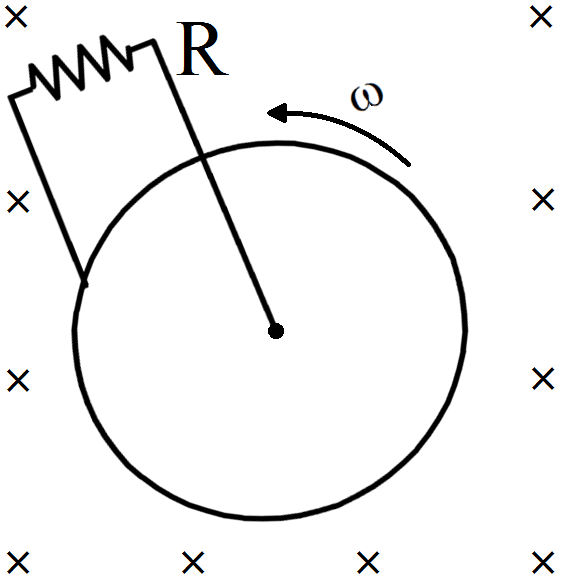
Figure shows a conducting disc rotating about its axis in a perpendicular magnetic field B. A resistor of resistance R is connected between the centre and the rim. Calculate the current in the resistor. Does it enter the disc or leave it at the centre? The radius of the disc is 5.0cm, angular speed $\omega=10 \ \text{rad/s}, \ \text{B}=0.40\text{T}$ and $\text{R}=10\Omega.$
Answer


$\text{B}=0.40\text{T},\omega=10 \ \text{rad}/',\text{r}=10\Omega$

$\text{r}=5\text{cm}=0.05\text{m}$

Considering a rod of length 0.05m affixed at the centre and rotating with the same $\omega$.

$\text{V}=\frac{\text{L}}{2}\times\omega=\frac{0.05}{2}\times10$

$\text{e}=\text{BLV}=0.40\times\frac{0.05}{2}\times10\times0.05=5\times10^{-3}\text{V}$

$\text{L}=\frac{\text{e}}{\text{R}}=\frac{5\times10^{-3}}{10}=0.5 \ \text{mA}$

It leaves from the centre.

Need a full question paper?

Generate a complete, print-ready paper with questions like this in minutes — across 16+ boards, with answer keys.

Start Generating Free

Similar questions

During India-Pakistan war, a soldier discovered that his lead bullet just melted when stopped by an obstacle. Calculate the velocity of the bullet if its temp. was 47.6°C. Given: melting point of lead = 327°C. Specific heat of lead = 0.03 cal g-1°C-1, latent heat of fusion of lead = 6 cal g-1 and J = 4.2 × 10⁷ erg car-1.
Assume that no heat is lost.
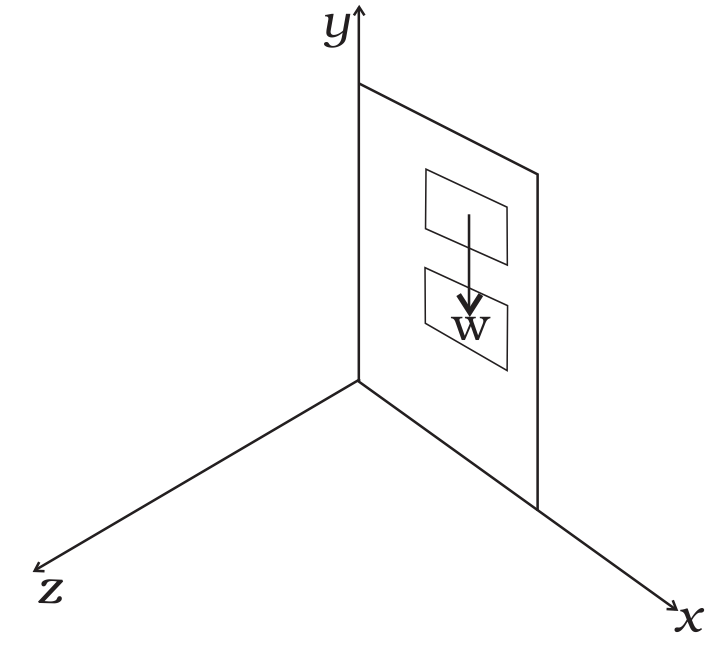
A door is hinged at one end and is free to rotate about a vertical axis. Does its weight cause any torque about this axis? Give reason for your answer.

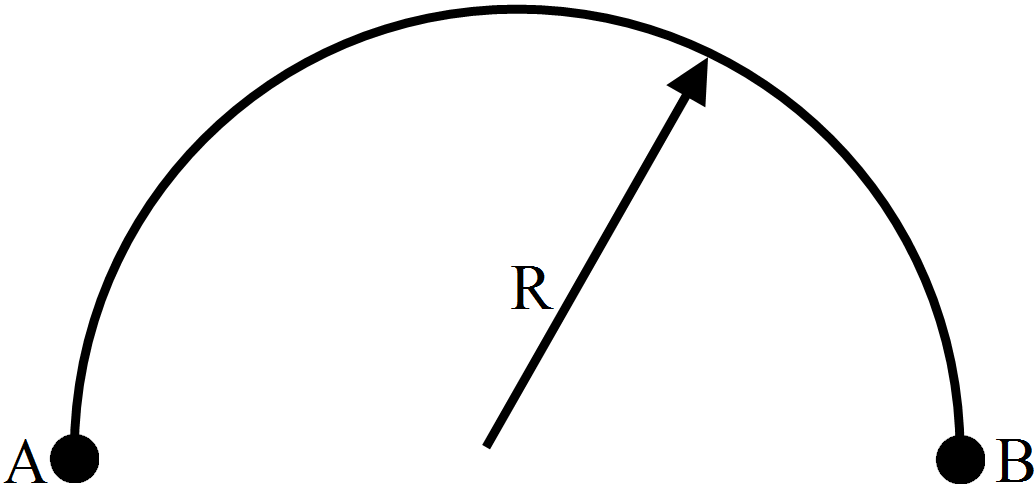
A particle moves along a semicircular path of radius R in time t with constant speed.

For particle calculate:
  1. Distance travelled.
  2. Displacement.
  3. Average speed.
  4. Average velocity.
  5. Average acceleration.
Two horizontal pipes of radius 1 cm and 2 cm are joined to each other. The velocity of water in first pipe is $8 m / sec$ and pressure is $1 \times 10^5 N / m ^2$. Calculate the velocity and pressure of water in second pipe.
If the frequency (n) of a tunning fork depends on length (1), density (d) and Young's modulus of elasticity (y) then establish the correct formula.
Show that the angular momentum about any point of a single particle moving with constant velocity remains constant throughout the motion.
A particle moves in a circle of radius 20cm. Its linear speed at any time is given by v = 2t where v is in m/s and t is in seconds. Find the radial and tangential accelerations at t = 3 seconds and hence calculate the total acceleration at this time.
A capillary tube is attached horizontally to a constant head arrangement. If the radius of the capillary tube is increased by 10% then by what percentage the rate of flow of liquid will change.
In Exercises 3.13 and 3.14, we have carefully distinguished between average speed and magnitude of average velocity. No such distinction is necessary when we consider instantaneous speed and magnitude of velocity. The instantaneous speed is always equal to the magnitude of instantaneous velocity. Why?
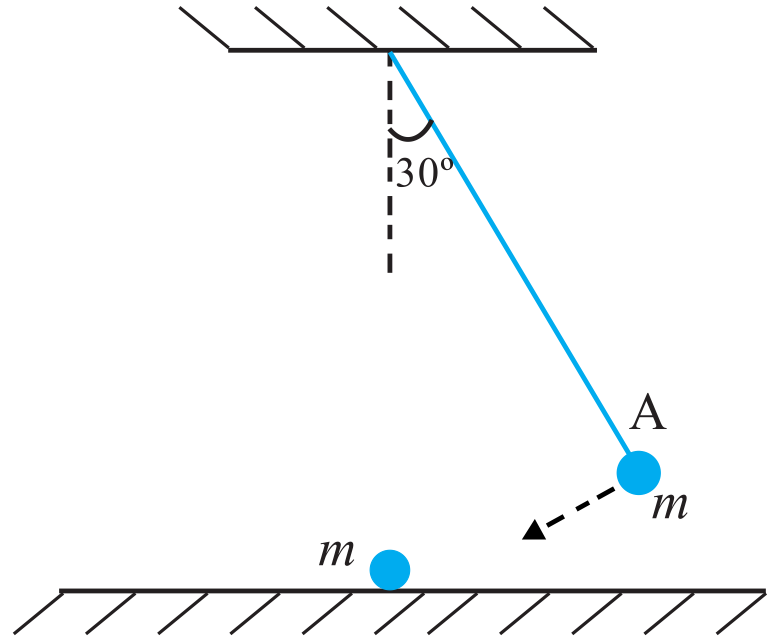
The bob A of a pendulum released from 30° to the vertical hits another bob B of the same mass at rest on a table as shown in. How high does the bob A rise after the collision? Neglect the size of the bobs and assume the collision to be elastic.