Question
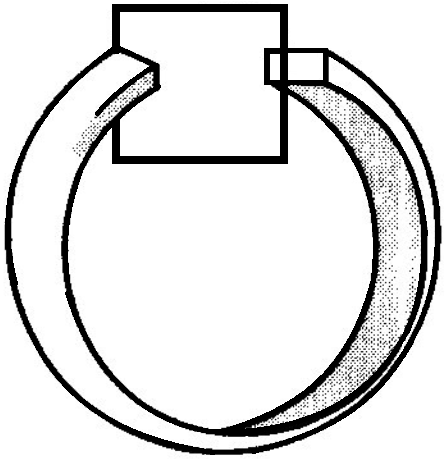
Figure shows a conducting square loop placed parallel to the pole faces of a ring magnet. The Pole-faces have an area of $1cm^2$ each and the field between the poles is 0.10T. The wires making the loop are all outside the magnetic field. If the magnet is removed in 1.0s, what is the average emf induced in the loop?
Answer

$\text{B}=0.10\text{T}$$\text{A}=1\text{cm}^2=10^{-4}\text{m}^2$
$\text{T}=1\text{s}$
$\phi=\text{B}.\text{A=}10^{-1}\times10^{-4}=10^{-5}$
$\text{e}=\frac{\text{d}\phi}{\text{dt}}=\frac{10^{-5}}{1}=10^{-5}=10\mu\text{V}$

Need a full question paper?

Generate a complete, print-ready paper with questions like this in minutes — across 16+ boards, with answer keys.

Start Generating Free

Similar questions

It is a common observation that rain clouds can be at about a kilometre altitude above the ground.A typical rain drop is about 4mm diameter. Momentum is mass x speed in magnitude. Estimate its momentum when it hits ground.
The breaking stress for a metal is $2 \times$ $10^6 N / m ^2$. Find the maximum length of this metal wire, by which it can suspended under its own weight without breaking. (Density of metal $=8 \times 10^3 kg / m ^3$ and $g=10 m / s ^2$ )
What are the two basic characteristics of a simple harmonic motion?
A Galilean telescope is 27cm long when focused to form an image at infinity. If the objective has a focal length of 30cm, what is the focal length of the eyepiece?
A railroad car of mass M is at rest on frictionless rails when a man of mass m starts moving on the car towards the engine. If the car recoils with a speed v backward on the rails, with what velocity is the man approaching the engine?
Explain why Surface tension of a liquid is independent of the area of the surface.
Given below are some functions of x and t to represent the displacement of an elastic wave.
$\text{y}=5\cos(4\times)\sin(20\text{t})$
Why does a phonograph-record attract dust particles just after it is cleaned?
The stress-strain curves of two different types of rubbers are shown in the following figure. How are these stress-strain curves of rubber different from those of metals?
Draw the graph showing the variation of potential energy and kinetic energy of a block attached to a spring, which obeys Hooke's law.