Question
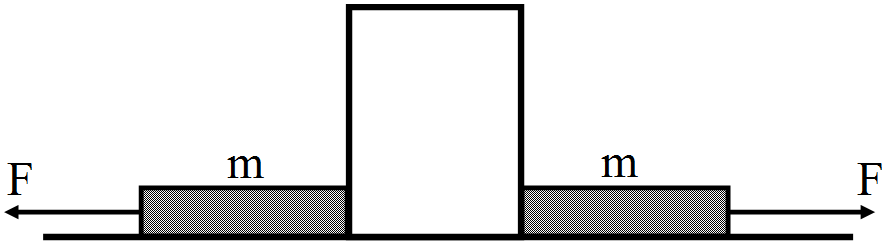
Figure shows a heavy block kept on a frictionless surface and being pulled by two ropes of equal mass m. At t = 0, the force on the left rope is withdrawn but the
force on the right end continues to act. Let F1 and F2 be the magnitudes of the forces by the right rope and the left rope on the block respectively:
  1. F= F2 = F for t < 0.
  2. F1 = F2 = F + mg for t < 0.
  3. F1 = F, F2 = F for t > 0.
  4. F1< F, F2 = F for t > 0.

Answer

  1. F= F2 = F for t < 0.

Explanation:

At t < 0, the block is in equilibrium in the horizontal direction.

So, F1 = F2 = F

At t > 0, F2 = 0 and F1 = F.

Need a full question paper?

Generate a complete, print-ready paper with questions like this in minutes — across 16+ boards, with answer keys.

Start Generating Free

Similar questions

Given mass of the moon is $1/81$ of the mass of the earth and corresponding radius is $1/4$ of the earth. If escape velocity on the earth surface is $11.2\, km/s$, the value of same on the surface of the moon is......... $km/sec$​
Two resistors A and B have resistances RA and RB, respectively, and RA < RB. The resistivities of their materials are $\rho _{\text{A}}$ and $\rho_{\text{B}}.$

  1. $\rho _\text{A}>\rho _\text{B}$

  2. $\rho _\text{A}=\rho _\text{B}$

  3. $\rho _\text{A}<\rho _\text{B}$

  4. The information is not sufficient to find the relation between $\rho _\text{A}$ and $\rho _\text{B}.$
The fraction of a floating object of volume ${V_0}$ and density ${d_0}$ above the surface of a liquid of density $d$  will be
Two waves having the intensities in the ratio of $9 : 1$ produce interference. The ratio of maximum to the minimum intensity, is equal to
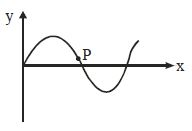
A transverse sinusoidal wave moves along a string in the positive $x-$ direction at a speed of $10\, cm/s$. The wavelength of the wave is $0.5\, m$ and its amplitude is $10\, cm$. At a prticular time $t$, the snap-shot of the wave is shown in the figure. the velocity of point $P$ when its displacement is $5\, cm$, is 
Temperature of water at the surface of lake is $ - {20^o}C$ Then temperature of water just below the lower surface of ice layer is ...... $^oC$
The $SI$ unit of a physical quantity is pascal-second. The dimensional formula of this quantity will be ..............
Assertion : A helium filled balloon does not rise indefinately in air but halts after a certain height.

Reason : Viscosity opposes the motion of balloon. Choose any one of the following four responses:

Avogadro's number is the number of molecules in:
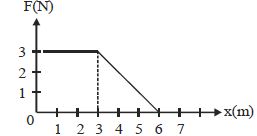
A force $F$ acting on an object varies with distance $x$ as shown here. The force is in $N$ and $x$ in $m$. The work done by the force in moving the object from $x = 0$ to $x = 6$ is ............. $\mathrm{J}$