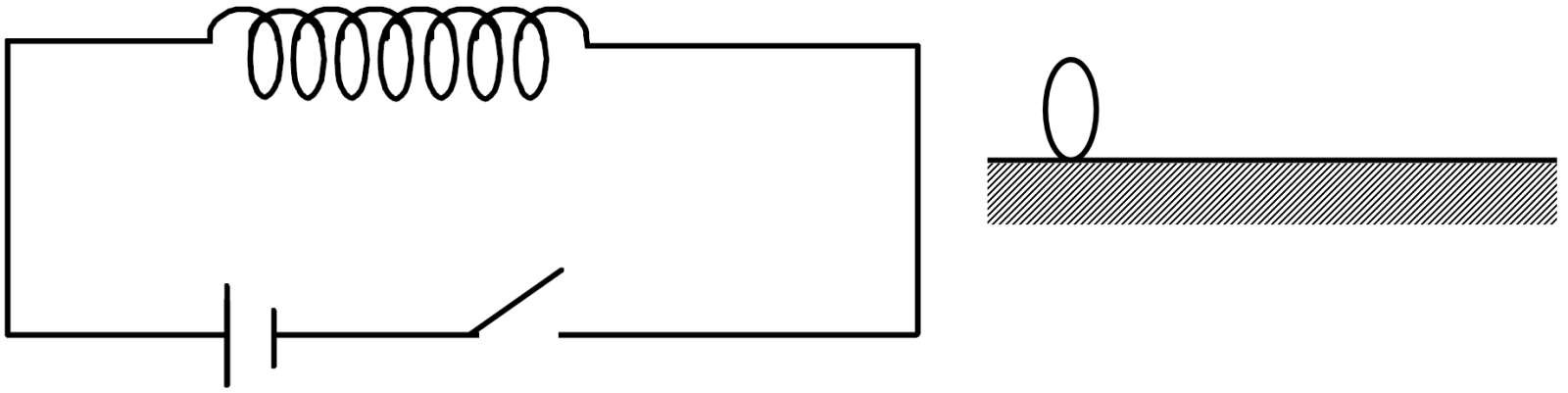
- Remain stationary.
- Move towards the solenoid.
- Move away from the solenoid.
- Move towards the solenoid or away from it depending on which terminal (positive or negative) of the battery is connected to the left end of the solenoid.
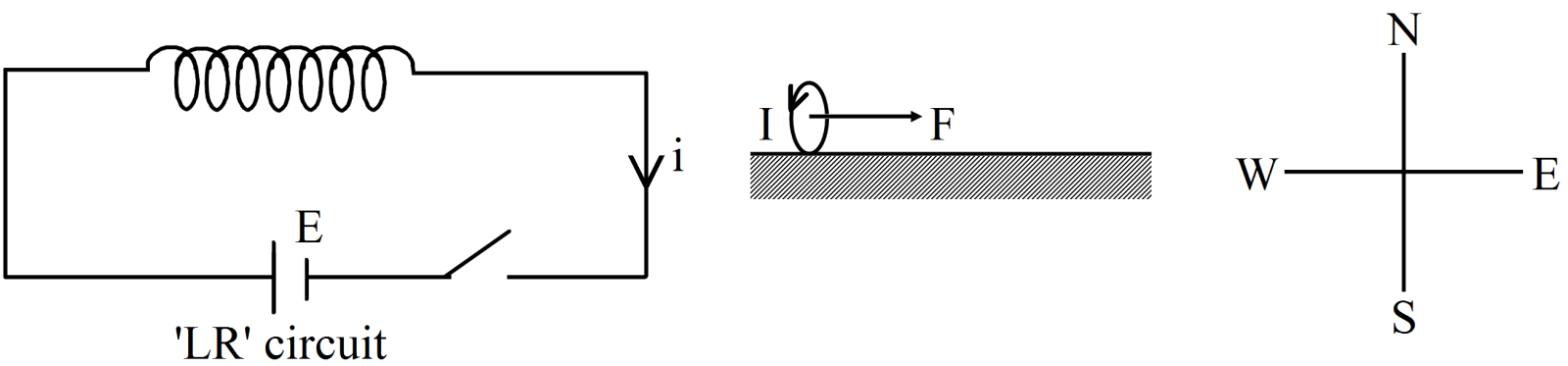

Explanation:

$\text{e}=-\text{L}\frac{\text{di}}{\text{dt}}$
Current flow in the CKt is clock wise direction, due to Mutual Induction current flow in the loop anti clockwise direction. The net force applied on the loop in east direction. So we can say that the ring will move away from the solenoid.
Generate a complete, print-ready paper with questions like this in minutes — across 16+ boards, with answer keys.
A circular coil of radius 5 cm has 500 turns of a wire. The approximate value of the coefficient of self induction of the coil will be
|
(a) 25 millihenry |
(b) 25 |
|
(c) 50 |
(d) 50 |
In a moving coil galvanometer, the deflection of the coil θ is related to the electrical current i by the relation
|
(a) i ∝ tanθ |
(b) i ∝ θ |
(c) i ∝ |
(d) i ∝ |
The wrong statement about electric lines of force is
|
(a) These originate from positive charge and end on negative charge |
|
(b) They do not intersect each other at a point |
|
(c) They have the same form for a point charge and a sphere |
|
(d) They have physical existence |
A convex lens is made of a material having refractive index 1.2. Both the surfaces of the lens are convex. If it is dipped into water $(\mu=1.33),$ it will behave like:
To produce magnified erect image of a far object, we will be required along with a convex lens, is
|
(a) Another convex lens |
(b) Concave lens |
(c) A plane mirror |
(d) A concave mirror |