Question
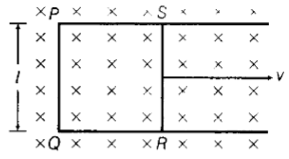
Figure shows a rectangular conducting loop $\text{PQRS}$ in which arm $RS$ of length I is movable. The loop is kept in a uniform magnetic field $B$ directed downward perpendicular to the plane of the loop. The arm $RS$ is moved with a uniform speed $v$.
Image

Deduce an expression for
$i$. the emf induced across the arm $RS$
$ii.$  the external force required to move the arm and
$iii.$ the power dissipated as heat.
Answer

$i.$ Let $RS$ moves with speed $v$ rightward and also $R S$ is at distances $x_1$ and $x_2$ from $PQ$ at instants $t_1$ and $t_2$, respectively.
Change in flux $, d \phi=\phi_2-\phi_1=B l\left(x_2-x_1\right)\left[\because \text { magnetic flux, } \phi=\vec{B} \cdot \vec{A}=B A \cos 0^0=B l x\right]$
$\Rightarrow d \phi=B l d x$
$ \Rightarrow \frac{d \phi}{d t}=B l \frac{d x}{d t}=B l v \quad\left[\because v=\frac{d x}{d t}\right]$
If resistance of loop is $R,$ then $I=\frac{v B I}{R}$
$ ii.$ Magnetic force $=B I l \sin 90^{\circ}$
$=\left(\frac{v B l}{R}\right) B l=\frac{v B^2 l^2}{R}$
Now, External force must be equal to magnetic force
$\therefore$ External force $=\frac{v B^2 l^2}{R}$
$\text { iii. As, } P=I^2 R=\left(\frac{ v B}{R}\right)^2 \times R=\frac{ v ^2 B^2 l^2}{R^2} \times R$
$\therefore P=\frac{ v ^2 B^2 l^2}{R}$

Need a full question paper?

Generate a complete, print-ready paper with questions like this in minutes — across 16+ boards, with answer keys.

Start Generating Free

Similar questions

In a hydrogen atom, the electron and proton are bound at a distance of about $0.53 \mathring{\text{A}}$:
  1. Estimate the potential energy of the system in $eV,$ taking the zero of the potential energy at infinite separation of the electron from proton.
  2. What is the minimum work required to free the electron, given that its kinetic energy in the orbit is half the magnitude of potential energy obtained in $(a)$?
  3. What are the answers to $(a)$ and $(b)$ above if the zero of potential energy is taken at $1.06 \mathring A$ separation?
Two identically charged particles are fastened to the two ends of a spring of spring constant $100Nm^{-1}$ and natural length $10\ cm.$ The system rests on a smooth horizontal table. If the charge on each particle is $2.0 \times 10^{-8}C$, find the extension in the length of the spring. Assume that the extension is small as compared to the natural length. Justify this assumption after you solve the problem.
Let $\varepsilon_1$ and $\varepsilon_2$ be the angles made by $\overrightarrow{\text{A}}$ and $-\overrightarrow{\text{A}}$ with the positive X-axis. Show that $\tan\varepsilon_1=\tan\varepsilon_2.$ Thus, giving tane does not uniquely determine the direction of $\overrightarrow{\text{A}}.$
Average lifetime of a hydrogen atom excited to $n = 2$ state is $10^{-8}s$. Find the number of revolutions made by the electron on the average before it jumps to the ground state.
Two insulating small spheres are rubbed against each other and placed 1cm apart. If they attract each other with a force of 0.1N, how many electrons were transferred from one sphere to the other dunng rubbing?
Magnitudes of $\frac{1}{4 \pi \epsilon_0}$ and $\frac{\mu_0}{4 \pi}$ for vacuum are respectively $9 \times 10^9 N / m ^2$ and $10^{-7}$ weber/ampere respectively. Calculate the speed of electromagnetic wave in vacuum.
A plate of area $10\ cm^2$ is to be electroplated with copper $($density $9000\ kg/m^3)$ to a thickness of $10$ micrometres on both sides, using a cell of $12V$. Calculate the energy spent by the cell in the process of deposition. If this energy is used to heat $100g$ of water, calculate the rise in the temperature of the water. $\ce{ECE}$ of copper $= 3 \times 10^{-7}kg C^1 $ and specific heat capacity of water $= 4200Jkg^1.$
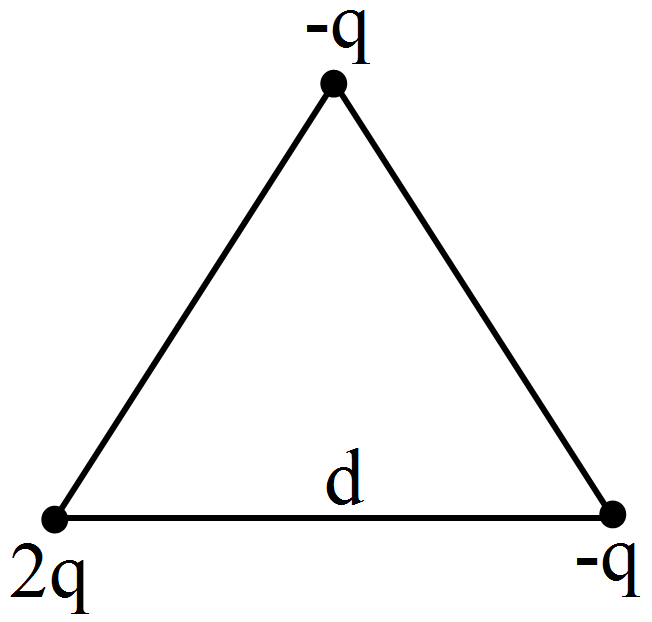
Three charges are arranged on the vertices of an equilateral triangle as shown in figure. Find the dipole moment of the combination.
A railway track $($made of iron$)$ is laid in winter when the average temperature is $18^\circ C$. The track consists of sections of $12.0m$ placed one after the other. How much $pp$ should be left between two such sections $80$ that there is no compression during summer when the maximum temperature goes to $48^\circ C$? Coefficient of linear expansion of iron $= 11 \times 10^{-6 }{}^{\circ} C^{-1}$.
A train approaching a platform at a speed of 54km/h sounds a whistle. An observer on the platform finds its frequency to be 1620Hz. The train passes the platform keeping the whistle on and without slowing down. What frequency will the observer hear after the train has crossed the platfrom? The speed of sound in air = 332m/s.