Question
Figure shows a series $\text{LCR}$ circuit connected to a variable frequency $230V$ source. $L = 5.0H, C = 80\ \mu F, R = 40\Omega .$
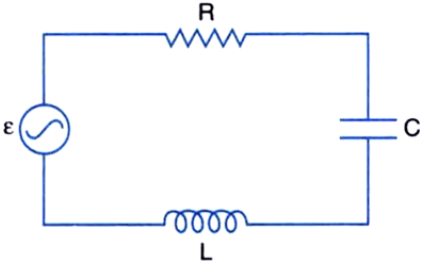
  1. Determine the source frequency which drives the circuit in resonance
  2. Obtain the impedance of the circuit and the amplitude of current at the resonating frequency.
  3. Determine the rms potential drops across the three elements of the circuit. Show that the potential drop across the $\text{LC}$ combination is zero at the resonating frequency.
Answer

Here, we are given a $\text{LCR}$ circuit.
Inductance, $L = 5.0H$
Resistance, $\text{R}=40\Omega$
Capacitance, $C = 80\ \mu F = 80 \times 10^{-6}F$
Effective voltage,
$E_v = 230$ volt
$\Rightarrow$ Peak voltage,$\text{E}_0=\sqrt{2}\text{E}_{\text{v}}=\sqrt{2}\times230\text{V}$
  1. Resonance angular frequency is given by
$\omega_{\text{r}}=\frac{1}{\sqrt{\text{LC}}}$
$=\frac{1}{\sqrt{5\times80\times10^{-6}}}$
$=\frac{1}{2\times10^{-2}}$
$= 50\ rad/\sec.$
  1. Impedance of the circuit,
$\text{Z}=\sqrt{\text{R}^2+\big(\omega\text{L}-\frac{1}{\omega\text{C}}\big)^2}$
At resonance, $\omega\text{L}=\frac{1}{\omega\text{C}}$
Therefore,
$\text{Z}=\sqrt{\text{R}^2}=\text{R}=40\Omega$
Amplitude of current at resonating frequency
Peak value of current, $\text{I}_0=\frac{\text{E}_0}{\text{z}}=\frac{\sqrt{2}\times230}{40}=8.13\text{A}$
Rms value of current, $\text{I}_{\text{v}}=\frac{\text{I}_0}{\sqrt{2}}=\frac{8.13}{\sqrt{2}}=5.75\text{A}$
  1. Potential drop across $L$
$\text{V}_{\text{L rms}}=\text{I}_\text{v}\omega_{\text{r}}\text{L}$
$= 5.75 \times 50 \times 5.0$
$= 1437.5V$
Potential drop across $R$
$\ce{V_{R rms} = I_v \times R}$
$= 5.75 \times 40$
$= 230$ volts
Potential drop across $C$
$\text{V}_{\text{C rms}}=\text{I}_{\text{v}}\Big(\frac{1}{\omega_{\text{r}}\text{C}}\Big)$
$=5.75\times\frac{1}{50\times80\times10^{-6}}$
$=\frac{5.75}{4}\times10^3$
$= 1437.5V$
Therefore,
Potential drop across $\text{LC}$ circuit
$\ce{V_{LC rms} = V_{L rms} - V_{C rms} = 0}$
Thus, the potential drop across the $\text{LC}$ combination is zero at the resonating frequency.

Need a full question paper?

Generate a complete, print-ready paper with questions like this in minutes — across 16+ boards, with answer keys.

Start Generating Free

Similar questions

Sometimes we show an idealised magnetic field which is uniform in a given region and falls to zero abruptly. One such field is represented in figure. Using Ampere's law over the path PQRS, show that such a field is not possible.
The plates of a parallel plate capacitor have an area of $90\ cm^2$ each and are separated by $2.5\ mm$. The capacitor is charged by connecting it to a $400V$ supply.
  1. How much electrostatic energy is stored by the capacitor?
  2. View this energy as stored in the electrostatic field between the plates, and obtain the energy per unit volume $u$. Hence arrive at a relation between $u$ and the magnitude of electric field $E$ between the plates.
An electric kettle used to prepare tea, takes $2$ minutes to boil $4$ cups of water $(1$ cup contains $200cc$ of water$)$ if the room temperature is $25C.$
  1. If the cost of power consumption is $Rs. 1.00$ per unit $(1$ unit $- 1000$ watt$-$hour$),$ calculate the cost of boiling $4$ cups of water.
  2. What will be the corresponding cost if the room temperature drops to $5^\circ C?$
Solve the previous problem if the pulley has a moment of inertia I about its axis and the string does not slip over it.
Deutrium was discovered in $1932$ by Harold Urey by measuring the small change in wavelength for a particular transition in $1H$ and $2H$. This is because, the wavelength of transition depend to a certain extent on the nuclear mass. If nuclear motion is taken into account then the electrons and nucleus revolve around their common centre of mass. Such a system is equivalent to a single particle with a reduced mass $\mu ,$ revolving around the nucleus at a distance equal to the electron $-$ nucleus separation. Here $\mu=\frac{\text{m}_\text{e}\text{M}}{\text{m}_\text{e}+\text{M}}$ where $M$ is the nuclear mass and me is the electronic mass. Estimate the percentage difference in wavelength for the $1^{st}$ line of the Lyman series in $1H$ and $2H. ($Mass of $1H$ nucleus is $1.6725 \times 10^{-27}kg,$ Mass of $2H$ nucleus is $3.3374 \times 10^{-27}kg$, Mass of electron $= 9.109 \times 10^{-31}kg).$
Consider the situation of the previous problem. Consider the fastest electron emitted parallel to the large metal plate. Find the displacement of this electron parallel to its initial velocity before it strikes the large metal plate.
A gas is initially at a pressure of $100\ kPa$ and its volume is $2.0m^3.$ Its pressure is kept constant and the volume is changed from $2.0m^3$ to $2.5m^3.$ Its volume is now kept constant and the pressure is increased from $100\ kPa$ to $200\ kPa.$ The gas is brought back to its initial state, the pressure varying linearly with its volume.
  1. Whether the heat is supplied to or extracted from the gas in the complete cycle?
  2. How much heat was supplied or extracted?
Describe the potential energy of an electric dipole in an external field in different positions also draw the diagram.
A particle slides on the surface of a fixed smooth sphere starting from the topmost point. Find the angle rotated by the radius through the particle, when it leaves contact with the sphere.
An electron makes $3 \times 10^5$ revolutions per second in a circle of radius $0.5$ angstrom. Find the magnetic field $B$ at the centre of the circle.