Question
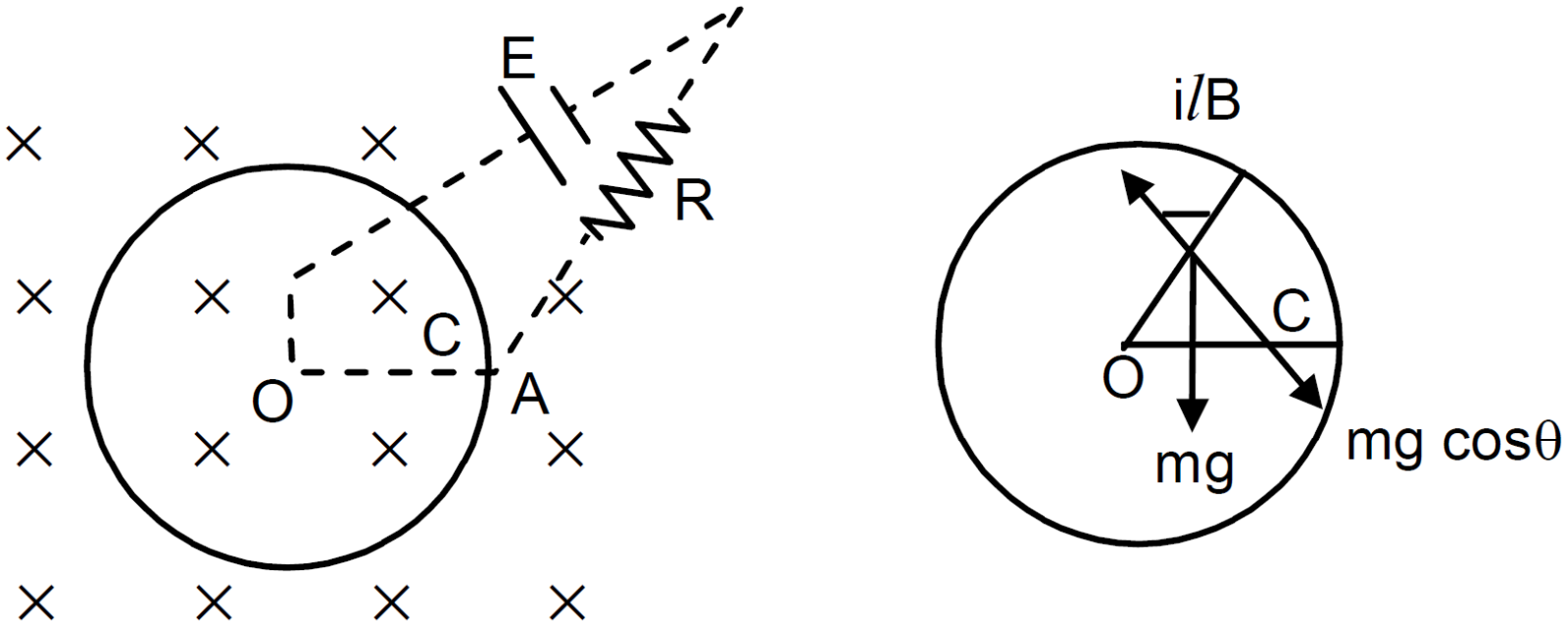
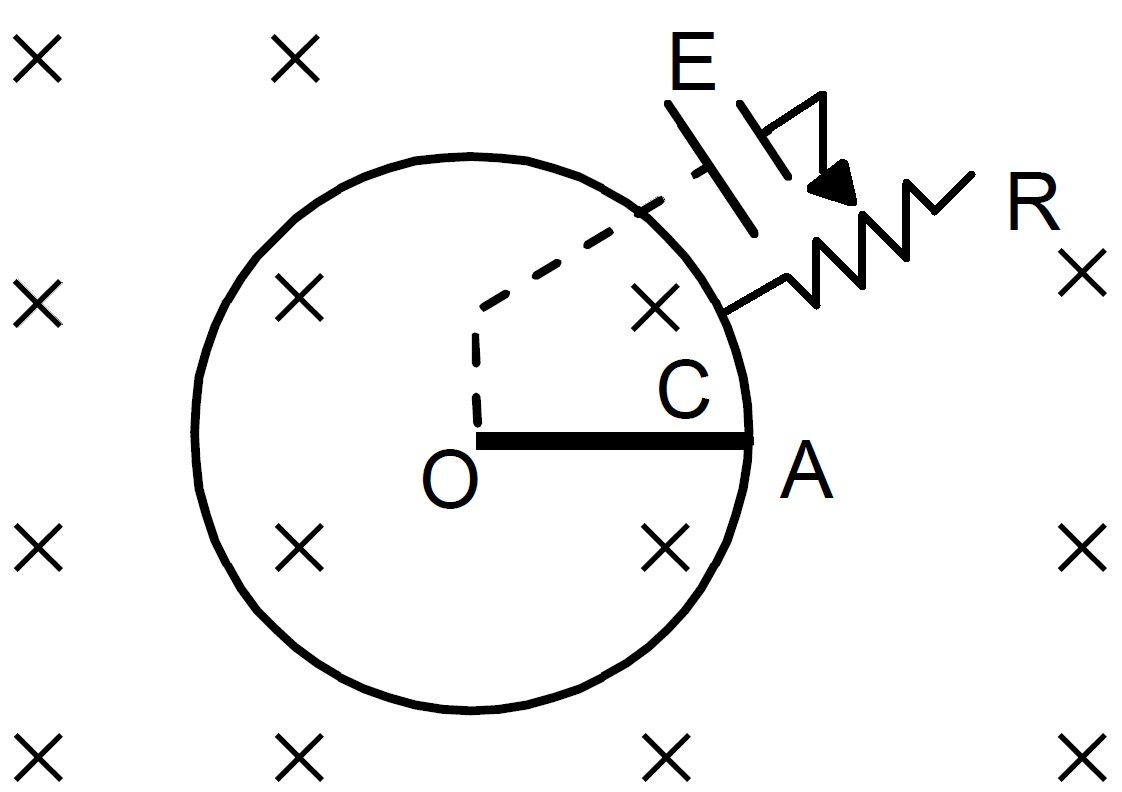
Figure shows a situation similar to the previous problem. All parameters are the same except that a battery of emf $\epsilon$ and a variable resistance R are connected between O and C. The connecting wires have zero resistance. No external force is applied on the rod (except gravity, forces by the magnetic field and by the pivot). In what way should the resistance R be changed so that the rod may rotate with uniform angular velocity in the clockwise direction? Express your answer in terms of the given quantities and the angle $\theta$ made by the rod OA with the horizontal.
Answer


$\text{emf}=\frac{1}{2}\text{B}\omega\text{a}^2$ [from previous problem]
Current $= \frac{\text{e}+\text{E}}{\text{R}}=\frac{\frac{1}{2}\times\text{B}\omega\text{a}^2+\text{E}}{\text{R}}$
$=\frac{\text{B}\omega\text{a}^2 +2\text{E}}{2\text{R}}$
$\Rightarrow \text{mg} \cos \theta =\text{ilB}$ [Net force acting on the rod is O]
$\Rightarrow \text{mg}\cos\theta =\frac{\text{B}\omega\text{a}^2+2\text{E}}{2\text{R}}\text{a}\times\text{B}$
$\Rightarrow \text{R}=\frac{\big(\text{B}\omega\text{a}^2+2\text{E}\big)\text{ab}}{2\text{mg}\cos\theta}$

Need a full question paper?

Generate a complete, print-ready paper with questions like this in minutes — across 16+ boards, with answer keys.

Start Generating Free

Similar questions

An adiabatic vessel of total volume $V$ is divided into two equal parts by a conducting separator. The separator is fixed in this position. The part on the left contains one mole of an ideal gas $(U = 1.5\ nRT)$ and the part on the right contains two moles of the same gas. Initially, the pressure on each side is $p$. The system is left for sufficient time so that a steady state is reached. Find,
  1. The work done by the gas in the left part during the process.
  2. The temperature on the two sides in the beginning.
  3. The final common temperature reached by the gases.
  4. The heat given to the gas in the right part.
  5. The increase in the internal energy of the gas in the left part.
Neglect the effect of rotation of the earth. Suppose the earth suddenly stops attracting objects placed near its surface. A person standing on the surface of the earth will:
  1. Fly up.
  2. Slip along the surface.
  3. Fly along a tangent to the earth's surface.
  4. Remain standing.
For a glass prism $(\mu=\sqrt{3})$ the angle of minimum deviation is equal to the angle of the prism. Find the angle of the prism.
With the help of circuit diagram, explain the working of junction diode as a full wave rectifier. Draw its input and output waveforms. Which characteristic property of junction diode makes it suitable for rectification?
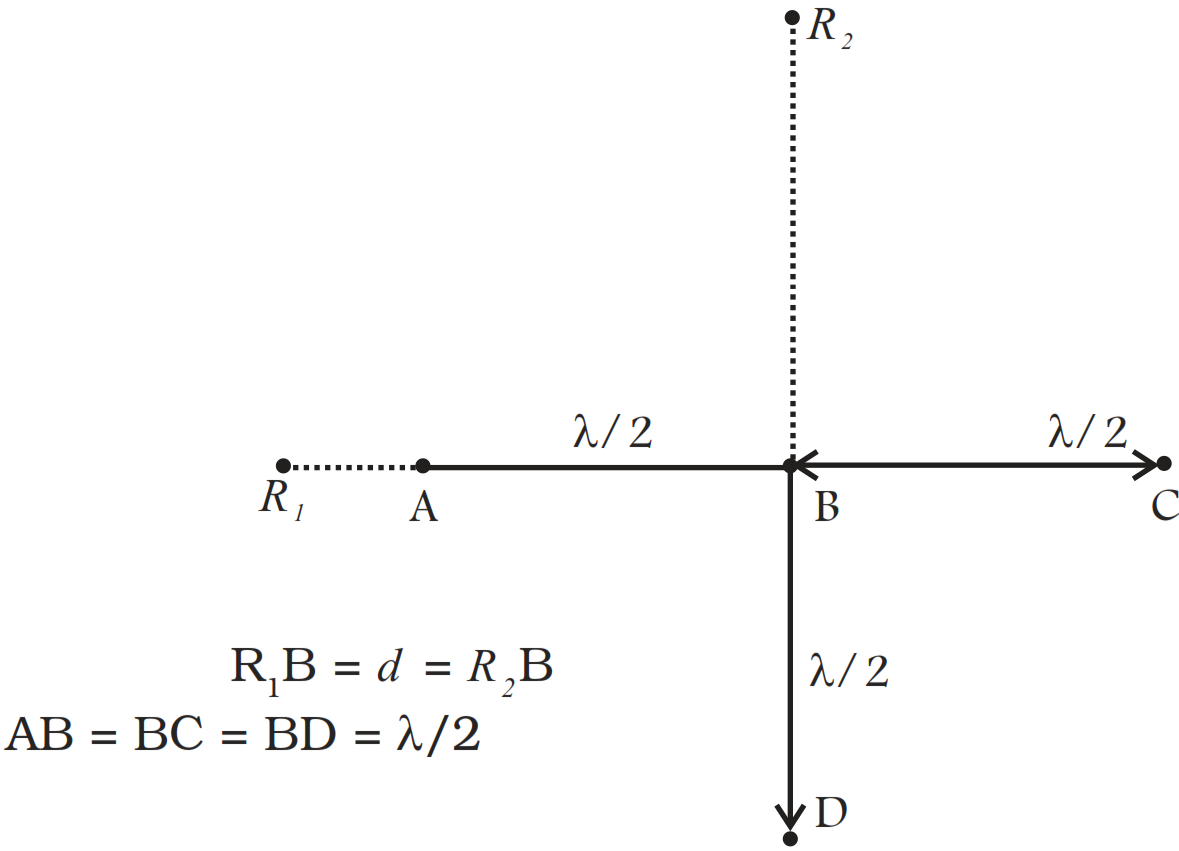
Four identical monochromatic sources $A,B,C,D$ as shown in the $($Fig.$)$ produce waves of the same wavelength $\lambda$ and are coherent. Two receiver $R_1$ and $R_2$ are at great but equal distaces from $B.$​​​​​​​
  1. Which of the two receivers picks up the larger signal?
  2. Which of the two receivers picks up the larger signal when $B$ is turned off?
  3. Which of the two receivers picks up the larger signal when $D$ is turned off?
  4. Which of the two receivers can distinguish which of the sources $B$ or $D$ has been turned off?
The frequency of vibration of a string depends on the length L between the nodes, the tension F in the string and its mass per unit length m. Guess the expression for its frequency from dimensional analysis.
A parallel beam of light of wavelength $100nm$ passes through a sample of atomic hydrogen gas in ground state. $(a)$ Assume that when a photon supplies some of its energy to a hydrogen atom, the rest of the energy appears as another photon. Neglecting the light emitted by the excited hydrogen atoms in the direction of the incident beam, what wavelengths may be observed in the transmitted beam? $(b)$ A radiation detector is placed near the gas to detect radiation coming perpendicular to the incident beam. Find the wavelengths of radiation that may be detected by the detector.
A town has a population of $1$ million. The average electric power needed per person is $300W.$ A reactor is to be designed to supply power to this town. The efficiency with which thermal power is converted into electric power is aimed at $25\%.$
  1. Assuming $200\ MeV$ to thermal energy to come from each fission event on an average, find the number of events that should take place every day.
  2. Assuming the fission to take place largely through $^{235}U,$ at what rate will the amount of $^{235}U$ decrease? Express your answer in kg per day.
  3. Assuming that uranium enriched to $3\%$ in $^{235}U$ will be used, how much uranium is needed per month $(30$ days$)?$
What are X-rays? If a X-ray tube is operated at V volt then prove that the minimum wavelength of X-rays emitted from the tube is given by: $\lambda_{min}=(12375/V)Å$
  1. Using the Bohr’s model calculate the speed of the electron in a hydrogen atom in the $n = 1, 2,$ and $3$ levels.
  2. Calculate the orbital period in each of these levels.