Question

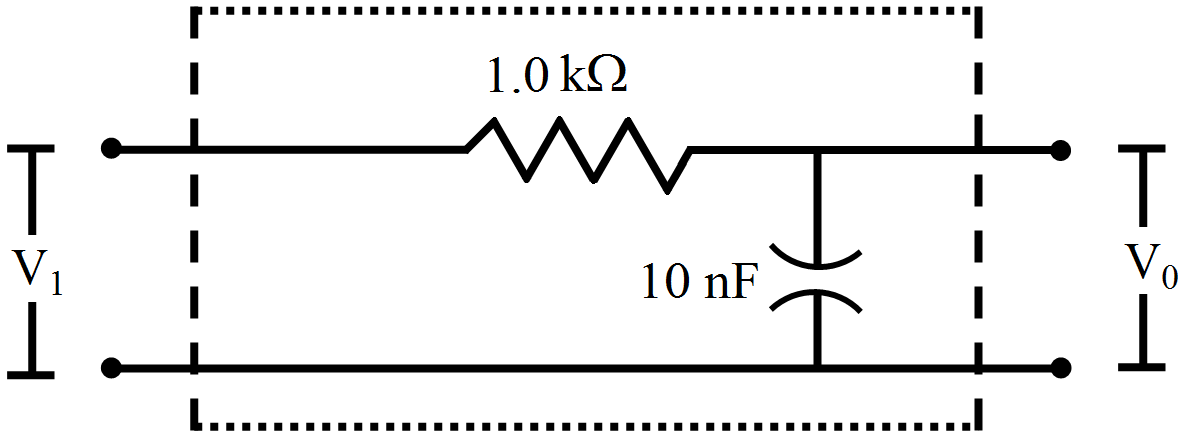
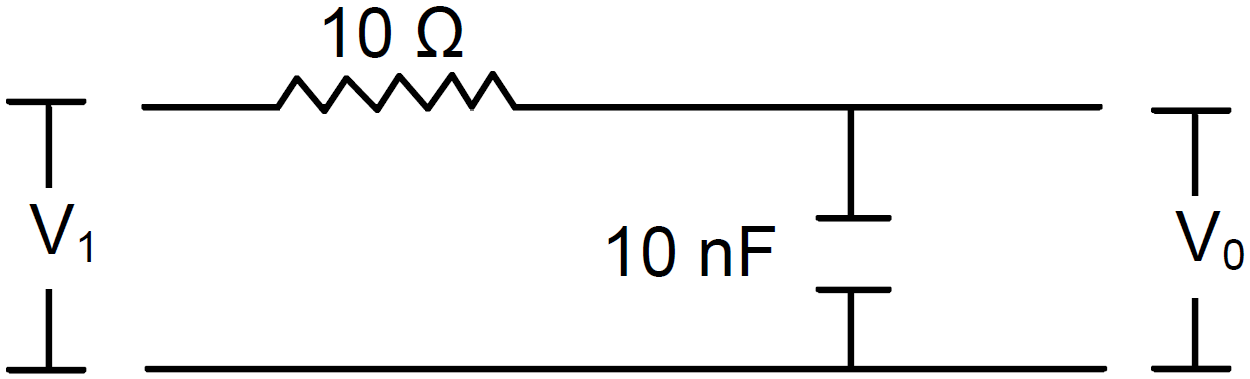
Figure shows a typical circuit for a low-pass filter. An AC input $V_{i }= 10mV$ is applied at the left end and the output $V_0$ is received at the right end. Find the output voltage for ν = 10kHz, 1.0MHz and 10.0MHz. Note that as the frequency is increased the output decreases and, hence, the name low-pass filter.
Answer


$\text{V}_1=10\times10^{-3}\text{V}$ $\text{R}=1\times10^3\Omega$ $\text{C}=10\times10^{-9}\text{F}$
  1. $\text{X}_\text{C}=\frac{1}{\omega\text{C}}=\frac{1}{2\pi\text{fC}}$
$=\frac{1}{2\pi\times10\times10^3\times10\times10^{-9}}$
$=\frac{1}{2\pi\times10^{-4}}$
$=\frac{10^4}{2\pi}=\frac{5000}{\pi}$
$\text{Z}=\sqrt{\text{R}^2+\text{X}_\text{C}{^2}}$
$=\sqrt{\big(1\times10^3\big)^2+\Big(\frac{5000}{\pi}\Big)^2}$
$=\sqrt{10^6+\Big(\frac{5000}{\pi}\Big)^2}$
$\text{I}_0=\frac{\text{E}_0}{\text{Z}}=\frac{\text{V}_1}{\text{Z}}$
$=\frac{10\times10^{-3}}{\sqrt{10^6+\Big(\frac{5000}{\pi}\Big)^2}}$
  1. $\text{X}_\text{C}=\frac{1}{\omega\text{C}}=\frac{1}{2\pi\text{fC}}$
$=\frac{1}{2\pi\times10^5\times10\times10^{-9}}$
$=\frac{1}{2\pi\times10^{-3}}=\frac{10^3}{2\pi}=\frac{500}{\pi}$
$\text{Z}=\sqrt{\text{R}^2+\text{X}_\text{C}{^2}}$
$=\sqrt{\big(10^3\big)^{2}+\Big(\frac{500}{\pi}\Big)^2}$
$=\sqrt{10^6+\Big(\frac{500}{\pi}\Big)^2}$
$\text{I}_0=\frac{\text{E}_0}{\text{Z}}=\frac{\text{V}_1}{\text{Z}}$
$=\frac{10\times10^{-3}}{\sqrt{10^6+\Big(\frac{500}{\pi}\Big)^2}}$
$\text{V}_0=\text{I}_0\text{X}_\text{C}=\frac{10\times10^{-3}}{\sqrt{10^6+\Big(\frac{500}{\pi}\Big)^2}}\times\frac{500}{\pi}$
$=1.6124\text{V}\approx1.6\text{mV}$
  1. $\text{f}=1\text{MHz}=10^6\text{Hz}$
$\text{X}_\text{C}=\frac{1}{\omega\text{C}}=\frac{1}{2\pi\text{fC}}$
$=\frac{1}{2\pi\times10^6\times10\times10^{-9}}$
$=\frac{1}{2\pi\times10^{-2}}=\frac{10^2}{2\pi}=\frac{50}{\pi}$
$\text{Z}=\sqrt{\text{R}^2+\text{X}_\text{C}{^2}}$
$=\sqrt{\big(10^3\big)^{2}+\Big(\frac{50}{\pi}\Big)^2}$
$=\sqrt{10^6+\Big(\frac{50}{\pi}\Big)^2}$
$\text{I}_0=\frac{\text{E}_0}{\text{Z}}=\frac{\text{V}_1}{\text{Z}}$
$=\frac{10\times10^{-3}}{\sqrt{10^6+\Big(\frac{50}{\pi}\Big)^2}}$
$\text{V}_0=\text{I}_0\text{X}_\text{C}=\frac{10\times10^{-3}}{\sqrt{10^6+\Big(\frac{50}{\pi}\Big)^2}}\times\frac{50}{\pi}$
$\approx1.16\mu\text{V}$
  1. $\text{f}=10\text{MHz}=10^7\text{Hz}$
$\text{X}_\text{C}=\frac{1}{\omega\text{C}}=\frac{1}{2\pi\text{fC}}$
$=\frac{1}{2\pi\times10^7\times10\times10^{-9}}$
$=\frac{1}{2\pi\times10^{-1}}=\frac{10}{2\pi}=\frac{5}{\pi}$
$\text{Z}=\sqrt{\text{R}^2+\text{X}_\text{C}{^2}}$
$=\sqrt{\big(10^3\big)^{2}+\Big(\frac{5}{\pi}\Big)^2}$
$=\sqrt{10^6+\Big(\frac{5}{\pi}\Big)^2}$
$\text{I}_0=\frac{\text{E}_0}{\text{Z}}=\frac{\text{V}_1}{\text{Z}}$
$=\frac{10\times10^{-3}}{\sqrt{10^6+\Big(\frac{5}{\pi}\Big)^2}}$
$\text{V}_0=\text{I}_0\text{X}_\text{C}=\frac{10\times10^{-3}}{\sqrt{10^6+\Big(\frac{5}{\pi}\Big)^2}}\times\frac{5}{\pi}$
$\approx16\mu\text{V}$

Need a full question paper?

Generate a complete, print-ready paper with questions like this in minutes — across 16+ boards, with answer keys.

Start Generating Free

Similar questions

A solenoid of length 1.0m, radius 1cm and total turns 1000 wound on it, carries a current of 5A. Calculate the magnitude of the axial magnetic field inside the solenoid. If an electron was to move with a speed of $104ms^{–1}$ along the axis of this current carrying solenoid, what would be the force experienced by this electron?
A vertical cylinder of height 100cm contains air at a constant temperature. The top is closed by a frictionless light piston. The atmospheric pressure is equal to 75cm of mercury. Mercury is slowly poured over the piston. Find the maximum height of the mercury column that can be put on the piston.
A resistor of $12 \Omega$, a capacitor of $14 \Omega$ reactance and a pure inductor of inductance 0.1 H are joined in series and an alternating current of 200 V, 50 Hz is joined with them. Compute: (i) current in the circuit and (ii) phase angle between current and the voltage (Take $\pi=3$ ).
Two parallel wires carry equal currents of 10A along the same direction and are separated by a distance of 2.0cm. Find the magnetic field at a point which is 2.0cm away from each of these wires
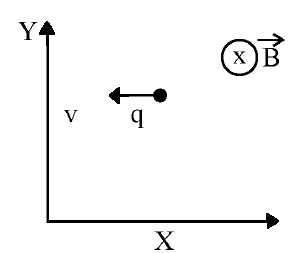
  1. A point charge q moving with speed v enters a uniform magnetic field B that is acting into the plane of the paper as shown. What is the path followed by the charge q and in which plane does it move?
  2. How does the path followed by the charge get affected if its velocity has a component parallel to $\overrightarrow{\text{B}}$?
  3. If an electric field $\overrightarrow{\text{E}}$ is also applied such that the particle continues moving along the original straight line path, what should be the magnitude and direction of the electric field $\overrightarrow{\text{E}}$?
In a single slit diffraction experiment, light of wavelength $\lambda$ illuminates the slit of width ‘a’ and the diffraction pattern is observed on a screen.
  1. Show the intensity distribution in the pattern with the angular position $\theta.$
  2. How are the intensity and angular width of central maxima affected when,
  1. Width of slit is increased,
  2. Separation between slit and screen is decreased?
Radioactive isotopes are produced in a nuclear physics experiment at a constant rate $\frac{\text{dN}}{\text{dt}}=\text{R}.$ An inductor of inductance 100mH, a resistor of resistance $100\Omega$ and a battery are connected to form a series circuit. The circuit is switched on at the instant the production of radioactive isotope starts. It is found that $\frac{\text{i}}{\text{N}}$ remains constant in time where i is the current in the circuit at time t and N is the number of active nuclei at time t. Find the half-life of the isotope.
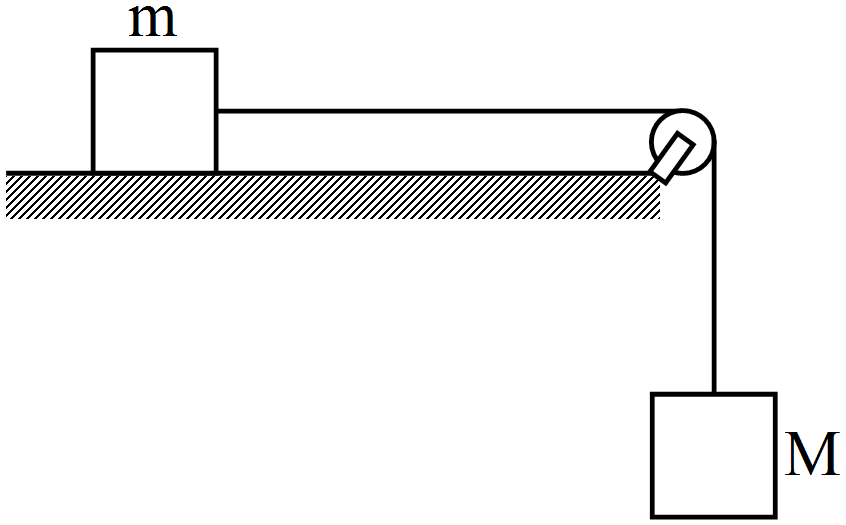
Figure shows two blocks of masses m and M connected by a string passing over a pulley. The horizontal table over which the mass m slides is smooth. The pulley has a radius r and moment of inertia I about its axis and it can freely rotate about this axis. Find the acceleration of the mass M assuming that the string does not slip on the pulley.
$a.$ Write the relationship between mobility and drift velocity in a current carrying conductor.
$b.$ Two aluminium wires have their lengths in the ratio $2 : 3$ and radii in the ratio $1 : 3.$ These are connected in parallel across a battery of emf $E$ and of negligible internal resistance. Find the ratio of drift velocities of the electrons in the two wires.
Find the energy, the frequency and the momentum of an X-ray photon of wavelength 0.10nm.