Question
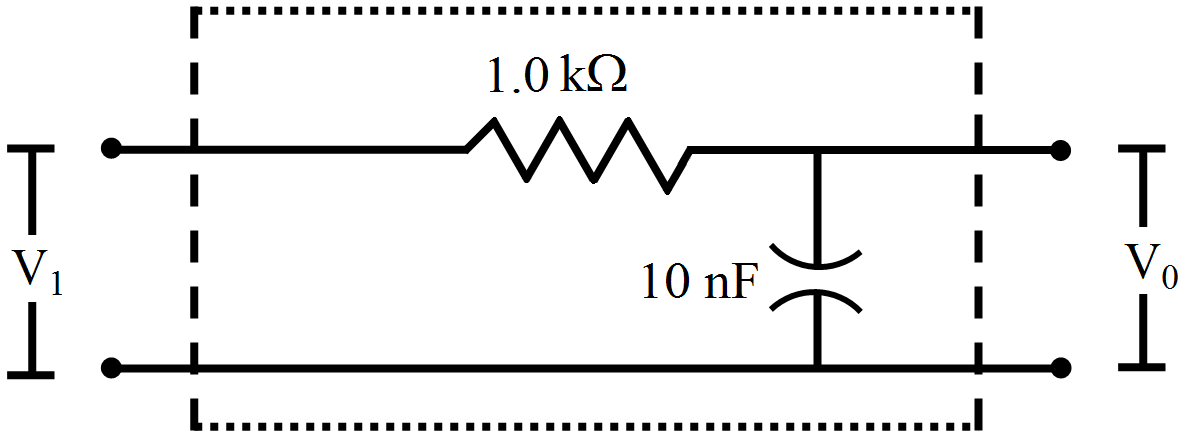
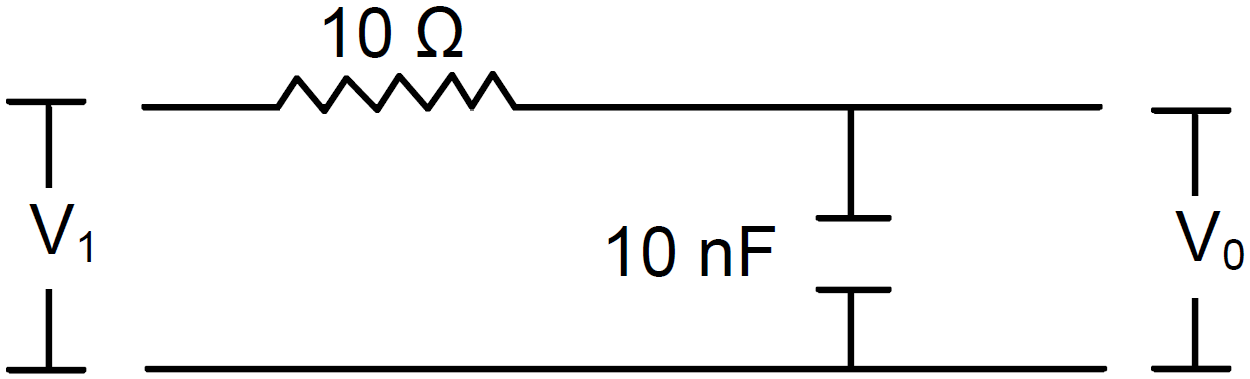
Figure shows a typical circuit for a low-pass filter. An AC input $V_{i }= 10mV$ is applied at the left end and the output $V_0$ is received at the right end. Find the output voltage for ν = 10kHz, 1.0MHz and 10.0MHz. Note that as the frequency is increased the output decreases and, hence, the name low-pass filter.
Answer


$\text{V}_1=10\times10^{-3}\text{V}$
$\text{R}=1\times10^3\Omega$
$\text{C}=10\times10^{-9}\text{F}$
  1. $\text{X}_\text{C}=\frac{1}{\omega\text{C}}=\frac{1}{2\pi\text{fC}}$
$=\frac{1}{2\pi\times10\times10^3\times10\times10^{-9}}$
$=\frac{1}{2\pi\times10^{-4}}$
$=\frac{10^4}{2\pi}=\frac{5000}{\pi}$
$\text{Z}=\sqrt{\text{R}^2+\text{X}_\text{C}{^2}}$
$=\sqrt{\big(1\times10^3\big)^2+\Big(\frac{5000}{\pi}\Big)^2}$

$=\sqrt{10^6+\Big(\frac{5000}{\pi}\Big)^2}$
$\text{I}_0=\frac{\text{E}_0}{\text{Z}}=\frac{\text{V}_1}{\text{Z}}$
$=\frac{10\times10^{-3}}{\sqrt{10^6+\Big(\frac{5000}{\pi}\Big)^2}}$
  1. $\text{X}_\text{C}=\frac{1}{\omega\text{C}}=\frac{1}{2\pi\text{fC}}$
$=\frac{1}{2\pi\times10^5\times10\times10^{-9}}$
$=\frac{1}{2\pi\times10^{-3}}=\frac{10^3}{2\pi}=\frac{500}{\pi}$
$\text{Z}=\sqrt{\text{R}^2+\text{X}_\text{C}{^2}}$
$=\sqrt{\big(10^3\big)^{2}+\Big(\frac{500}{\pi}\Big)^2}$
$=\sqrt{10^6+\Big(\frac{500}{\pi}\Big)^2}$
$\text{I}_0=\frac{\text{E}_0}{\text{Z}}=\frac{\text{V}_1}{\text{Z}}$
$=\frac{10\times10^{-3}}{\sqrt{10^6+\Big(\frac{500}{\pi}\Big)^2}}$
$\text{V}_0=\text{I}_0\text{X}_\text{C}=\frac{10\times10^{-3}}{\sqrt{10^6+\Big(\frac{500}{\pi}\Big)^2}}\times\frac{500}{\pi}$
$=1.6124\text{V}\approx1.6\text{mV}$
  1. $\text{f}=1\text{MHz}=10^6\text{Hz}$
$\text{X}_\text{C}=\frac{1}{\omega\text{C}}=\frac{1}{2\pi\text{fC}}$
$=\frac{1}{2\pi\times10^6\times10\times10^{-9}}$
$=\frac{1}{2\pi\times10^{-2}}=\frac{10^2}{2\pi}=\frac{50}{\pi}$
$\text{Z}=\sqrt{\text{R}^2+\text{X}_\text{C}{^2}}$
$=\sqrt{\big(10^3\big)^{2}+\Big(\frac{50}{\pi}\Big)^2}$
$=\sqrt{10^6+\Big(\frac{50}{\pi}\Big)^2}$
$\text{I}_0=\frac{\text{E}_0}{\text{Z}}=\frac{\text{V}_1}{\text{Z}}$
$=\frac{10\times10^{-3}}{\sqrt{10^6+\Big(\frac{50}{\pi}\Big)^2}}$
$\text{V}_0=\text{I}_0\text{X}_\text{C}=\frac{10\times10^{-3}}{\sqrt{10^6+\Big(\frac{50}{\pi}\Big)^2}}\times\frac{50}{\pi}$
$\approx1.16\mu\text{V}$
  1. $\text{f}=10\text{MHz}=10^7\text{Hz}$
$\text{X}_\text{C}=\frac{1}{\omega\text{C}}=\frac{1}{2\pi\text{fC}}$
$=\frac{1}{2\pi\times10^7\times10\times10^{-9}}$
$=\frac{1}{2\pi\times10^{-1}}=\frac{10}{2\pi}=\frac{5}{\pi}$
$\text{Z}=\sqrt{\text{R}^2+\text{X}_\text{C}{^2}}$
$=\sqrt{\big(10^3\big)^{2}+\Big(\frac{5}{\pi}\Big)^2}$
$=\sqrt{10^6+\Big(\frac{5}{\pi}\Big)^2}$
$\text{I}_0=\frac{\text{E}_0}{\text{Z}}=\frac{\text{V}_1}{\text{Z}}$
$=\frac{10\times10^{-3}}{\sqrt{10^6+\Big(\frac{5}{\pi}\Big)^2}}$
$\text{V}_0=\text{I}_0\text{X}_\text{C}=\frac{10\times10^{-3}}{\sqrt{10^6+\Big(\frac{5}{\pi}\Big)^2}}\times\frac{5}{\pi}$
$\approx16\mu\text{V}$

Need a full question paper?

Generate a complete, print-ready paper with questions like this in minutes — across 16+ boards, with answer keys.

Start Generating Free

Similar questions

A potential difference V is applied across a conductor of length L and diameter D. How is the drift velocity, $V_d,$ of charge carriers in the conductor affected when (i) V is halved, (ii) L is doubled and (iii) D is halved? Justify your answer in each case.
A hypothetical magnetic field existing in a region is given by $\overrightarrow{\text{B}}=\text{B}_0\overrightarrow{\text{e}}_\text{r},$ where $\overrightarrow{\text{e}}_\text{r}$ denotes the unit vector along the radial direction. A circular loop of radius a, carrying a current i, is placed with its plane parallel to the x-y plane and the centre at (0, 0, d). Find the magnitude of the magnetic force acting on the loop.
Consider two conducting spheres of radii $R_1$ and $R_2$ with $R_1 > R_2$. If the two are at the same potential, the larger sphere has more charge than the smaller sphere. State whether the charge density of the smaller sphere is more or less than that of the larger one.
  1. State two important features of Einstein's photoelectric equation.
  2. Radiation of frequency $10^{15}\ Hz$ is incident on two photosensitive surface P and Q. There is no photoemission from surface P. Photoemission occurs from surface Q but photoelectrons have zero kinetic energy. Explain these observations and find the value of work function for surface Q.
A circular coil of wire consisting of 100 turns, each of radius 8.0 cm carries a current of 0.40 A. What is the magnitude of the magnetic field B at the centre of the coil?
A transverse wave described by$\text{y}=(0.02\text{m})\sin\Big[(1.0\text{m}^{-1})\text{x}+(30\text{s}^{-1})\text{t}\Big]$
propagates on a stretched string having a linear mass density of $1.2 \times 10^{-4}kg/m$. Find the tension in the string.
What is the effect on the interference fringes in Young’s double slit experiment due to each of the following operations? Justify your answers.
  1. The screen is moved away from the plane of the slits.
  2. The separation between slits is increased.
  3. The source slit is moved closer to the plane of double slit.
Why are the magnification properties of microscopes and telescopes defined in terms of the ratio of angles and not in terms of the ratio of sizes of objects and images?
If the operating potential in an X-ray tube is increased by 1%, by what percentage does the cutoff wavelength decrease?
A 12.3 eV electron beam is used to bombard gaseous hydrogen at room temperature. Upto which energy level the hydrogen atoms would be excited?
Calculate the wavelengths of the second member of Lyman series and second member of Balmer series.