Question
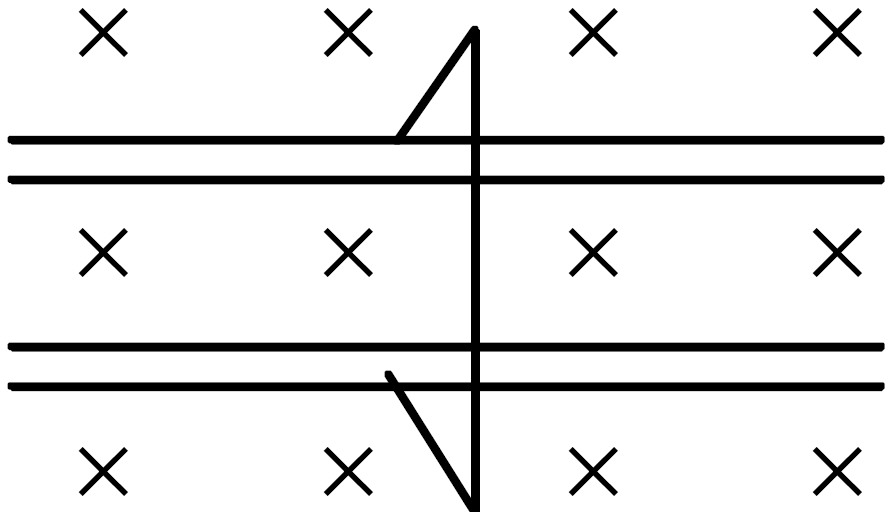
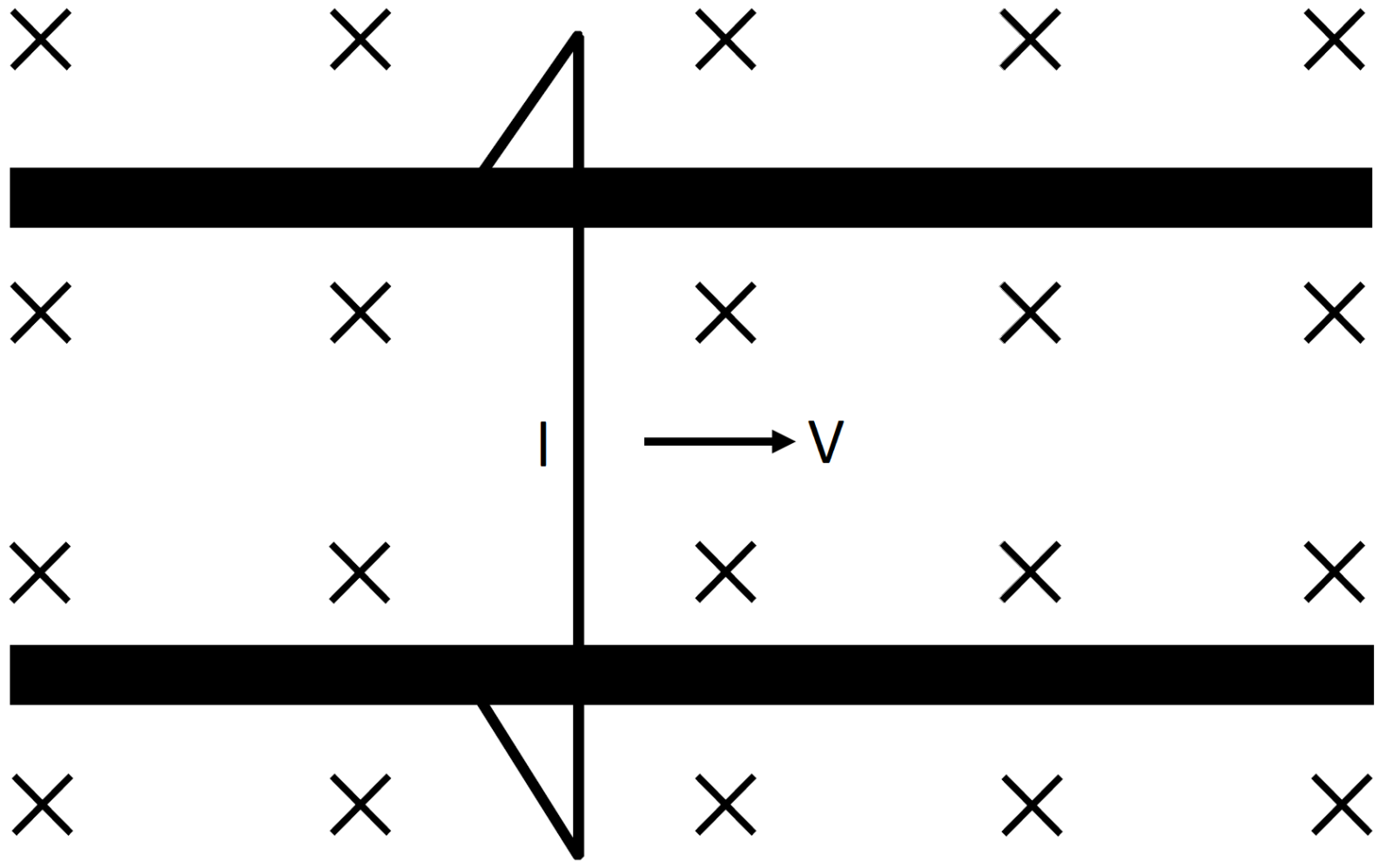
Figure shows a wire sliding on two parallel, conducting rails placed at a separation l. A magnetic field B exists in a direction perpendicular to the plane of the rails. What force is necessary to keep the wire moving at a constant velocity v?
Answer


Fmagnetic = ilB
This force produces an acceleration of the wire.
But since the velocity is given to be constant.
Hence net force acting on the wire must be zero.

Need a full question paper?

Generate a complete, print-ready paper with questions like this in minutes — across 16+ boards, with answer keys.

Start Generating Free

Similar questions

State factors on which coefficient of mutualinductance between two coils depend.
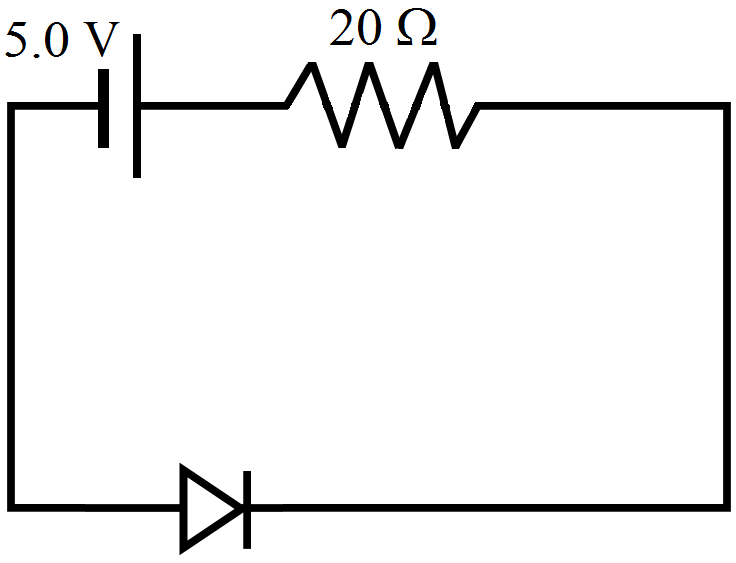
Calculate the current through the circuit and the potential difference across the diode shown in figure. The drift current for the diode is $20\mu\text{A}.$

When n capacitors of capacitance C are connected in series, the equivalence is $C _s$ and when connected in parallel, the equivalence is $C _p$. Prove that $C _{ P }- C _{ S }=\frac{\left(n^2-1\right) C }{n}$
A ray of light, incident on an equilateral glass prism$(\mu_{g} = \sqrt{3})$ moves parallel to the base line of the prism inside it. Find the angle of incidence for this ray.
Write a note on equipotential surface.
Calculate the shortest wavelength of the spectral lines emitted in Balmer series.

[Give Rydberg constant, R = 10m-1]

Complete the following decay schemes.
  1. $\text{ }^{226}_{88}\text{Ra}\rightarrow\alpha+$
  2. $\text{ }^{19}_8\text{O}\rightarrow\text{ }^{19}_9\text{F}+$
  3. $\text{ }^{25}_{13}\text{Al}\rightarrow\text{ }^{25}_{12}\text{Mg}+$
In order to have a current in a long wire, it should be connected to a battery or some such device. Can we obtain the magnetic due to a straight, long wire by using Ampere's law without mentioning this other part of the circuit?
The electric current in a charging R-C circuit is given by $\text{i}=\text{i}_0\text{e}^{-\frac{\text{t}}{\text{RC}}}$ where $\text{i}_0,$ R and C are constant parameters of the circuit and t is time. Find the rate of change of current at
  1. t = 0.
  2. t = RC.
  3. t = 10RC.
No interference pattern is detected when two coherent sources are infinitely close to each other. Why?