MCQ
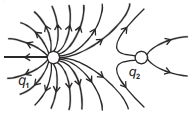
Figure shows electric field lines due to a charge configuration, from this we conclude that
  • A
    $q_1$ and $q_2$ are positive and $q_2 > q_1$
  • $q_1$ and $q_2$ are positive and $q_1 > q_2$
  • C
    $q_1$ and $q_2$ are negative and $\left|q_1\right| > \left|q_2\right|$
  • D
    $q_1$ and $q_2$ are negative and $\left|q_2\right| > \left|q_1\right|$

Answer

Correct option: B.
$q_1$ and $q_2$ are positive and $q_1 > q_2$
b
(b)

$(i)$ Electric field lines originates from positive charge.

$(ii)$ Higher the number of field lines originating from positive charge, greater is magnitude of charge.

Need a full question paper?

Generate a complete, print-ready paper with questions like this in minutes — across 16+ boards, with answer keys.

Start Generating Free

Similar questions

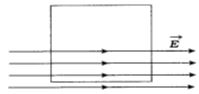
A square surface of side $L$ metres is in the plane of the paper. A uniform electric field $\vec E(V/m) $, also in the plane of the paper, is limited only to the lower half of the square surface, (see figure). The electric flux in SI units associated with the surface is
A $1.5 \,kW$ laser beam of wavelength $6400 \,\mathring A$ is used to levitate a thin aluminium disc of same area as the cross-section of the beam. The laser light is reflected by the aluminium disc without any absorption. The mass of the foil is close to ......... $kg$
$64$ drops each having the capacity $C$ and potential $V$ are combined to form a big drop. If the charge on the small drop is $q$, then the charge on the big drop will be
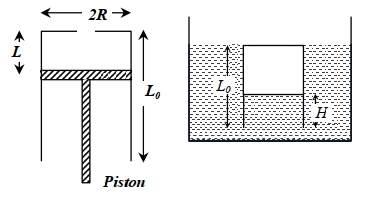
A fixed thermally conducting cylinder has a radius $\mathrm{R}$ and height $\mathrm{L}_0$. The cylinder is open at its bottom and has a small hole at its top. A piston of mass $M$ is held at a distance $L$ from the top surface, as shown in the figure. The atmospheric pressure is $\mathrm{P}_0$.

$1.$  The piston is now pulled out slowly and held at a distance $2 \mathrm{~L}$ from the top. The pressure in the cylinder between its top and the piston will then be

$(A)$ $\mathrm{P}_0$ $(B)$ $\frac{\mathrm{P}_0}{2}$  $(C)$ $\frac{P_0}{2}+\frac{M g}{\pi R^2}$  $(D)$ $\frac{\mathrm{P}_0}{2}-\frac{\mathrm{Mg}}{\pi \mathrm{R}^2}$

$2.$  While the piston is at a distance $2 \mathrm{~L}$ from the top, the hole at the top is sealed. The piston is then released, to a position where it can stay in equilibrium. In this condition, the distance of the piston from the top is

$(A)$ $\left(\frac{2 \mathrm{P}_0 \pi \mathrm{R}^2}{\pi \mathrm{R}^2 \mathrm{P}_0+\mathrm{Mg}}\right)(2 \mathrm{~L})$  $(B)$ $\left(\frac{\mathrm{P}_0 \pi R^2-\mathrm{Mg}}{\pi R^2 \mathrm{P}_0}\right)(2 \mathrm{~L})$ 

$(C)$ $\left(\frac{\mathrm{P}_0 \pi \mathrm{R}^2+\mathrm{Mg}}{\pi \mathrm{R}^2 \mathrm{P}_0}\right)(2 \mathrm{~L})$  $(D)$ $\left(\frac{\mathrm{P}_0 \pi \mathrm{R}^2}{\pi \mathrm{R}^2 \mathrm{P}_0-\mathrm{Mg}}\right)(2 \mathrm{~L})$

$3.$  The piston is taken completely out of the cylinder. The hole at the top is sealed. A water tank is brought below the cylinder and put in a position so that the water surface in the tank is at the same level as the top of the cylinder as shown in the figure. The density of the water is $\rho$. In equilibrium, the height $\mathrm{H}$ of the water column in the cylinder satisfies

$(A)$ $\rho g\left(\mathrm{~L}_0-\mathrm{H}\right)^2+\mathrm{P}_0\left(\mathrm{~L}_0-\mathrm{H}\right)+\mathrm{L}_0 \mathrm{P}_0=0$

$(B)$ $\rho \mathrm{g}\left(\mathrm{L}_0-\mathrm{H}\right)^2-\mathrm{P}_0\left(\mathrm{~L}_0-\mathrm{H}\right)-\mathrm{L}_0 \mathrm{P}_0=0$

$(C)$ $\rho g\left(\mathrm{~L}_0-\mathrm{H}\right)^2+\mathrm{P}_0\left(\mathrm{~L}_0-\mathrm{H}\right)-\mathrm{L}_0 \mathrm{P}_0=0$

$(D)$ $\rho \mathrm{g}\left(\mathrm{L}_0-\mathrm{H}\right)^2-\mathrm{P}_0\left(\mathrm{~L}_0-\mathrm{H}\right)+\mathrm{L}_0 \mathrm{P}_0=0$

Give the answer question $1,2$ and $3.$
The $r.m.s.$ current in an ac circuit is $2 A$. If the wattless current be $\sqrt 3 A$, what is the power factor
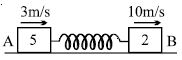
Two blocks $A(5kg)$ and  $B(2kg)$ attached to the ends of a spring constant $1120N/m$ are placed on a smooth horizontal plane with the spring undeformed. Simultaneously velocities of $3m/s$ and $10m/s$ along the line of the spring in the same direction are imparted to $A$ and $B$ then
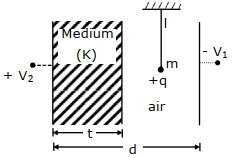
A simple pendulum of mass $'m',$ length $'I'$ and charge $'+q'$ suspended in the electric field produced by two conducting parallel plates as shown. The value of deflection of pendulum in equilibrium position will be -
The work done in blowing a soap bubble of radius $0.2\, m$ is (the surface tension of soap solution being $0.06\, N/m$)
A charge of $5\,C$ experiences a force of $5000\,N$ when it is kept in a uniform electric field. .........$V$ is the potential difference between two points separated by a distance of $1\,cm$
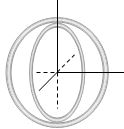
Two insulated rings, one of slightly smaller diameter than the other are suspended along their common diameter as shown. Initially the planes of the rings are mutually perpendicular. When a steady current is set up in each of them