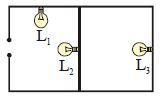
Figure shows three similar lamp. $L_1,L_2$ and $L_3$ connected across a power supply. If the lamp $L_3$ fuses, how will the light emitted by $L_1$ and $L_2$ change ?
Easy


Download our appand get started for free
Experience the future of education. Simply download our apps or reach out to us for more information. Let's shape the future of learning together!No signup needed.*
Similar Questions
- 1An electric kettle takes $4\, A$ current at $220\,V.$ How much time will it take to boil $1\,\, kg$ of water circuits are consequences of from temperature $20\,^o C\, ?$ The temperature of $(a)$ conservation of energy and electric charge boiling water is $100\,^o C.$ ............... $min$View Solution
- 2Two resistors are connected $(a)$ in series $(b)$ in parallel. The equivalent resistance in the two cases are $9$ $ohm$ and $2$ $ohm$ respectively. Then the resistances of the component resistors areView Solution
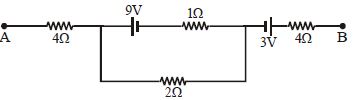
- 3In the circuit shown in figure, potential difference between points $A$ and $B$ is $16\, V$. The current passing through $2\,\Omega $ resistance will be ................. $\mathrm{A}$View Solution
- 4Two coils require $20$ minutes and $60$ minutes respectively to produce same amount of heat energy when connected separately to the same source. If they are connected in parallel arrangement to the same source; the time required to produce same amount of heat by the combination of coils, will be________ $min$View Solution
- 5The current density in a cylindrical wire of radius $4 \; mm$ is $4 \times 10^{6} \; Am ^{-2}$. The current through the outer portion of the wire between radial distance $\frac{R}{2}$ and $R$ is $\dots \; \pi A .$View Solution
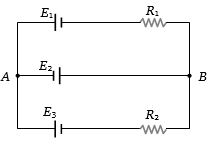
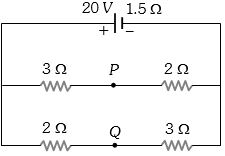
- 6If in the circuit shown below, the internal resistance of the battery is $1.5$ $\Omega$ and $V_P$ and $V_Q$ are the potentials at $P$ and $Q$ respectively, what is the potential difference between the points $P$ and $Q$View Solution
- 7In an electrolyte $3.2 \times {10^{18}}$ bivalent positive ions drift to the right per second while $3.6 \times {10^{18}}$ monovalent negative ions drift to the left per second. Then the current isView Solution
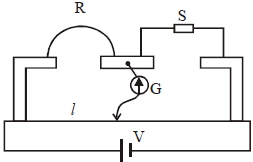
- 8In a meter bridge experiment $\mathrm{S}$ is a standard resistance. $\mathrm{R}$ is a resistance wire. It is found that balancing length is $l=25 \;\mathrm{cm} .$ If $\mathrm{R}$ is replaced by a wire of half length and half diameter that of $\mathrm{R}$ of same material, then the balancing distance $\left.l^{\prime} \text { (in } \mathrm{cm}\right)$ will now beView Solution
- 9View SolutionAssertion : An electric bulb becomes dim, when the electric heater in parallel circuit is switched on.
Reason : Dimness decreases after sometime.
- 10In the circuit shown here, $E_1 = E_2 = E_3 = 2 V$ and $R_1 = R_2 = 4\,ohms$. The current flowing between points $A$ and $B$ through battery $E_2$ isView Solution