Question
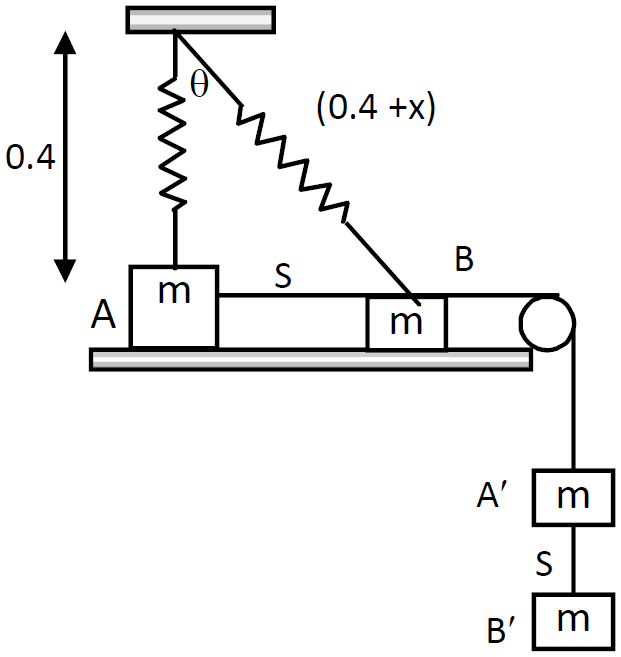
Figure shows two blocks A and B, each having a mass of $320g$ connected by a light string passing over a smooth light pulley. The horizontal surface on which the block A can slide is smooth. The block A is attached to a spring of spring constant $40N/m$ whose other end is fixed to a support $40cm$ above the horizontal surface. Initially, the spring is vertical and unstretched when the system is released to move. Find the velocity of the block A at the instant it breaks off the surface below it. Take $g = 10m/s^2$.
Answer

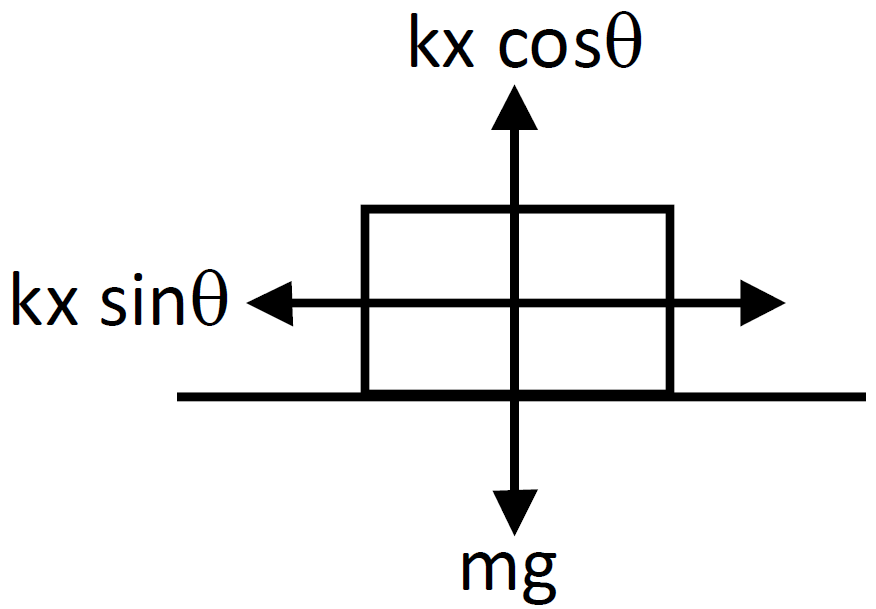
$m = 320g = 0.32kg, k = 40N/m h = 40cm = 0.4m, g = 10 m/s^2$ From the free body diagram,


$\text{kx}\cos\theta=\text{mg}$ (when the block breaks off R = 0) $\Rightarrow\cos\theta=\frac{\text{mg}}{\text{kx}}$ So, $\frac{0.4}{0.4+\text{x}}=\frac{3.2}{40+\text{x}}$
$\Rightarrow16\text{x}=3.2\text{x}+1.28$
$\Rightarrow\text{x}=0.1\text{m}$ So, $\text{s}=\text{AB}$
$\Rightarrow\sqrt{(\text{h}+\text{x})^2-\text{h}^2}$
$\Rightarrow\sqrt{(0.5)^2-(0.4)^2}=0.3\text{m}$ Let the velocity of the body at B be v, Charge in K.E. = work done (for the system) $\Big(\frac{1}{2}\text{mv}^2+\frac{1}{2}\text{mv}^2\Big)=\frac{-1}{2}\text{kx}^2+\text{mgs}$
$\Rightarrow(0.32)\times\text{v}^2=-\Big(\frac{1}{2}\Big)\times40\times(0.1)^2+0.32\times10\times(0.3)$
$\Rightarrow\text{v}=1.5\text{m}/\text{sec}$

Need a full question paper?

Generate a complete, print-ready paper with questions like this in minutes — across 16+ boards, with answer keys.

Start Generating Free

Similar questions

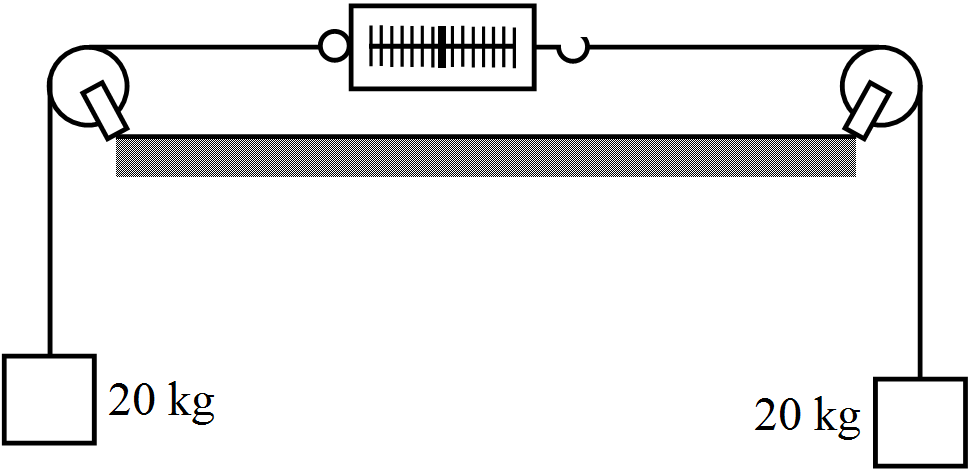
Figure shows a light spring balance connected to two blocks of mass 20kg each. The graduations in the balance measure the tension in the spring.
  1. What is the reading of the balance?
  2. Will the reading change if the balance is heavy, say 2.0kg?
  3. What will happen if the spring is light but the blocks have unequal masses?
An ornament weighing $36g$ in air, weighs only $34g$ in water. Assuming that some copper is mixed with gold to prepare the ornament, find the amount of copper in it. Specific gravity of gold is $19.3$ and that of copper is $8.9$.
Establish the following vector inequalities geometrically or otherwise: $|\text{a}-\text{b}|\ge||\text{a}|-|\text{b}||$When does the equality sign above apply?
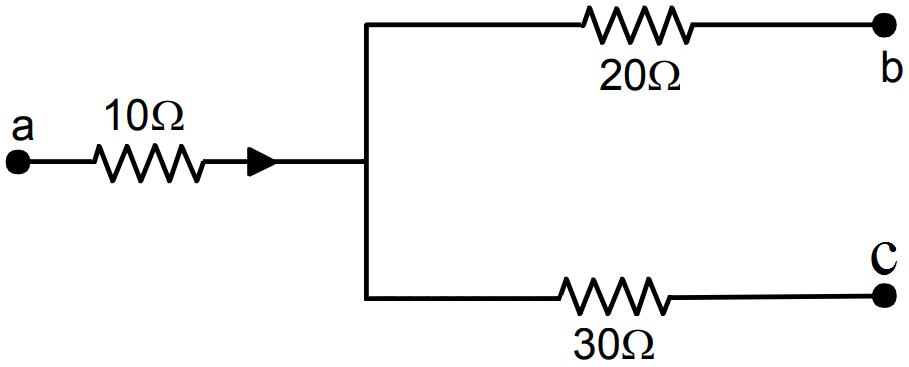
Figure. showa a part of an electric circuit. The potentials at the point a, b and c are 30V, 12V and 2V respectively. Find the currents through the three resistors.
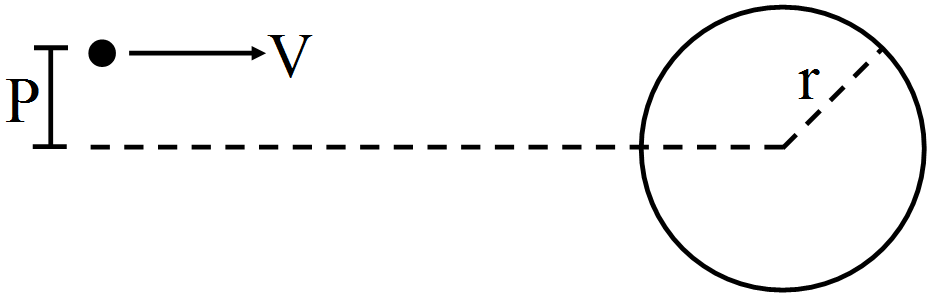
A small particle travelling with a velocity u collides elastically with a spherical body of equal mass and of radius r initially kept at rest. The centre of this spherical body is located a distance (p < r) away from the direction of motion of the particle. Find the final velocities of the two particles. [Hint: The force acts along the normal to the sphere through the contact. Treat the collision as onedimensional for this direction. In the tangential direction no force acts and the velocities do not change].
For the wave described in Exercise 15.8, plot the displacement (y) versus (t) graphs for x = 0, 2 and 4cm. What are the shapes of these graphs? In which aspects does the oscillatory motion in travelling wave differ from one point to another: amplitude, frequency or phase?
Describe the method of determining coefficient of viscosity.
An electron of kinetic energy 100eV circulates in a path of radius 10cm in a magnetic field. Find the magnetic field and the number of revolutions per second made by the electron.
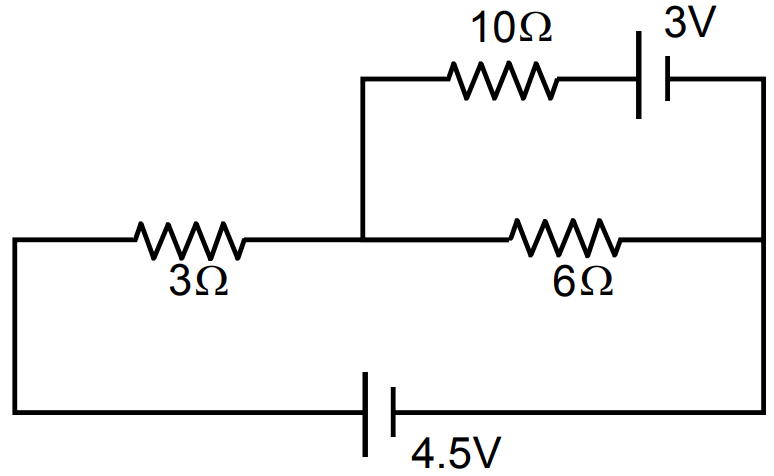
Find the current through the $10\Omega$ resistor shown in figure.
At what temperature is the root mean square speed of an atom in an argon gas cylinder equal to the rms speed of a helium gas atom at$-20°C$? (atomic mass of $Ar = 39.9u,$ of $He = 4.0u$).