Question
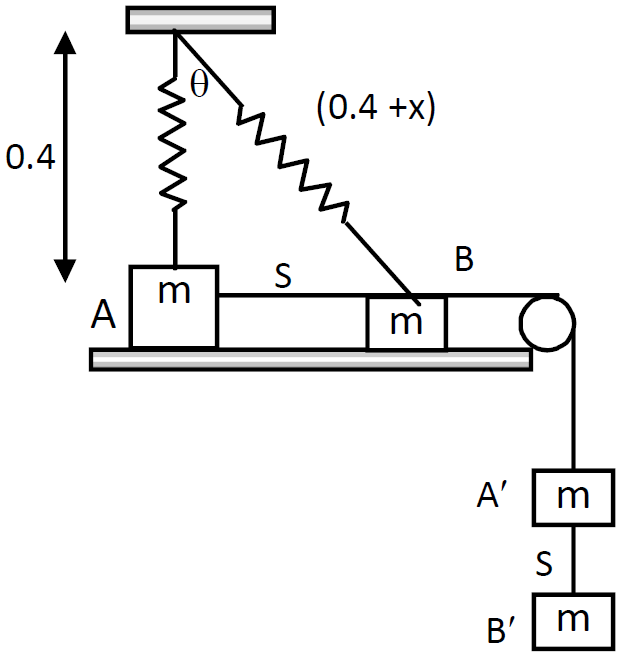
Figure shows two blocks A and B, each having a mass of 320g connected by a light string passing over a smooth light pulley. The horizontal surface on which the block A can slide is smooth. The block A is attached to a spring of spring constant 40N/m whose other end is fixed to a support 40cm above the horizontal surface. Initially, the spring is vertical and unstretched when the system is released to move. Find the velocity of the block A at the instant it breaks off the surface below it. Take g = 10m/s2.
Answer

m = 320g = 0.32kg, k = 40N/m

h = 40cm = 0.4m, g = 10 m/s2

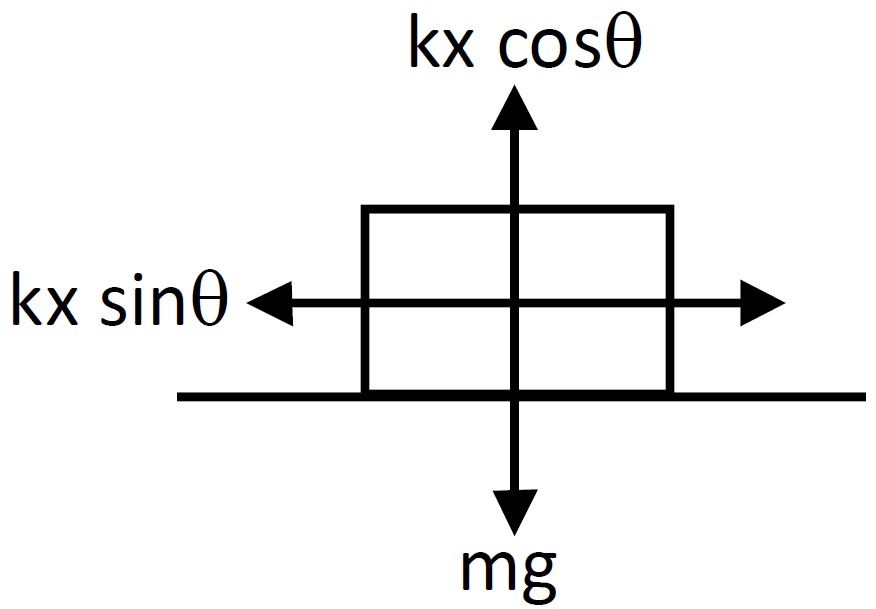
From the free body diagram,

$\text{kx}\cos\theta=\text{mg}$

(when the block breaks off R = 0)

$\Rightarrow\cos\theta=\frac{\text{mg}}{\text{kx}}$

So, $\frac{0.4}{0.4+\text{x}}=\frac{3.2}{40+\text{x}}$

$\Rightarrow16\text{x}=3.2\text{x}+1.28$

$\Rightarrow\text{x}=0.1\text{m}$

So, $\text{s}=\text{AB}$

$\Rightarrow\sqrt{(\text{h}+\text{x})^2-\text{h}^2}$

$\Rightarrow\sqrt{(0.5)^2-(0.4)^2}=0.3\text{m}$

Let the velocity of the body at B be v,

Charge in K.E. = work done (for the system)

$\Big(\frac{1}{2}\text{mv}^2+\frac{1}{2}\text{mv}^2\Big)=\frac{-1}{2}\text{kx}^2+\text{mgs}$

$\Rightarrow(0.32)\times\text{v}^2=-\Big(\frac{1}{2}\Big)\times40\times(0.1)^2+0.32\times10\times(0.3)$

$\Rightarrow\text{v}=1.5\text{m}/\text{sec}$

Need a full question paper?

Generate a complete, print-ready paper with questions like this in minutes — across 16+ boards, with answer keys.

Start Generating Free

Similar questions

The left end of a copper rod (length = 20cm area of cross section = 0.20cm) is maintained at 20°C and the right end is maintained at 80°C. Neglecting any loss of heat through radiation, find,
  1. The temperature at a point 11cm from the left end
  2. The heat current through the rod. Thermal conductivity of copper $=385\text{Wm}^{-1}{^{\circ}}\text{C}^{-1}.$
A particle of mass m is kept on the top of a smooth sphere of radius R. It is given a sharp impulse which imparts it a horizontal speed v.
  1. Find the normal force between the sphere and the particle just after the impulse.
  2. What should be the minimum value of v for which the particle does not slip on the sphere?
  3. Assuming the velocity v to be half the minimum calculated in part.
  4. Find the angle made by the radius through the particle with the vertical when it leaves the sphere.

Ten small planes are flying at a speed of 150km/h in total darkness in an air space that is 20 × 20 × 1.5km 3 in volume. You are in one of the planes, flying at random within this space with no way of knowing where the other planes are. On the average about how long a time will elapse between near collision with your plane. Assume for this rough computation that a safety region around the plane can be approximated by a sphere of radius 10m.
Find the total energy of the particle executing S.H.M. and show graphically the variation of P.E. and K.E. with time in S.H.M. What is the frequency of these energies with respect to the frequency of the particle executing S.H.M?
An air bubble of volume 1.0cm3 rises from the bottom of a lake 40m deep at a temperature of 12°C. To what volume does it grow when it reaches the surface, which is at a temperature of 35°C?
A rod, when suspended in a magnetic field, stays in the east-west direction. Can we be sure that the field is in the east-west direction? Can it be in the north-south direction?
A billard ball A moving with an initial speed of 1ms-1 undergoes a perfectly elastic collision with another identical ball B at rest. A is scattered through an angle of 30°. What is the angle of recoil of B? What is the speed of ball A after the collision?
The force of buoyancy exerted by the atmosphere on a balloon is B in the upward direction and remains constant. The force of air resistance on the balloon acts opposite to the direction of velocity and is proportional to it. The balloon carries a mass M and is found to fall down near the earth's surface with a constant velocity v. How much mass should be removed from the balloon so that it may rise with a constant velocity v?
A famous relation in physics relates ‘moving mass’ m to the ‘rest mass’ mo of a particle in terms of its speed v and the speed of light, c. (This relation first arose as a consequence of special relativity due to Albert Einstein). A boy recalls the relation almost correctly but forgets where to put the constant c. He writes:

$\text{m}=\frac{\text{m}_0}{(1-\text{v}^2)^{1/2}}.$

Guess where to put the missing c.

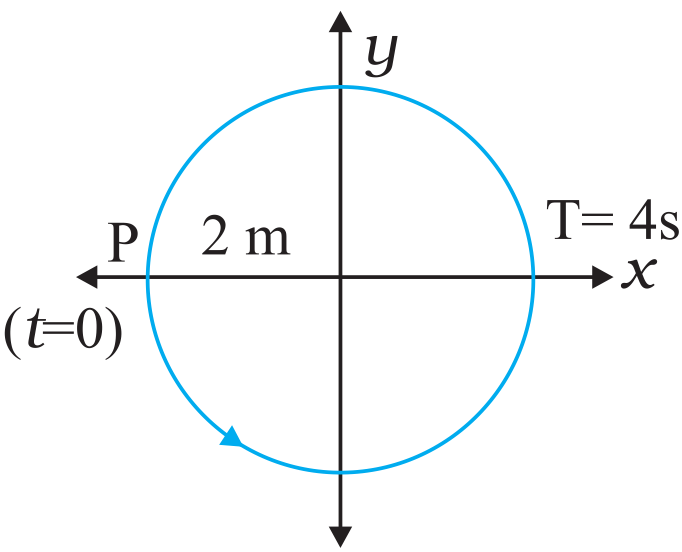
Figures correspond to two circular motions. The radius of the circle, the period of revolution, the initial position, and the sense of revolution (i.e. clockwise or anti-clockwise) are indicated on each figure.

Obtain the corresponding simple harmonic motions of the x-projection of the radius vector of the revolving particle P, in each case.