Question
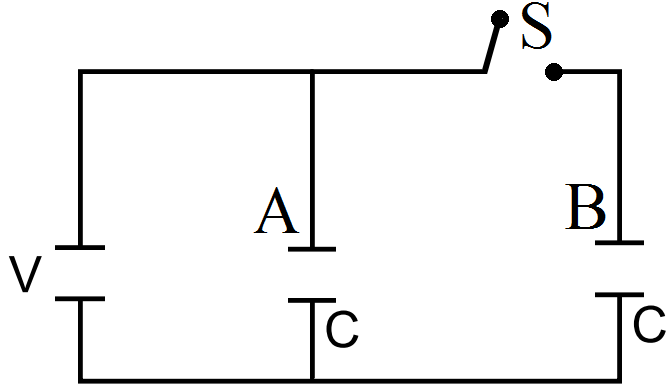
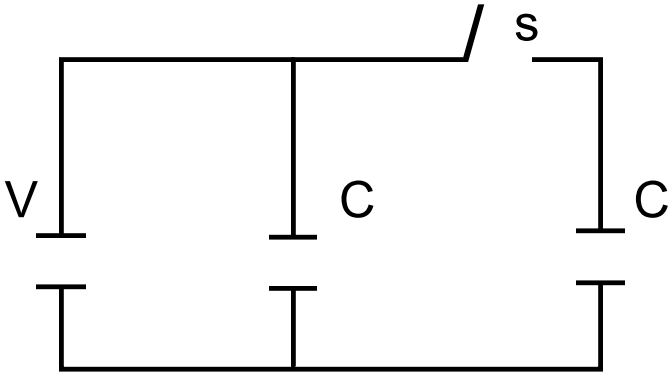
Figure shows two identical parallel plate capacitors connected to a battery through a switch S. Initially, the switch is closed so that the capacitors are completely charged. The switch is now opened and the free space between the plates of the capacitors is filled with a dielectric of dielectric constant 3. Find the ratio of the initial total energy stored in the capacitors to the final total energy stored.
Answer


Initially when switch ‘s’ is closed
Total Initial Energy $=\Big(\frac{1}{2}\Big)\text{CV}^2+\Big(\frac{1}{2}\Big)\text{CV}^2=\text{CV}^2\ \dots(1)$
When switch is open the capacitance in each of capacitors varies, hence the energy also varies.
i.e. in case of ‘B’, the charge remains.
Same i.e. cv
$\text{C}_{\text{eff}}=3\text{C}$
$\text{E}=\frac{1}{2}\times\frac{\text{q}^2}{\text{c}}$
$=\frac{1}{2}\times\frac{\text{c}^2\text{v}^2}{3\text{c}}=\frac{\text{cv}^2}{6}$
In case of 'A'
$\text{C}_{\text{eff}}=3\text{c}$
$\text{E}=\frac{1}{2}\times\text{C}_{\text{eff}}\text{v}^2$
$=\frac{1}{2}\times\text{3c}\times\text{v}^2=\frac{3}{2}\text{cv}^2$
Total final energy $=\frac{\text{cv}^2}{6}+\frac{3\text{cv}^2}{2}=\frac{10\text{cv}^2}{6}$
Now, $\frac{\text{Initial Energy}}{\text{Final Energy}}=\frac{\text{cv}^2}{\frac{10\text{cv}^2}{6}}=3$

Need a full question paper?

Generate a complete, print-ready paper with questions like this in minutes — across 16+ boards, with answer keys.

Start Generating Free

Similar questions

A block of weight 100N is slowly slid up on a smooth incline of inclination 37° by a person. Calculate the work done by the person in moving the block through a distance of 2.0m, if the driving force is:
  1. Parallel to the incline.
  2. In the horizontal direction.
Consider $N = n_1n_2$ identical cells, each of emf $\in$ and internal resistance r. Suppose $n_1$ cells are joined in series to form a line and $n_2$ such lines are connected in parallel. The combination drives a current in an external resistance R. (a) Find the current in the external resistance. (b) Assuming that $n_1$ and $n_2$ can be continuously varied, find the relation between $n_1, n_2, R$ and r for which the current in R is maximum.
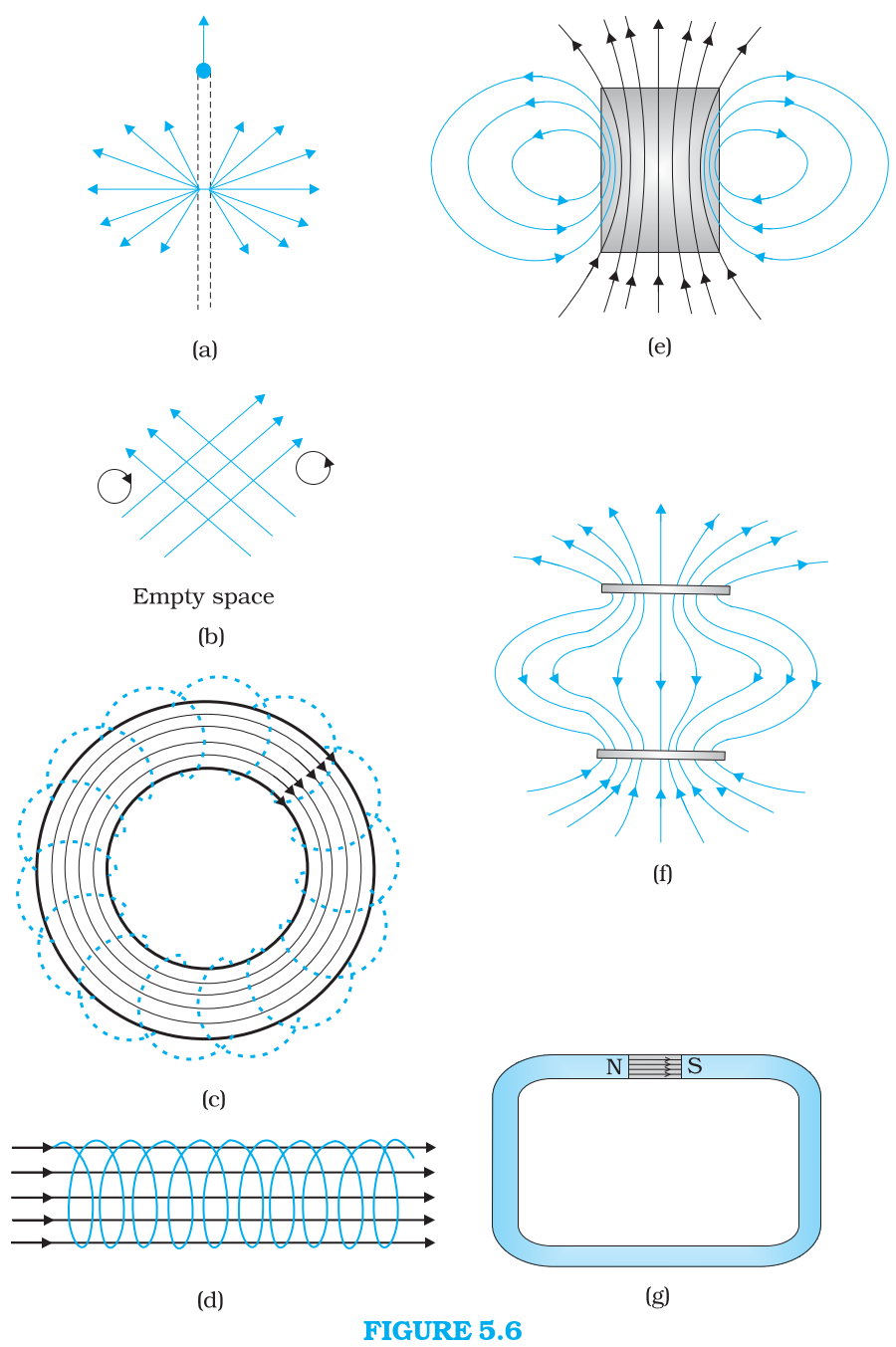
Many of the diagrams given in Fig. 5.7 show magnetic field lines (thick lines in the figure) wrongly. Point out what is wrong with them. Some of them may describe electrostatic field lines correctly. Point out which ones.
Image
A room has a window fitted with a single 1.0m × 2.0m glass of thickness 2mm.
  1. Calculate the rate of heat flow through the closed window when the temperature inside the room is 32°C and that outside is 40°C.
  2. The glass is now replaced by two glasspanes, each having a thickness of 1mm and separated by a distance of 1mm. Calculate the rate of heat flow under the same conditions of temperature. Thermal conductivity of window glass $= 1.0Js^{-1}m^{-1}{^\circ}C^{-1} $ and that of air $= 0.025Js^{-1}m^{-1}{^\circ}C^{-1}.$
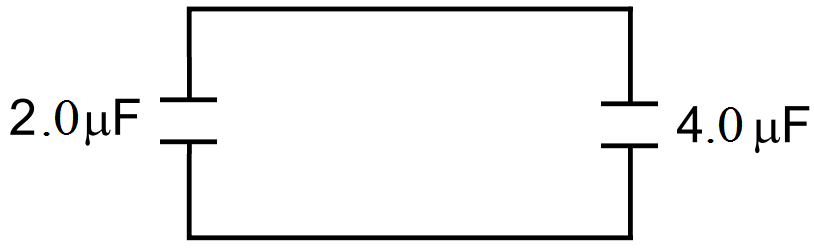
A capacitor of capacitance $2.0\mu\text{F}$ is charged to a potential difference of 12V. It is then connected to an uncharged capacitor of capacitance $4.0\mu\text{F}$ as shown in figure. Find:
  1. The charge on each of the two capacitors after the connection.
  2. The electrostatic energy stored in each of the two capacitors.
  3. The heat produced during the charge transfer from one capacitor to the other.
A biconvex thick lens is constructed with glass $(\mu=1.50)$ Each of the surfaces has a radius of 10cm and the thickness at the middle is 5cm. Locate the image of an object placed far away from the lens.
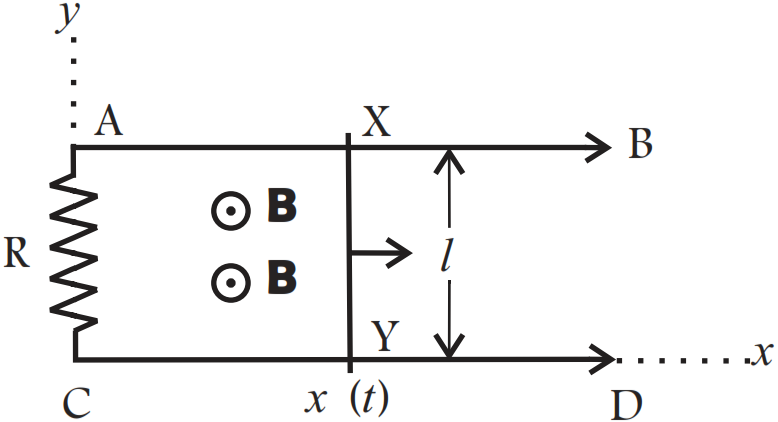
A conducting wire XY of mass m and neglibile resistance slides smoothly on two parallel conducting wires as shown in Fig. The closed circuit has a resistance R due to AC. AB and CD are perfect conductors. There is a magnetic field $\text{B}=\text{B}(\text{t})\hat{\text{k}}$.
  1. Write down equation for the acceleration of the wire XY.
  2. If B is independent of time, obtain v(t), assuming $v(0) = u_0.$
  3. For (b), show that the decrease in kinetic energy of XY equals the heat lost in R.
A 4µF capacitor is charged by a 200V supply. It is then disconnected from the supply, and is connected to another uncharged 2µF capacitor. How much electrostatic energy of the first capacitor is lost in the form of heat and electromagnetic radiation?
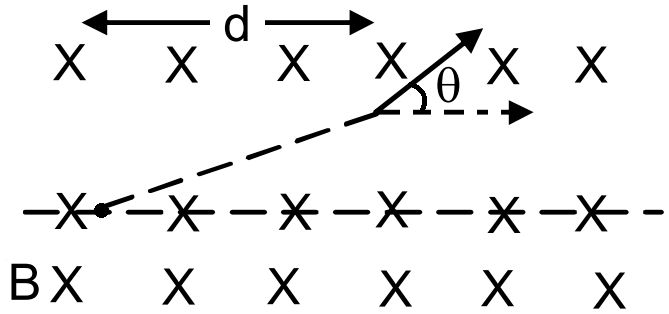
A particle of mass m and charge q is projected into a region that has a perpendicular magnetic field B. Find the angle of deviation of the particle as it comes out of the magnetic field if the width d of the region is very slightly smaller than
  1. $\frac{\text{mv}}{\text{qB}}$
  2. $\frac{\text{mv}}{2\text{qB}}$
  3. $\frac{2\text{mv}}{\text{qB}}.$
A particle stays at rest as seen in a frame. We can conclude that:
  1. The frame is inertial.
  2. Resultant force on the particle is zero.
  3. The frame may be inertial but the resultant force on the particle is zero.
  4. The frame may be non-inertial but there is a non-zero resultant force.